
Blood oxygen levels are most likely low when blood _____.
leaves the aorta
fills the right atrium
reaches body tissues
flows through arteries
Correct Answer : B
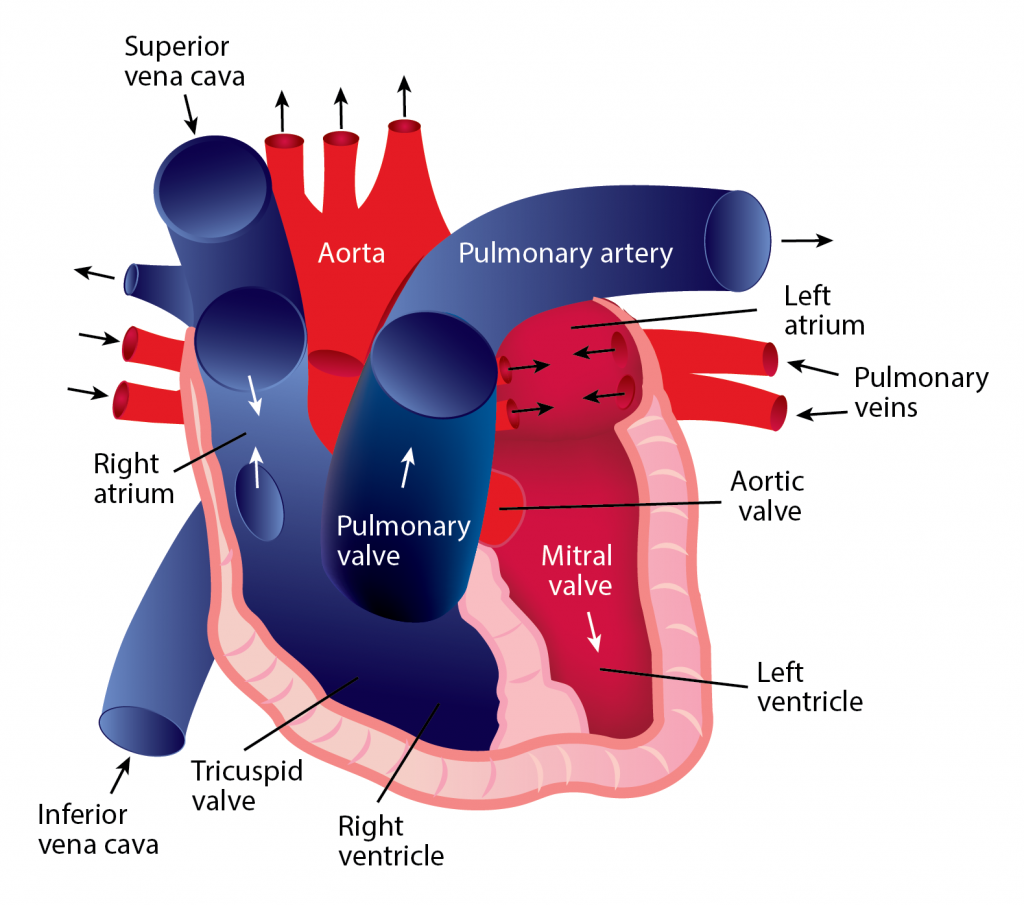
Blood continually flows in one direction, beginning in the heart and proceeding to the arteries, arterioles, and capillaries. When blood reaches the capillaries, exchanges occur between blood and tissues. After this exchange happens, blood is collected into venules, which feed into veins and eventually flow back to the heart’s atrium. The heart must relax between two heartbeats for blood circulation to begin.
Two types of circulatory processes occur in the body:
Systemic circulation
- The pulmonary vein pushes oxygenated blood into the left atrium.
- As the atrium relaxes, oxygenated blood drains into the left ventricle through the mitral valve. 3. The left ventricle pumps oxygenated blood to the aorta.
- Blood travels through the arteries and arterioles before reaching the capillaries that surround the tissues.
Pulmonary circulation
- Two major veins, the Superior Vena Cava and the Inferior Vena Cava, brings deoxygenated blood from the upper and lower half of the body.
- Deoxygenated blood is pooled into the right atrium and then sent into the right ventricle through the tricuspid valve, which prevents blood from flowing backward.
- The right ventricle contracts, causing the blood to be pushed through the pulmonary valve into the pulmonary artery.
- Deoxygenated blood becomes oxygenated in the lungs.
- Oxygenated blood returns from the lungs to the left atrium through the pulmonary veins.
TEAS 7 Exam Quiz Bank
HESI A2 Exam Quiz Bank
Find More Questions 📚
Teas 7 Questions: We got the latest updated TEAS 7 questions
100% Money Refund: 100% money back guarantee if you take our full
assessment pass with 80% and fail the actual exam.
Live Tutoring: Fully customized live tutoring lessons.
Guaranteed A Grade: All students who use our services pass with 90%
guarantee.
Related Questions
Correct Answer is B
Explanation
In this reaction, chlorine (Cl2) is an element in the reaction that replaces iodine in the compound sodium iodide (NaI). This allows chlorine to form a compound with sodium (NaCl) and leaves iodine (I2) as an element.
Synthesisreactions involve two or more reactants (A and B) combining to form one product (AB). In the example provided, hydrogen (H2) and oxygen (O2) begin as separate elements. At the end of the reaction, the hydrogen and oxygen atoms are bonded in a molecule of water (H2O).
Decompositionreactions have only one reactant (AB) that breaks apart into two or more products (A and B). In the example above, hydrogen peroxide (H2O2) breaks apart into two smaller molecules: water (H2O) and oxygen (O2).
Single-replacementreactions involve two reactants, one compound (AB) and one element (C). In this type of reaction, one element replaces another to form a new compound (AC), leaving one element by itself (B). In the example, zinc replaces hydrogen in hydrochloric acid (HCl). As a result, zinc forms a compound with chlorine, zinc chloride (ZnCl2), and hydrogen (H2) is left by itself.
Double-replacementreactions involve two reactants, both of which are compounds made of two components (AB and CD). In the example, silver nitrate, composed of silver (Ag1+) and nitrate (NO31-) ions, reacts with sodium chloride, composed of sodium (Na1+) and chloride (Cl1-) ions. The nitrate and chloride ions switch places to produce two compounds that are different from those in the reactants.
Combustionreactions occur when fuels burn, and they involve specific reactants and products, as seen in the examples below. Some form of fuel that contains carbon and hydrogen is required. Examples of such fuels are methane, propane in a gas grill, butane in a lighter, and octane in gasoline. Notice that these fuels all react with oxygen, which is necessary for anything to burn. In all combustion reactions, carbon dioxide, water, and energy are produced. When something burns, energy is released, which can be felt as heat and seen as light.
Correct Answer is A
Explanation
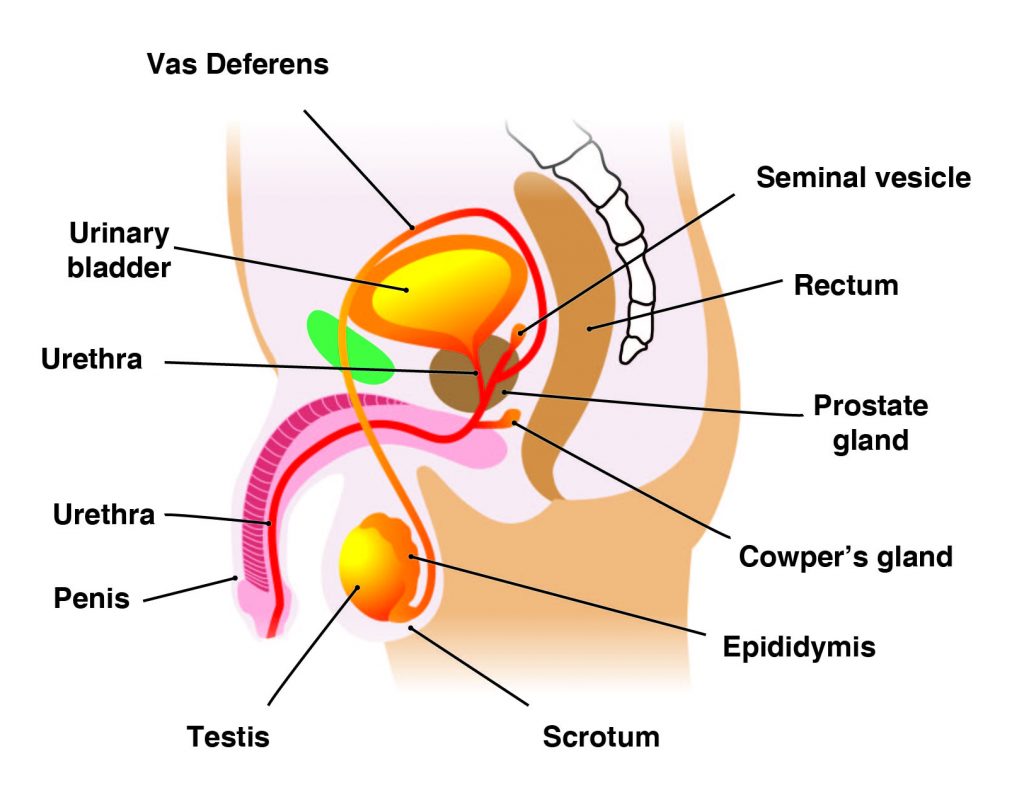
The main male reproductive organs are thepenisand thetesticles, which are located external to the body. The penis is composed of a long shaft and a bulbous end called the glans penis. The glans penis is usually surrounded by an extension of skin called the foreskin.
Thetestes(analogous to the female ovaries), or testicles, are retained in a pouch of skin called thescrotum, which descends from the base of the penis. The scrotum contains nerves and blood vessels needed to support the testicles’ functions. Each testicle (or testis) produces sperm (analogous to the female ova), which are passed into a series of coiled tubules called theepididymis. The epididymis stores and nurtures sperm until they are passed into thevas deferens, a tubule that is about 30 centimeters long, extending from the testicle into the pelvis and ending at the ejaculatory duct.
The epididymis and vas deferens are supported by several accessory glands (the seminal vesicles, the prostate gland, and the Cowper glands) that produce fluid components of semen and support the sperm cells.
Correct Answer is D
Explanation
A sensory nerveis a nerve that carries sensory signals from the external environment to the brain to the central nervous system. It is also an afferent nerve, long dendrites of sensory neurons, which sends sensory information towards the central nervous system (CNS). This information is what is sensed, using the five senses from external environment, sight, sound, smell, taste, and touch.
Motor nerveshave onlyefferent fibers, long axons of motor neurons, that carry impulses away from the CNS to the effectors, which are typically tissues and muscles of the body.
Interneuronsarenerve cellsthat act as a bridge between motor and sensory neurons in the CNS. These neurons help form neural circuits, which helps neurons communicate with each other.
Correct Answer is A
Explanation
Autotrophs are organisms that use basic raw materials in nature, like the sun, to make energy-rich biomolecules. Minerals are naturally inorganic.
Autotrophsare organisms that make energy-rich biomolecules from raw material in nature. They do this by using basic energy sources such the sun. This explains why most autotrophs rely on photosynthesis to transform sunlight into usable food that can produce energy necessary for life. Plants and certain species of bacteria are autotrophs.
Autotrophs, such as plants, use carbon dioxide (CO2) during photosynthesis to create chemical energy in the form of sugar molecules (like glucose) for growth.
Correct Answer is D
Explanation
Kidneys makes urine isincorrect.Kidneys do not make urine. They help regulate water balance, regulate levels of electrolytes such as sodium and potassium, and eliminate metabolic wastes. Urine is a byproduct of these functions.
As a person ages, kidney tissue and filtration capacity increase isincorrect. As a person ages, the kidneys and bladder change. This can affect functions such as bladder control and how well the kidneys filter blood. Kidney changes range from a decrease in kidney tissue to decreased filtration capacity.
Kidneys help regulate water balance iscorrect.Kidneys help regulate water balance, regulate levels of electrolytes such as sodium and potassium, and eliminate metabolic wastes. Urine is a byproduct of these functions.
Regulates levels of electrolytes such as sodium and potassium iscorrect.There must be a continual balance of water and salt in the blood. The urinary system, specifically the kidneys, help maintain this balance. It also balances levels of metabolites or electrolytes such as sodium, potassium, and calcium.
Eliminates metabolic wastes iscorrect. Urea, creatinine, uric acid, and ammonium are the primary types of nitrogenous wastes excreted from the body. The urinary system also detects and excretes excess water from the blood and out of the body.
Correct Answer is C
Explanation
The particles in a sample of gas are farther apart than in solids or liquids and therefore have the lowest amount of cohesion.
- Cohesion is the tendency of particles of the same kind to stick to each other.
- A solid has the lowest amount of energy because its particles are packed close together. Liquids have more energy than a solid, and gases have more energy than solids or liquids because the cohesive forces are very weak.
Correct Answer is B
Explanation
The number of protons, 28, gives the atomic number, which identifies this atom as nickel. The mass is the number after the dash in the isotope name, which is determined by adding the numbers of protons and neutrons (28 + 32 = 60).
Correct Answer is D
Explanation
The cardiovascular system is closely associated with hematopoiesis because it includes the heart and blood vessels, which are responsible for circulating blood throughout the body. Hematopoiesis, the process of blood cell formation, primarily occurs in the bone marrow, which is part of the skeletal system. However, the cardiovascular system plays a crucial role in transporting these blood cells to various parts of the body once they are produced in the bone marrow.
So, while the skeletal system provides the site for hematopoiesis, the cardiovascular system is responsible for distributing the blood cells, making it the most closely associated system in this context.
Correct Answer is B
Explanation
There are two major types of receptor molecules that respond to an intercellular chemical signal:
- Intracellular receptors: These receptors are located in either the cytoplasm or the nucleus of the cell. Signals diffuse across the cell membrane and bind to the receptor sites on intracellular receptors, of the same cell.
- Membrane-bound receptors: These receptors extend across the cell membrane, with their receptor sites on the outer surface of the cell membrane. They respond to intercellular chemical signals that are large, water-soluble molecules that do not diffuse across the cell membrane.
Correct Answer is D
Explanation
The autonomic nervous systemis responsible for activities that arenonvoluntaryand under unconscious control. This system controls glands and the smooth muscles of internal organs, heart rate, breathing, and digestion. The autonomic nervous system is further divided into the following:
- Sympathetic nervous system: The sympathetic nervous system focuses on emergency situations by preparing the body forfight or flight. (Sympathetic = Stress)
- Parasympathetic nervous system: The parasympathetic nervous system controls involuntary processes unrelated to emergencies. This system deals with “rest or digest” activities. (Parasympathetic = Peace)
Thesomatic nervous systemprimarily controlsvoluntaryactivities such as walking and riding a bicycle. Thus, this system sends information to the CNS and motor nerve fibers that are attached to skeletal muscle.
This question was extracted from the actual TEAS Exam. Ace your TEAS exam with the actual TEAS 7 questions, Start your journey with us today
Visit Naxlex, the Most Trusted TEAS TEST Platform With Guaranteed Pass of 90%.
Money back guarantee if you use our service and fail the actual exam. Option of personalised live tutor on your area of weakness.