
How do neurons communicate with each other?
Through electrical signals only
Through chemical signals only
Through electrical and chemical signals
Through mechanical signals only.
Correct Answer : C
Neurons communicate with each other through both electrical and chemical signals.
The electrical signal, or action potential, runs from the cell body area to the axon terminals, through a thin fiber called axon.
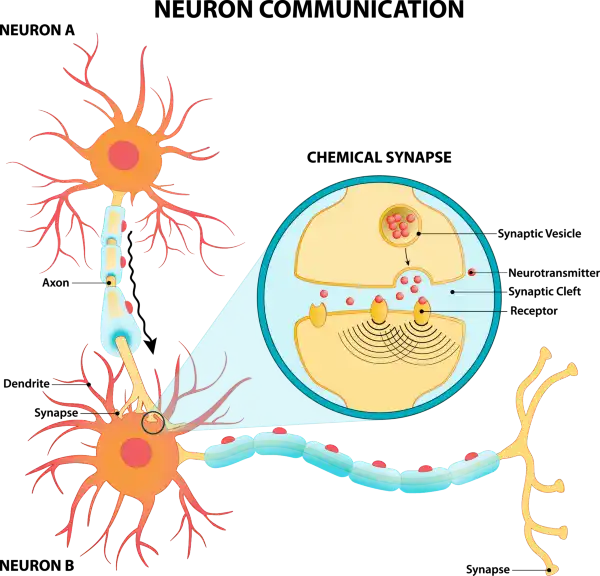
Neurons also communicate with one another at junctions called synapses.
At a synapse, one neuron sends a message to a target neuron—another cell.
Most synapses are chemical; these synapses communicate using chemical messengers.
Choice A is incorrect because neurons communicate not only through electrical signals but also through chemical signals.
Choice B is incorrect because neurons communicate not only through chemical signals but also through electrical signals.
Choice D is incorrect because neurons do not communicate through mechanical signals.
TEAS 7 Exam Quiz Bank
HESI A2 Exam Quiz Bank
Find More Questions 📚
Teas 7 Questions: We got the latest updated TEAS 7 questions
100% Money Refund: 100% money back guarantee if you take our full
assessment pass with 80% and fail the actual exam.
Live Tutoring: Fully customized live tutoring lessons.
Guaranteed A Grade: All students who use our services pass with 90%
guarantee.
Related Questions
Correct Answer is A
Explanation
The correct answer is choice A.
An increase in viscosity of a fluid results in a decrease in mobility of particles.
Viscosity is the resistance of a fluid to a change in shape or movement of neighboring portions relative to one another.
It denotes opposition to flow and may be thought of as internal friction between the molecules.
Choice B is incorrect because an increase in viscosity does not affect the density of a fluid.
Choice C is incorrect because an increase in viscosity results in a decrease, not an increase, in flow rate.
Choice D is incorrect because an increase in viscosity does not affect the pressure of a fluid.
Correct Answer is A
Explanation
The neuromuscular junction is a type of synapse where neuronal signals from the brain or spinal cord interact with skeletal muscle fibers, causing them to contract.
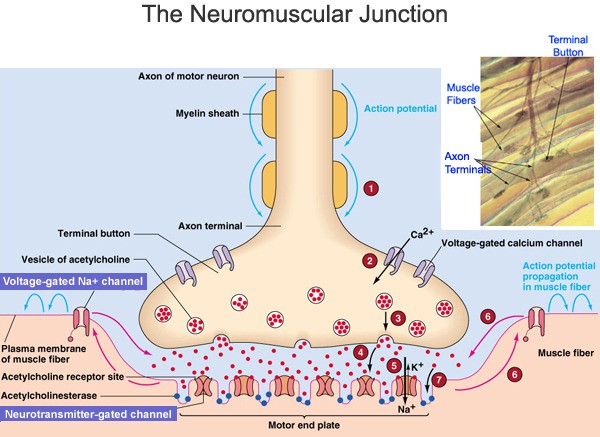
The activation of many muscle fibers together causes muscles to contract, which in turn can produce movement.
Choice B is incorrect because binding acetylcholine to nAChRs is a process that occurs at the neuromuscular junction, but it is not the function of the neuromuscular junction itself.
Choice C is incorrect because depolarizing the muscle cell membrane is a result of the function of the neuromuscular junction, but it is not the function itself.
Choice D is incorrect because activating voltage-gated sodium channels on the muscle membrane is a result of the function of the neuromuscular junction, but it is not the function itself.
Correct Answer is C
Explanation
Granzymes.
Granzymes are a family of serine proteases that are stored in and secreted from the cytotoxic granules of cytotoxic T lymphocytes (CTL) and natural killer (NK) cells.
They work in synergy with perforin, a pore-forming toxin, to induce apoptosis in target cells.
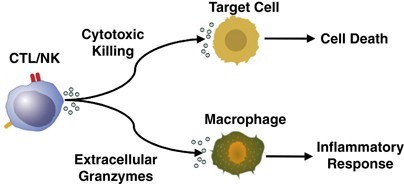
Perforin is necessary for the delivery of granzyme B to the target cell cytosol where caspase-dependent and -independent pathways to apoptosis are activated.
Perforins (choice A) are pore-forming toxins that work in synergy with granzymes to induce apoptosis in target cells.
Cytokines (choice B) are signaling molecules that regulate immune responses but do not directly induce apoptosis in target cells.
Interferons (choice D) are a type of cytokine that play a role in immune responses but do not directly induce apoptosis in target cells.
Correct Answer is C
Explanation
Water is sometimes called the “universal solvent” because it dissolves more substances than any other liquid.
This is due to its polarity and ability to form hydrogen bonds, which allows it to dissolve ions and polar molecules.
Choice A) Because water dissolves all solutes equally well is incorrect because water does not dissolve all solutes equally well.
Choice B) Because water is a nonpolar solvent is incorrect because water is a polar solvent.
Choice D) Because water is poor at dissolving nonpolar molecules is incorrect because it does not explain why water is called the “universal solvent”.
Correct Answer is A
Explanation
The correct answer is choice A. Golgi apparatus.
The Golgi apparatus is a membrane-bound organelle that is responsible for transporting, modifying, and packaging proteins and lipids into vesicles for delivery to targeted destinations.
Choice B is incorrect because mitochondria are responsible for energy production.
Choice C is incorrect because ribosomes are responsible for protein production.
Choice D is incorrect because the endoplasmic reticulum is responsible for lipid production and protein production, but not for modifying, sorting and packaging proteins and lipids.
Correct Answer is B
Explanation
Concentration of solute particles in the solution.
Osmosis is the movement of water across a semipermeable membrane from an area of lower solute concentration to an area of higher solute concentration.
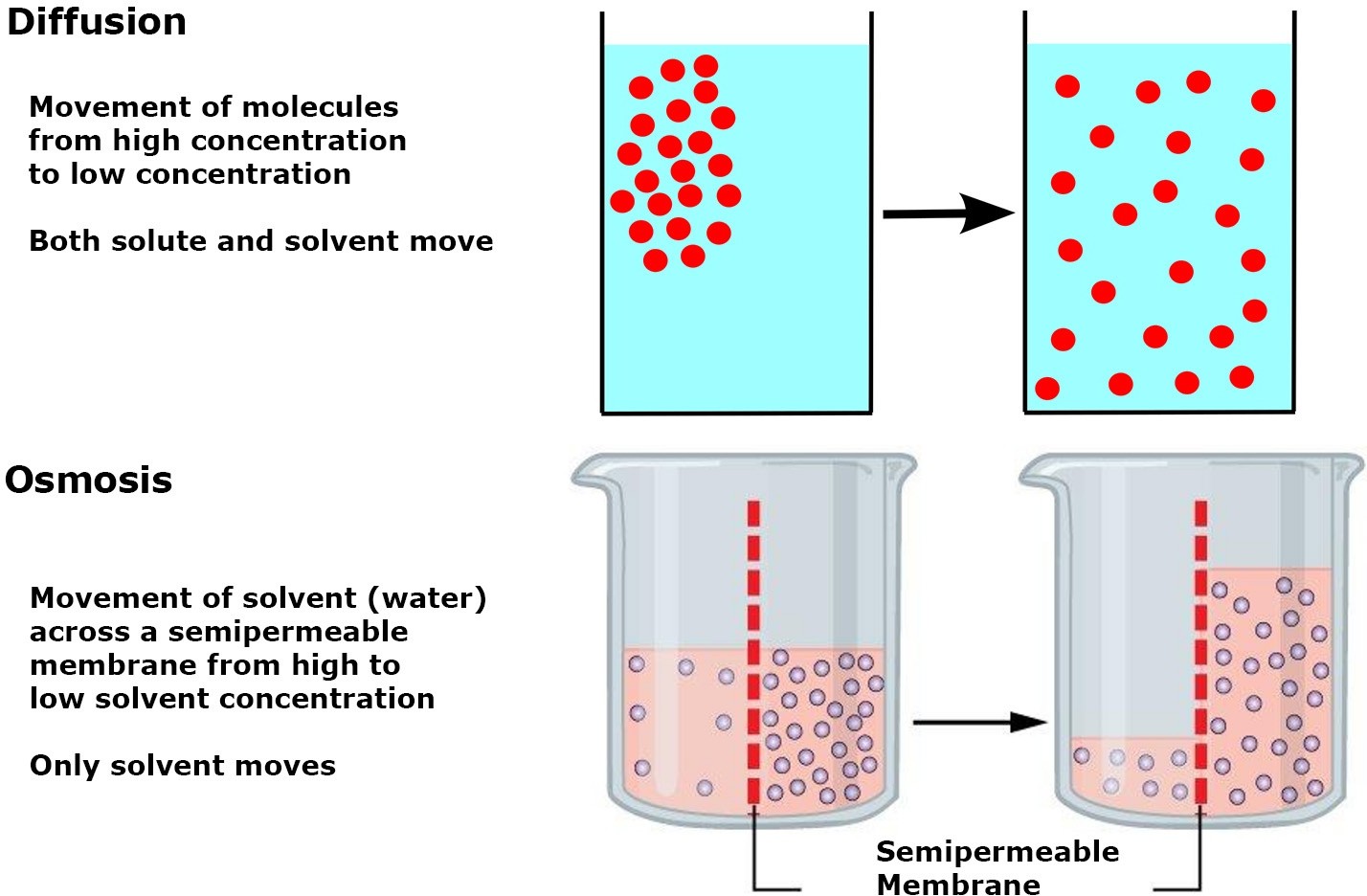
The concentration of solute particles in the solution is the primary factor that determines the movement of water across cell membranes in osmosis.
Hydrostatic pressure (choice A) can affect the movement of water across cell membranes but is not the primary factor responsible for osmosis.
Temperature (choice C) can affect the rate of osmosis but is not the primary factor responsible for osmosis.
Kinetic energy of liquid water molecules (choice D) can affect the rate of osmosis but is not the primary factor responsible for osmosis.
Correct Answer is B
Explanation
The correct answer is choice B.
Maintaining normal body temperature and blood pressure.
Early identification and management of potential organ donors must take into consideration specific pathophysiologic changes for medical optimization 1.
The VIPPS (ventilation, infusion and pumping, pharmacological treatment, and specificities) strategy is a mnemonic method that brings together key aspects of the restoration of oxygen delivery to tissues during hemodynamic instability plus organ optimization strategies.
Choice A is incorrect because administering antibiotics to prevent infection is not the most important intervention to preserve organ viability.
Choice C is incorrect because providing emotional support to family members, while important, is not an intervention that directly affects organ viability.
Choice D is incorrect because applying eye drops and ointment to prevent corneal drying is not the most important intervention to preserve organ viability.
Correct Answer is A
Explanation
The correct answer is choice A.
The superior vena cava is the largest vein in the human body that returns deoxygenated blood from the upper half of the body to the right atrium of the heart.
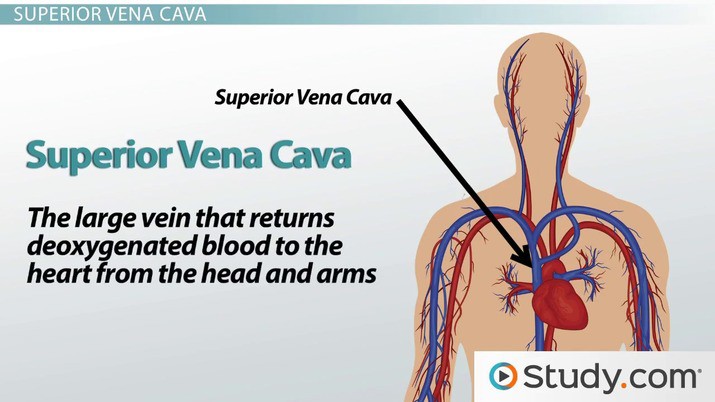
Choice B is incorrect because the inferior vena cava returns deoxygenated blood from the lower half of the body to the right atrium of the heart.
Choice C is incorrect because the pulmonary vein carries oxygenated blood from the lungs to the left atrium of the heart.
Choice D is incorrect because the renal vein carries deoxygenated blood from the kidneys to the inferior vena cava.
Correct Answer is A
Explanation
The correct answer is choice A.
The spleen is an organ in the human body that is responsible for the removal of damaged red blood cells and the production of certain types of white blood cells.
Choice B is incorrect because the kidneys are responsible for filtering waste from the blood and regulating electrolyte balance.
Choice C is incorrect because the pancreas produces hormones and enzymes that aid in digestion.
Choice D is incorrect because the thyroid gland produces hormones that regulate metabolism.
Correct Answer is B
Explanation
The correct answer is choice B.
To amplify specific regions of DNA.
PCR (polymerase chain reaction) is a laboratory technique used to make many copies of a specific region of DNA.
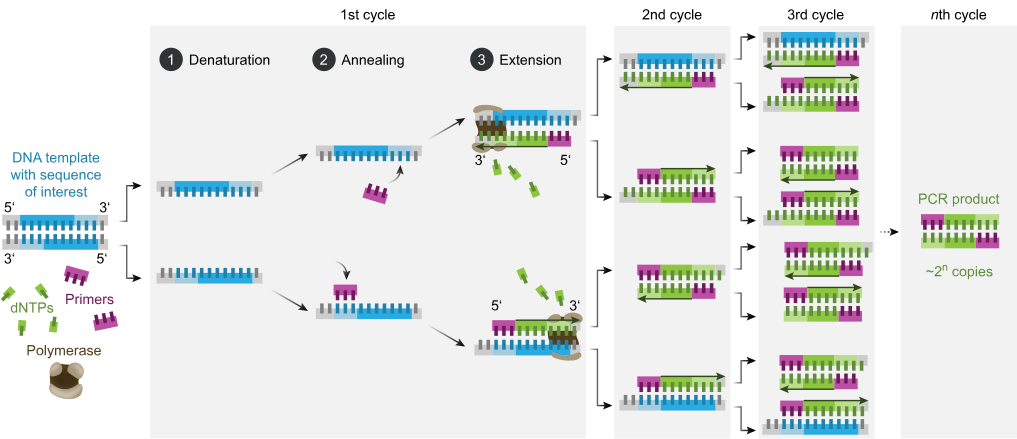 |
The goal of PCR is to make enough of the target DNA region that it can be analyzed or used in some other way.
PCR has many research and practical applications, including DNA cloning, medical diagnostics, and forensic analysis of DNA.
Choice A is incorrect because PCR does not separate DNA fragments by size. Choice C is incorrect because PCR does not sequence DNA fragments.
Choice D is incorrect because PCR does not analyze protein expression levels.
This question was extracted from the actual TEAS Exam. Ace your TEAS exam with the actual TEAS 7 questions, Start your journey with us today
Visit Naxlex, the Most Trusted TEAS TEST Platform With Guaranteed Pass of 90%.
Money back guarantee if you use our service and fail the actual exam. Option of personalised live tutor on your area of weakness.