
A client who is diagnosed with heart failure has been taking a diuretic as part of the treatment and recently developed symptoms of drowsiness, confusion, and muscle weakness.
The nurse is assessing the client in the scenario who has been taking diuretics for several months for signs of dehydration. What should the nurse assess for? Select all that apply
Elastic skin turgor
Lower lab values of hematocrit and hemoglobin from baseline
Dry and sticky oral mucous membranes
Lab values of hematocrit and hemoglobin elevated from baseline
Sunken eyeballs
Weak pedal pulses
Crackles in the lung bases
Excessive thirst
Correct Answer : C,D,E,F,H
Diuretics induce therapeutic negative fluid balance by increasing renal solute and water excretion. Excessive diuresis precipitates hypovolemia, characterized by reduced intravascular volume and potential cellular dehydration. Signs include decreased ocular tension and poor skin mobility. Hemato-concentration occurs as plasma volume contracts. Serum sodium may fluctuate, while increased blood urea nitrogen typically accompanies this state. Hypotension and tachycardia often follow significant fluid deficit.
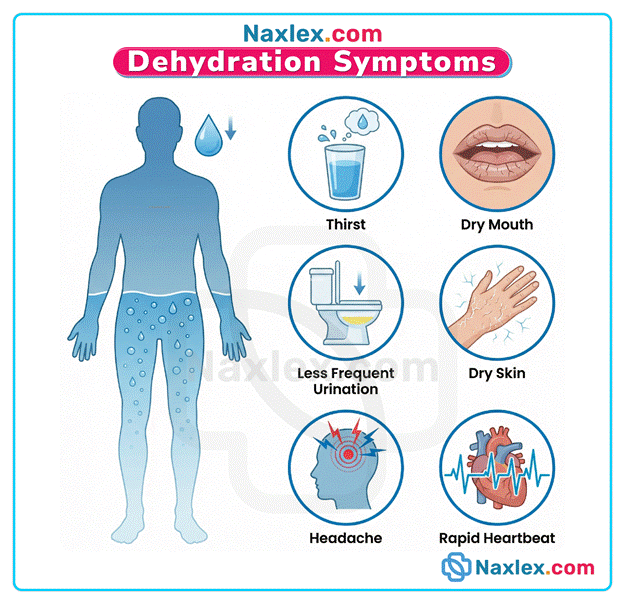
Rationale for correct answers
C. Inadequate intravascular and interstitial fluid volume reduces the production of saliva by the salivary glands. This physiological shift results in oral mucous membranes that appear dry, dull, and significantly sticky to the touch. It is a reliable clinical indicator of systemic water deficit.
D. As the total volume of plasma decreases due to diuresis, the cellular components of the blood become relatively more concentrated. This process, known as hematoconcentration, results in laboratory values for hematocrit and hemoglobin that are artificially elevated above the patient's baseline. It reflects a contraction of the vascular compartment.
E. Intraocular pressure is partially maintained by the volume of aqueous and vitreous humors. Systemic dehydration leads to a reduction in these fluids, causing the eyeballs to appear soft or sunken within the orbits. This physical finding is a hallmark of moderate to severe volume depletion.
F. A reduction in circulating blood volume leads to decreased stroke volume and lower peripheral perfusion pressure. Consequently, the nurse will palpate pedal pulses that feel diminished, thready, or weak upon physical examination. This reflects the body's inability to maintain robust peripheral arterial tension.
H. The hypothalamus contains osmoreceptors that detect increased plasma osmolality associated with fluid loss. This triggers a potent neurological drive for water intake, manifesting as excessive thirst or polydipsia. It is the body's primary compensatory mechanism to restore homeostatic fluid levels during active diuresis.
Rationale for incorrect answers
A. Healthy, well-hydrated skin possesses elastic turgor, meaning it immediately returns to its original position after being pinched. Dehydration causes the skin to lose this elasticity, resulting in a phenomenon called tenting, where the skin remains peaked. Elastic turgor indicates a euvolemic state rather than a fluid deficit.
B. Lowering of the hematocrit and hemoglobin levels from baseline typically suggests either active hemorrhage or fluid volume overload. In states of hemodilution, the excess plasma volume makes the red cell count appear decreased relative to the total volume. This is the opposite of what occurs during diuretic-induced dehydration.
G. Crackles are adventitious breath sounds produced by the snapping open of small airways filled with fluid. They are a classic clinical sign of pulmonary edema or volume overload often seen in heart failure. Dehydration would result in clear lung fields as the pulmonary interstitial fluid is mobilized.
Test-taking strategy
- Identify the core clinical problem: The question asks for signs of dehydration (fluid volume deficit).
- Apply the "Dry" principle: Focus on symptoms that represent a lack of moisture or volume.
- This directly points to dry mucous membranes (option 3), sunken eyeballs (option 5), and thirst (option 8).
- Recall physiological concentration:
- When water is lost from the blood, the remaining solids (like red blood cells) become more concentrated. This explains why elevated lab values (option 4) are correct and lower values (option 2) are incorrect.
- Assess perfusion and tension:
- Less volume means less pressure. This leads to weak pulses (option 6).
- Less volume in the skin means it loses its "bounce." Therefore, elastic turgor (option 1) must be incorrect because "elastic" implies normal hydration.
- Rule out volume overload: Crackles (option 7) indicate too much fluid in the lungs, which is what the diuretic is meant to treat, not a side effect of over-diuresis.
Take home points
- Dehydration in patients on diuretics is often evidenced by hematoconcentration, resulting in elevated hemoglobin and hematocrit levels.
- Physical assessment findings such as sunken eyes, sticky mucous membranes, and skin tenting are critical indicators of a fluid volume deficit.
- Weak peripheral pulses and orthostatic hypotension signify that the intravascular volume has dropped below the level required for optimal perfusion.
- The nurse must distinguish between signs of heart failure (crackles, edema) and signs of over-treatment with diuretics (thirst, weakness, dehydration).
Nursing Test Bank
Naxlex Comprehensive Predictor Exams
Related Questions
Correct Answer is C
Explanation
Furosemide is a potent loop diuretic that acts on the thick ascending limb of the loop of Henle to inhibit the Na+/K+/2Cl- symporter. By preventing the reabsorption of sodium and chloride, it forces the renal excretion of water, which significantly reduces intravascular volume and cardiac preload. This pharmacological action is the primary mechanism for treating hypertension and pulmonary edema. Adverse effects include profound hypokalemia (potassium < 3.5 mEq/L), orthostatic hypotension, and potential ototoxicity if infused too rapidly.
Rationale for correct answer
C. The intended therapeutic effect of furosemide is the reduction of total body fluid through increased urine output. As the volume of circulating blood decreases, the pressure exerted against the arterial walls naturally drops. This explanation provided by the nurse accurately reflects the hemodynamic shift expected during active diuresis. It educates the client on how the medication is successfully achieving its goal of lowering systemic blood pressure and reducing fluid overload.
Rationale for incorrect answers
A. Assuming a decreased reading is a measurement error without assessment data ignores the expected pharmacological outcome of a loop diuretic. While the nurse should ensure accuracy, labeling a therapeutic response as an error may cause unnecessary confusion or alarm for the client. The drop in pressure is a predictable result of volume depletion. Relying on rechecks alone fails to acknowledge the drug's physiological impact on the cardiovascular system.
B. Attributing a decrease in blood pressure to anxiety or worry is scientifically inconsistent with physiological responses to stress. Psychological stress typically activates the sympathetic nervous system, leading to tachycardia and an increase in blood pressure via vasoconstriction. This explanation provides incorrect information to the client and misses an opportunity for essential medication education. It ignores the direct relationship between the diuretic and the patient's hemodynamic status.
D. A decrease in blood pressure is an indicator of a positive response to diuretic therapy, not a failure. Stating the client is not responding correctly is a significant clinical misinterpretation of the data presented. Furosemide is prescribed specifically to reduce pressure and volume; therefore, a lower reading suggests therapeutic efficacy. Reevaluating the medication based on a successful drop in pressure would be counterproductive to the treatment plan for heart failure or hypertension.
Test-taking strategy
- Identify the drug's primary action: Furosemide is a diuretic. Diuretics remove fluid. Less fluid in the pipes (vessels) means lower pressure.
- Distinguish between therapeutic effects and errors: A lower blood pressure reading after starting an antihypertensive diuretic is an expected outcome, not an error (ruling out option 1).
- Apply physiological principles:
- Stress usually raises BP, it doesn't lower it (ruling out option 2).
- If the drug is meant to lower BP, and the BP is lower, the drug is working (ruling out option 4).
- Focus on patient education: The most "nursing-centric" and scientifically accurate answer is the one that explains the mechanism of action (volume reduction) in understandable terms (option 3).
- Analyze the relationship between volume and pressure: Always remember that in a closed system, a decrease in intravascular volume leads to a decrease in hydrostatic pressure.
Take home points
- Diuretics lower blood pressure primarily by reducing the total volume of blood the heart must pump through the vascular system.
- A decrease in blood pressure measurements is a standard therapeutic goal and a sign of effective furosemide therapy.
- Nurses must monitor for orthostatic hypotension, as a rapid drop in volume can lead to dizziness when the patient stands.
- Accurate patient education involves explaining that the "water pill" works by shifting fluid out of the blood and into the urine.
Correct Answer is B
Explanation
Spironolactone is a steroid-based aldosterone antagonist that competitively inhibits mineralocorticoid receptors in the distal renal tubules. This potassium-sparing diuretic prevents the reabsorption of sodium while inhibiting the active secretion of potassium and hydrogen ions. It effectively manages heart failure by mitigating the deleterious effects of hyperaldosteronism and cardiac remodeling. Side effects include gynecomastia, menstrual irregularities, and life-threatening electrolyte disturbances.
Rationale for correct answer
B. By antagonizing the mineralocorticoid receptor, spironolactone prevents the renal collecting duct from excreting potassium in exchange for sodium. This pharmacological mechanism leads directly to the retention of potassium, resulting in hyperkalemia (serum potassium > 5.0 mEq/L). This condition is the most dangerous metabolic complication of therapy. The nurse must monitor for cardiac dysrhythmias or peaked T-waves.
Rationale for incorrect answers
A. Loop and thiazide diuretics cause the loss of potassium, but spironolactone belongs to the potassium-sparing class which prevents such depletion. Consequently, hypokalemia is not a characteristic adverse effect of this specific medication. Patients are actually instructed to avoid high-potassium diets. This prevents the risk of myocardial instability associated with low potassium.
C. Spironolactone does not interfere with pancreatic insulin secretion or hepatic gluconeogenesis pathways to cause a drop in blood sugar. While some diuretics impact glucose, hypoglycemia is not a documented or expected side effect of aldosterone antagonists. The drug primarily influences electrolyte homeostasis rather than carbohydrate metabolism. Diabetic monitoring focuses more on potassium-induced insulin shifts.
D. Although diuretics can occasionally influence secondary mineral levels, spironolactone is not a primary cause of significant hypermagnesemia. Excessive magnesium levels ( > 2.2 mEq/L) are typically associated with renal failure or antacid overuse. The clinical priority for this drug remains the potassium balance. Magnesium shifts are rarely the primary clinical concern during standard dosing.
Test-taking strategy
- Identify the drug class: Categorize spironolactone as a potassium-sparing diuretic.
- Recall the physiological trade-off:
- Normal aldosterone causes the body to keep sodium and lose potassium.
- An aldosterone antagonist does the opposite: it loses sodium and keeps potassium.
- Evaluate the suffix/prefix: Recognize the "one" suffix often denotes a steroid-related structure, which in this case competes with the steroid hormone aldosterone.
- Match the mechanism to the risk: If the body is "sparing" or keeping potassium, the primary risk must be an excess of that ion.
- Differentiate from other diuretics: Contrast this with "potassium-wasting" diuretics like furosemide (loop) or hydrochlorothiazide (thiazide).
- Select the high-acuity answer: Hyperkalemia (Option 2) is the most common and life-threatening risk associated with this specific drug's mechanism of action.
Take home points
- Spironolactone is used in heart failure to block the effects of aldosterone, which helps prevent myocardial fibrosis and sodium retention.
- The most critical nursing priority is monitoring for hyperkalemia, especially in patients with impaired renal function or those taking ACE inhibitors.
- Patients should be educated to avoid salt substitutes containing potassium chloride, as these can cause lethal increases in serum potassium.
- Endocrine side effects such as gynecomastia or breast tenderness may occur because spironolactone can also bind to androgen and progesterone receptors.
Whether you are a student looking to ace your exams or a practicing nurse seeking to enhance your expertise , our nursing education contents will empower you with the confidence and competence to make a difference in the lives of patients and become a respected leader in the healthcare field.
Visit Naxlex, invest in your future and unlock endless possibilities with our unparalleled nursing education contents today