
A nurse is assessing a newly admitted client. The nurse discovers the following upon turning the client on their side:
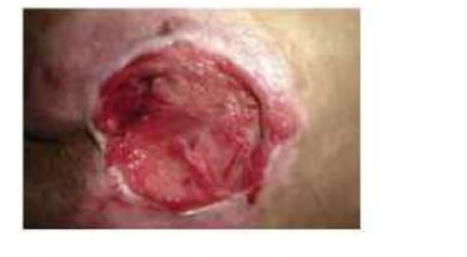
How will the nurse document this finding?
Stage 4 pressure injury.
Stage 2 pressure injury.
Stage 1 pressure injury.
Deep Tissue Injury
The Correct Answer is A
A. Stage 4 pressure injury: Stage 4 pressure injuries involve full-thickness skin and tissue loss with extensive destruction, exposing underlying structures such as muscle, fascia, or bone. The presence of undermining, mixed granulation and slough tissue, and visible deep tissue confirms severe involvement beyond subcutaneous layers, consistent with a Stage 4 classification.
B. Stage 2 pressure injury: Stage 2 pressure injuries involve partial-thickness loss of skin with exposed dermis. They are typically shallow and do not extend into subcutaneous tissue or expose muscle or fascia, making this stage inconsistent with the wound.
C. Stage 1 pressure injury: Stage 1 injuries present as intact skin with localized, nonblanchable erythema over a bony prominence. There is no open wound or tissue destruction, which is clearly present in this patient.
D. Deep Tissue Injury: Deep tissue injuries appear as purple or maroon areas of intact skin or blood-filled blisters, indicating underlying tissue damage without full-thickness skin loss. While serious, the wound shown has open tissue and exposed structures, distinguishing it from a deep tissue injury.
Nursing Test Bank
Naxlex Comprehensive Predictor Exams
Related Questions
Correct Answer is D
Explanation
A. Deep-vein thrombophlebitis: Deep-vein thrombophlebitis involves clot formation in a deep vein, usually in the lower extremity, and presents with swelling, warmth, and tenderness. It does not cause an open, “punched-out” lesion with callus formation, which differentiates it from the wound observed.
B. Venous stasis ulcer: Venous stasis ulcers are typically located on the medial lower leg near the ankle and are shallow with irregular borders. They are associated with hemosiderin staining and chronic venous insufficiency, unlike the plantar, callus-bordered lesion seen here.
C. Arterial ulcer: Arterial ulcers generally occur on distal areas such as the toes or lateral malleolus and have well-defined, often deep, necrotic bases with minimal exudate. Pain is often severe, and peripheral pulses are diminished, which does not match the classic neuropathic ulcer features.
D. Neuropathic ulcer: Neuropathic ulcers, often seen in patients with diabetes, occur on pressure-bearing areas of the foot such as the plantar surface. They are “punched-out” in appearance with a surrounding callus because the patient continues to walk on the area, often without noticing due to sensory neuropathy. The location and thick reactive tissue, confirm the diagnosis of a neuropathic ulcer.
Correct Answer is C
Explanation
A. Increases cellular metabolism to enhance healing process: Applying ice actually slows cellular metabolism in the affected area, which helps reduce tissue damage and inflammation immediately after injury. Increased metabolism is not the goal of cold therapy in acute musculoskeletal injuries.
B. Increases perfusion to promote the delivery of essential nutrients: Cold application causes vasoconstriction, which decreases blood flow to the area temporarily, reducing edema and inflammation. It does not increase perfusion; in fact, increased perfusion occurs with heat therapy, not ice.
C. Increases vasoconstriction to decrease pain at the site of injury: Cold therapy induces vasoconstriction, which limits local blood flow and reduces swelling. It also slows nerve conduction, which decreases pain perception. This is the primary mechanism for using an ice pack immediately after an acute injury such as a sprain or contusion.
D. Increases muscle tension to decrease use of the extremity: Ice can cause temporary muscle stiffness, but the purpose is not to increase muscle tension to restrict movement. The main goal is to reduce inflammation and pain, which may incidentally limit movement but not through increased muscle tension.
Whether you are a student looking to ace your exams or a practicing nurse seeking to enhance your expertise , our nursing education contents will empower you with the confidence and competence to make a difference in the lives of patients and become a respected leader in the healthcare field.
Visit Naxlex, invest in your future and unlock endless possibilities with our unparalleled nursing education contents today