
A nurse is caring for a client who is undergoing a fetal non-stress test (NST).
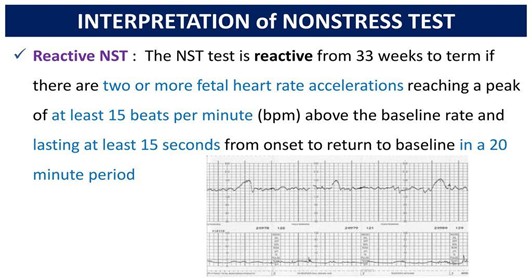
The nurse observes that the fetal heart rate (FHR) accelerates at least 10 bpm for at least 10 seconds with each fetal movement.
The client is 30 weeks pregnant.
How should the nurse interpret this finding?
The NST is reactive and normal for gestational age.
The NST is nonreactive.
The NST is reactive and abnormal for gestational age.
The NST is nonreactive and normal for gestational age.
The Correct Answer is A
The NST is reactive and normal for gestational age. This means that the fetal heart rate (FHR) accelerates at least 10 bpm for at least 10 seconds with each fetal movement, indicating that the fetus is healthy and getting enough oxygen. A reactive NST is expected for fetuses at 26 to 30 weeks of gestation.
Choice B is wrong because a nonreactive NST means that the FHR does not accelerate with fetal movement, which could indicate fetal distress or hypoxia. A nonreactive NST is abnormal for any gestational age and requires further evaluation.
Choice C is wrong because a reactive NST is not abnormal for gestational age. It is a normal finding that shows the fetus is well-oxygenated and responsive.
Choice D is wrong because a nonreactive NST is not normal for gestational age. It is an abnormal finding that suggests the fetus may be compromised or in need of intervention.
Nursing Test Bank
Naxlex Comprehensive Predictor Exams
Related Questions
Correct Answer is D
Explanation
“You will need to press a button when you feel the baby move.” This is because a non-stress test (NST) is a pregnancy screening that measures fetal heart rate and reaction to movement.The test is performed to make sure the fetus is healthy and getting enough oxygen.By pressing a button when the baby moves, the patient can help the provider record the changes in the fetal heart rate.
Choice A is wrong because the patient does not need to fast for 8 hours before the test.There is no dietary restriction for an NST.
Choice B is wrong because the patient does not need to drink plenty of fluids before the test.However, drinking some fluids may help stimulate fetal movement.
Choice C is wrong because the patient does not need to lie on their back during the test.In fact, lying on the back can compress the blood vessels and reduce blood flow to the fetus.The patient can lie on their side or recline on a chair or exam table.
Correct Answer is A
Explanation
The NST is reactive and normal for gestational age.This means that the fetal heart rate (FHR) accelerates at least 10 bpm for at least 10 seconds with each fetal movement, indicating that the fetus is healthy and getting enough oxygen.A reactive NST is expected for fetuses at 26 to 30 weeks of gestation.
Choice B is wrong because a nonreactive NST means that the FHR does not accelerate with fetal movement, which could indicate fetal distress or hypoxia.A nonreactive NST is abnormal for any gestational age and requires further evaluation.
Choice C is wrong because a reactive NST is not abnormal for gestational age.It is a normal finding that shows the fetus is well-oxygenated and responsive.
Choice D is wrong because a nonreactive NST is not normal for gestational age.It is an abnormal finding that suggests the fetus may be compromised or in need of intervention.
Whether you are a student looking to ace your exams or a practicing nurse seeking to enhance your expertise , our nursing education contents will empower you with the confidence and competence to make a difference in the lives of patients and become a respected leader in the healthcare field.
Visit Naxlex, invest in your future and unlock endless possibilities with our unparalleled nursing education contents today