
A nurse is caring for a client with a chest tube in situ. Which number corresponds to the spot where the nurse would assess for an air leak?
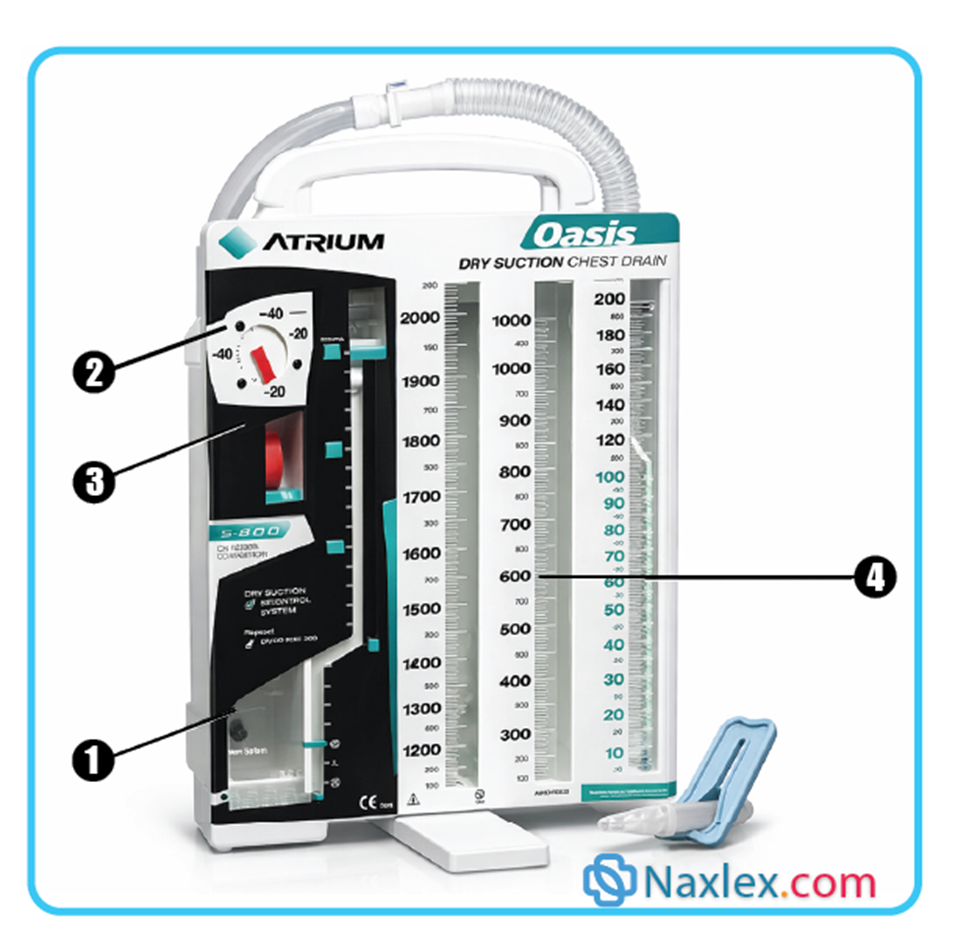
A portable chest tube drainage system shows four labels marked 1 to 4 as:
Water seal chamber
Alphabet A marked on top of a meter
Alphabet E marked below meter
Graduated drainage collection chamber.
The Correct Answer is A
The water-seal chamber is a diagnostic component of a chest drainage system designed to maintain a one-way valve between the patient and the environment. This chamber is partially filled with sterile water to prevent atmospheric air from entering the pleural space while allowing the escape of air and fluid. Visual inspection of this compartment for bubbling is the primary clinical method for identifying a pneumothorax or a breach in the integrity of the closed-circuit system.
Rationale for correct answer
1. This compartment contains the water column that serves as a pressure-sensitive indicator for the pleural cavity. The presence of bubbling within this specific chamber signifies that air is passing through the water, which indicates an air leak from either the patient's lung or the tubing connections. Nurses monitor this area for tidaling and bubbling to assess the progression of respiratory healing.
Rationale for incorrect answers
2. This area contains the suction control regulator, which determines the amount of negative pressure applied to the pleural space. While it is essential for managing the rate of drainage and lung re-expansion, it does not provide visual data regarding the presence of an air leak. It is a mechanical setting rather than a diagnostic assessment window.
3. This section houses the bellows or suction indicator, which confirms that the vacuum source is active and functioning at the prescribed level. It serves as a visual confirmation that the dry suction mechanism is operational and properly connected to the wall regulator. It does not communicate information regarding the patient's internal air leaks or pleural status.
4. These graduated columns are designated for the collection and measurement of fluid, blood, or serosanguinous exudate from the chest. While monitoring the volume and character of the output is a critical nursing assessment, this chamber is not used to detect the passage of air. It tracks the quantitative resolution of a hemothorax or pleural effusion.
Test-taking strategy
- Identify the diagnostic window: In chest tube systems, the water-seal chamber (usually at the bottom left) is the gold standard for leak detection.
- Differentiate chamber functions:
- Chamber 1 (Water Seal) - Air Leak Detection.
- Chamber 4 (Collection) - Fluid Measurement.
- Area 2/3 (Suction Control) - Vacuum Management.
- Apply clinical logic: To “see” air, it must pass through a liquid medium. Therefore, the nurse must look at the water in chamber 1 to identify bubbles escaping from the patient.
- Select for evidence: Choice 1 is the only section of the device that facilitates the visualization of air movement from the pleural space into the drainage unit.
Take home points
- Intermittent bubbling in the water-seal chamber during exhalation is expected if a pneumothorax is present.
- Continuous bubbling suggests a persistent air leak in the patient or a disconnection in the drainage tubing.
Nursing Test Bank
Naxlex Comprehensive Predictor Exams
Related Questions
Correct Answer is A
Explanation
The water-seal chamber is a diagnostic component of a chest drainage system designed to maintain a one-way valve between the patient and the environment. This chamber is partially filled with sterile water to prevent atmospheric air from entering the pleural space while allowing the escape of air and fluid. Visual inspection of this compartment for bubbling is the primary clinical method for identifying a pneumothorax or a breach in the integrity of the closed-circuit system.
Rationale for correct answer
1. This compartment contains the water column that serves as a pressure-sensitive indicator for the pleural cavity. The presence of bubbling within this specific chamber signifies that air is passing through the water, which indicates an air leak from either the patient's lung or the tubing connections. Nurses monitor this area for tidaling and bubbling to assess the progression of respiratory healing.
Rationale for incorrect answers
2. This area contains the suction control regulator, which determines the amount of negative pressure applied to the pleural space. While it is essential for managing the rate of drainage and lung re-expansion, it does not provide visual data regarding the presence of an air leak. It is a mechanical setting rather than a diagnostic assessment window.
3. This section houses the bellows or suction indicator, which confirms that the vacuum source is active and functioning at the prescribed level. It serves as a visual confirmation that the dry suction mechanism is operational and properly connected to the wall regulator. It does not communicate information regarding the patient's internal air leaks or pleural status.
4. These graduated columns are designated for the collection and measurement of fluid, blood, or serosanguinous exudate from the chest. While monitoring the volume and character of the output is a critical nursing assessment, this chamber is not used to detect the passage of air. It tracks the quantitative resolution of a hemothorax or pleural effusion.
Test-taking strategy
- Identify the diagnostic window: In chest tube systems, the water-seal chamber (usually at the bottom left) is the gold standard for leak detection.
- Differentiate chamber functions:
- Chamber 1 (Water Seal) - Air Leak Detection.
- Chamber 4 (Collection) - Fluid Measurement.
- Area 2/3 (Suction Control) - Vacuum Management.
- Apply clinical logic: To “see” air, it must pass through a liquid medium. Therefore, the nurse must look at the water in chamber 1 to identify bubbles escaping from the patient.
- Select for evidence: Choice 1 is the only section of the device that facilitates the visualization of air movement from the pleural space into the drainage unit.
Take home points
- Intermittent bubbling in the water-seal chamber during exhalation is expected if a pneumothorax is present.
- Continuous bubbling suggests a persistent air leak in the patient or a disconnection in the drainage tubing.
Correct Answer is B
Explanation
Pneumonia causes an inflammatory exudate to accumulate within the alveoli, impairing gas exchange and increasing the viscosity of respiratory secretions. When a patient is in a supine position, the weight of the abdominal contents and the effects of gravity reduce diaphragmatic excursion and promote the pooling of secretions in the dependent lung segments. Positioning the patient is the most rapid non-invasive intervention to optimize lung expansion and facilitate the mechanical clearance of the airway.
Rationale for correct answer
2. Elevating the head of the bed to 45 degrees (Fowler's position) uses gravity to shift the diaphragm downward, allowing for maximal thoracic expansion. This position decreases the work of breathing and helps the patient utilize their cough more effectively to mobilize secretions. It is the immediate action in the nursing process to improve respiratory status.
Rationale for incorrect answers
1. While oxygen therapy may be necessary, it does not address the mechanical problem of secretions blocking the airway. Oxygen should be administered after the patient's position has been optimized and the airway has been assessed for patency. Proper positioning may even reduce the immediate need for supplemental oxygen by improving ventilation.
3. An incentive spirometer is a tool for preventing atelectasis but is not the priority for a patient currently struggling to clear active secretions. The patient must first be repositioned and stabilized before they can effectively perform the slow, deep inspirations required for spirometry. It is a secondary, preventive intervention.
4. Notifying the healthcare provider is appropriate if the patient's condition does not improve, but the nurse must first perform nursing interventions to stabilize the patient. Calling the doctor before attempting to reposition the patient is a failure of independent nursing judgment in an acute situation. Initial stabilization is always the nurse's priority.
Test-taking strategy
- Identify the least invasive first: In respiratory distress, positioning is almost always the first and fastest action the nurse can take independently.
- Apply the nursing process: Before calling for help or starting medications, the nurse should optimize the patient's anatomical ability to breathe.
- Evaluate the priority:
- Rule out 4 because you must act before you call.
- Rule out 3 because it's for prevention, not acute distress.
- Rule out 1 because airway and positioning come before oxygenation (ABC).
- Focus on gravity: Elevating the head of the bed is the gold standard first step for any patient who is coughing or short of breath.
Take home points
- High Fowler's position (60 to 90 degrees) provides the greatest decrease in abdominal pressure on the diaphragm.
- Frequent position changes help prevent the pooling of secretions and the development of hypostatic pneumonia.
Whether you are a student looking to ace your exams or a practicing nurse seeking to enhance your expertise , our nursing education contents will empower you with the confidence and competence to make a difference in the lives of patients and become a respected leader in the healthcare field.
Visit Naxlex, invest in your future and unlock endless possibilities with our unparalleled nursing education contents today