
A nurse is caring for a patient who has just undergone abdominal surgery. The patient suddenly reports feeling a 'pop' at the incision site and you observe that the wound edges have separated with protrusion of abdominal organs. What is the nurse's immediate priority action?
Elevate the head of the bed to reduce pressure on the abdominal area.
Cover the wound with sterile saline-soaked gauze and notify the surgeon immediately.
Reapproximate the wound edges using steri-strips.
Apply a dry sterile dressing over the wound.
The Correct Answer is B
A. Elevate the head of the bed to reduce pressure on the abdominal area: Elevating the head of the bed increases tension on the abdominal suture line, which can increase the protrusion of organs. The patient should be placed in a low Fowler's position with knees flexed to relax the abdominal muscles.
B. Cover the wound with sterile saline-soaked gauze and notify the surgeon immediately: The exposed organs must be kept moist to prevent drying and necrosis, and sterile to prevent infection. The surgeon must be notified instantly as this requires emergency surgical closure.
C. Reapproximate the wound edges using steri-strips: This procedure is far too complex and critical for simple bedside closure and must be handled by a surgeon in a sterile environment.
D. Apply a dry sterile dressing over the wound: A dry dressing would adhere to and dry out the exposed abdominal viscera, leading to tissue damage and necrosis. The dressing must be kept moist with sterile saline.
Nursing Test Bank
Naxlex Comprehensive Predictor Exams
Related Questions
Correct Answer is C
Explanation
A. The patient has a high-protein diet: A high-protein diet promotes healing, which would decrease the risk of wound separation.
B. Patient is ambulating frequently post-surgery: Frequent, gentle ambulation improves circulation and general strength, which helps recovery and reduces complications like infection and DVT.
C. The patient has a history of chronic coughing and sneezing: This is the most strongly contributing factor. Any activity that suddenly and dramatically increases intra-abdominal pressure (like severe coughing, vomiting, straining, or sneezing) can place extreme tension on a healing surgical incision, leading to separation (dehiscence) and potentially organ protrusion (evisceration).
D. Patient is on immunosuppressant therapy: This is a factor that impairs healing and increases infection risk, but it does not directly cause the mechanical failure of the incision, which is the immediate cause of evisceration.
Correct Answer is A
Explanation
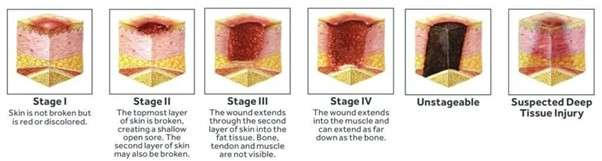
A. Full-thickness tissue loss extending to bone or tendon: A Stage 4 pressure injury is characterized by full-thickness tissue loss where fascia, muscle, tendon, ligament, cartilage, or bone are directly exposed or directly palpable. Undermining and tunneling are often extensive at this stage.
B. Intact skin with nonblanchable erythema: This describes a Stage 1 pressure injury.
C. Full-thickness skin loss with visible fat: This describes a Stage 3 pressure injury, which extends through the dermis and involves the subcutaneous fat but does not expose bone, tendon, or muscle.
D. Partial-thickness skin loss involving the dermis and epidermis: This describes a Stage 2 pressure injury, which involves only the partial loss of skin layers.
Whether you are a student looking to ace your exams or a practicing nurse seeking to enhance your expertise , our nursing education contents will empower you with the confidence and competence to make a difference in the lives of patients and become a respected leader in the healthcare field.
Visit Naxlex, invest in your future and unlock endless possibilities with our unparalleled nursing education contents today