
A nurse is evaluating the results of a nonstress test (NST) for a pregnant client at 34 weeks of gestation who has gestational diabetes mellitus.
The nurse notes that the fetal heart rate (FHR) baseline is 150 bpm with moderate variability and three accelerations of 20 bpm lasting 20 seconds each in a 10-minute period.
How should the nurse document these findings?
Reactive NST
Nonreactive NST
Positive NST
Negative NST
The Correct Answer is A
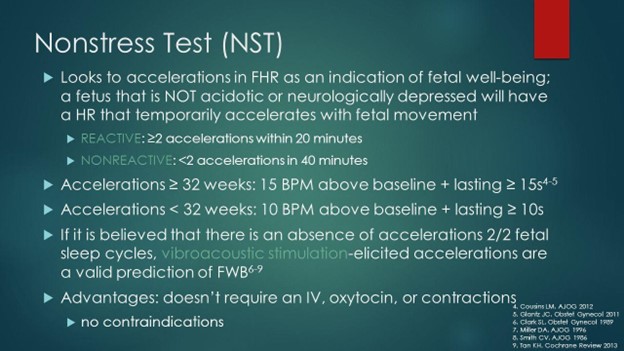
Reactive NST. This means that the fetal heart rate increased by at least 15 beats per minute (bpm) for at least 15 seconds twice or more in a 20-minute period. This indicates that the baby is getting enough oxygen and is doing well.
Nonreactive NST is wrong because it means that the fetal heart rate did not meet the criteria for a reactive NST. This could mean that the baby is not getting enough oxygen, is asleep, or has a problem with the nervous system.
Positive NST is wrong because it is not a term used to describe the results of a nonstress test. It is a term used to describe the results of a contraction stress test (CST), which is a different test that measures how the fetal heart rate responds to uterine contractions.
Negative NST is wrong because it is also not a term used to describe the results of a nonstress test. It is another term used to describe the results of a contraction stress test (CST), which means that the fetal heart rate did not show any signs of distress during contractions.
The normal range for fetal heart rate is 110 to 160 bpm, with moderate variability.
Variability refers to how much the heart rate changes from beat to beat. Moderate variability means that the heart rate changes by 6 to 25 bpm. Accelerations are brief increases in the heart rate that are usually caused by fetal movement.
Nursing Test Bank
Naxlex Comprehensive Predictor Exams
Related Questions
Correct Answer is A
Explanation
The NST is reactive, indicating fetal well-being.A reactive NST means that the fetal heart rate increases by at least15 bpmfor at least15 secondstwice or more in a20-minuteperiod.This shows that the fetus is healthy and getting enough oxygen.
Choice B is wrong because a nonreactive NST means that the fetal heart rate does not show the expected accelerations in a 40-minute period, which may indicate fetal compromise.
Choice C is wrong because an inconclusive NST means that the test results are unclear or not enough data was collected, which may require further testing.
Choice D is wrong because an invalid NST means that the test was not performed correctly or there was interference with the fetal heart rate monitoring, which may require a repeat test.
Normal ranges for fetal heart rate are110 to 160 bpmwith moderate variability (5 to 25 bpm) and no decelerations.
Correct Answer is A
Explanation
Reactive NST.This means that the fetal heart rate increased by at least 15 beats per minute (bpm) for at least 15 seconds twice or more in a 20-minute period.This indicates that the baby is getting enough oxygen and is doing well.
Nonreactive NST is wrong because it means that the fetal heart rate did not meet the criteria for a reactive NST.This could mean that the baby is not getting enough oxygen, is asleep, or has a problem with the nervous system.
Positive NST is wrong because it is not a term used to describe the results of a nonstress test.It is a term used to describe the results of a contraction stress test (CST), which is a different test that measures how the fetal heart rate responds to uterine contractions.
Negative NST is wrong because it is also not a term used to describe the results of a nonstress test.It is another term used to describe the results of a contraction stress test (CST), which means that the fetal heart rate did not show any signs of distress during contractions.
The normal range for fetal heart rate is 110 to 160 bpm, with moderate variability.
Variability refers to how much the heart rate changes from beat to beat.Moderate variability means that the heart rate changes by 6 to 25 bpm.Accelerations are brief increases in the heart rate that are usually caused by fetal movement.
Whether you are a student looking to ace your exams or a practicing nurse seeking to enhance your expertise , our nursing education contents will empower you with the confidence and competence to make a difference in the lives of patients and become a respected leader in the healthcare field.
Visit Naxlex, invest in your future and unlock endless possibilities with our unparalleled nursing education contents today