
A nurse is performing a physical assessment on a client. The nurse finds the following on the client's left lower extremity
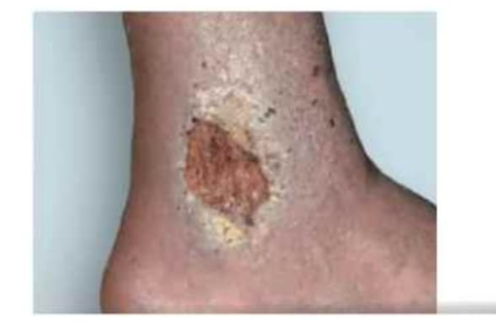
Stage 1 pressure injury
Venous stasis ulcer
Arterial ulcer
Diabetic ulcer
The Correct Answer is B
A. Stage 1 pressure injury: Stage 1 pressure injuries are characterized by intact skin with localized nonblanchable redness, typically over bony prominences. The presence of a large, open wound with granulation tissue and irregular borders on the lower leg does not fit the criteria for a Stage 1 injury.
B. Venous stasis ulcer: Venous stasis ulcers are commonly located on the medial lower leg near the ankle and are often shallow with irregular borders. The wound bed contains red granulation tissue and has areas of slough. Surrounding skin shows brownish discoloration (hemosiderin staining) due to chronic venous insufficiency and red blood cell leakage as seen in this patient.
C. Arterial ulcer: Arterial ulcers generally occur on the distal lower extremities, such as the toes or lateral malleolus, and have well-defined borders with a pale, dry wound bed. They are often painful and associated with diminished pulses, which differs from the characteristics of the wound observed here.
D. Diabetic ulcer: Diabetic ulcers most commonly appear on pressure points of the foot, such as the plantar surface or under the metatarsal heads, and are usually neuropathic in origin. The medial lower leg location and the features of venous insufficiency make a diabetic ulcer less likely.
Nursing Test Bank
Naxlex Comprehensive Predictor Exams
Related Questions
Correct Answer is C
Explanation
A. An 45 year-old adult with a femur fracture that is working on a home computer: This patient has a cognitive and visual engagement with the computer, providing ongoing sensory input through sight, sound, and mental stimulation. Despite limited mobility from the fracture, interactive activities reduce the risk of sensory deprivation by keeping the brain engaged.
B. An 55 year-old adult who is in an oncology unit reading magazines brought in by friends: Reading provides continuous cognitive and visual stimulation, and the presence of social support from friends increases auditory and emotional input. These factors serve as protective measures against sensory deprivation, even if mobility is limited due to illness.
C. An 78 year-old aged adult who had a stroke with the lights off: Older adults with neurological impairments such as a recent stroke are highly susceptible to sensory deprivation. The lack of environmental stimulation, compounded by possible deficits in vision, hearing, or cognitive processing, significantly increases the risk of confusion, depression, or delirium in this scenario, making this patient the greatest risk.
D. An 70 year-old adult who is sitting in a chair with the television off visiting with family: Although the television is off, social interaction with family provides auditory, visual, and emotional stimulation. This helps maintain orientation and sensory input, decreasing the likelihood of sensory deprivation compared with a patient who is isolated.
Correct Answer is B
Explanation
Calculation:
- Identify the given time in 24-hour format
Given time: 2100
- Convert to 12-hour format
Since 2100 is greater than 1200, subtract 1200 to convert to PM time: 2100 − 1200 = 900
- Add the colon and AM/PM notation
= 9:00 pm
Whether you are a student looking to ace your exams or a practicing nurse seeking to enhance your expertise , our nursing education contents will empower you with the confidence and competence to make a difference in the lives of patients and become a respected leader in the healthcare field.
Visit Naxlex, invest in your future and unlock endless possibilities with our unparalleled nursing education contents today