
A nurse is teaching a pregnant client about the advantages and limitations of nonstress test (NST).
Which statement by the client indicates a need for further teaching?
“The test is safe and simple for me and my baby.”
“The test is inexpensive and widely available.”
“The test can tell me if my baby has any birth defects.”
“The test can be repeated as often as needed without any harm.”
The Correct Answer is C
The test can tell me if my baby has any birth defects.
This statement indicates a need for further teaching because a nonstress test (NST) does not detect birth defects. An NST is a prenatal test that measures the fetal heart rate and movement to assess the health and oxygen supply of the fetus. It is usually done for high-risk pregnancies or when there are concerns about fetal well-being.
Choice A is correct because an NST is safe and simple for both the pregnant person and the fetus. It is a noninvasive test that does not pose any physical risks or stress.
Choice B is correct because an NST is inexpensive and widely available. It is a common test that can be done in most healthcare settings with minimal equipment.
Choice D is correct because an NST can be repeated as often as needed without any harm. It can be done at certain intervals or during delivery depending on the situation.
Nursing Test Bank
Naxlex Comprehensive Predictor Exams
Related Questions
Correct Answer is ["B","D","E"]
Explanation
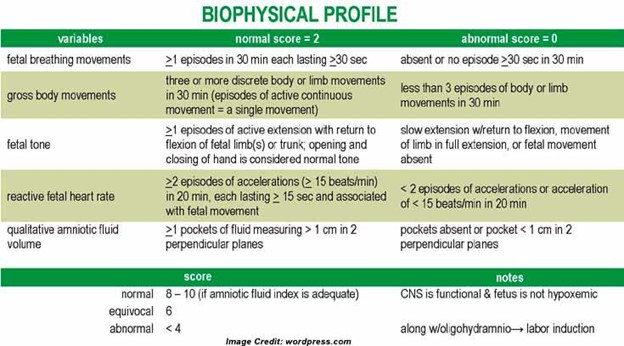
A biophysical profile (BPP) is a prenatal test that evaluates the well-being of the fetus by combining an ultrasound examination with a nonstress test.The test assesses five components: fetal heart rate, breathing, movement, tone, and amniotic fluid volume.Each component is scored as 2 (normal) or 0 (abnormal), and a total score of 8 or 10 is normal, 6 is equivocal, and 4 or less is abnormal.
Choice C is wrong because fetal heart rate is not part of the ultrasound assessment, but rather the nonstress test.The nonstress test evaluates fetal heart rate and response to fetal movement.
Normal ranges for each component are as follows:
• Fetal heart rate: At least two accelerations in 20 minutes
• Fetal breathing: At least one episode of > 30s or >20sin 30 minutes
• Fetal movement: At least three discrete body/limb movement in 30 minutes
• Fetal tone: At least one episode of active extension with return to flexion of fetal limb(s) or trunk, opening and closing of hand considered to be normal tone
• Amniotic fluid volume: At least one vertical pocket > 2 cm in the vertical axis or AFI of 5 cm
Correct Answer is C
Explanation
The test can tell me if my baby has any birth defects.
This statement indicates a need for further teaching because a nonstress test (NST) does not detect birth defects.An NST is a prenatal test that measures the fetal heart rate and movement to assess the health and oxygen supply of the fetus.It is usually done for high-risk pregnancies or when there are concerns about fetal well-being.
Choice A is correct because an NST is safe and simple for both the pregnant person and the fetus.It is a noninvasive test that does not pose any physical risks or stress.
Choice B is correct because an NST is inexpensive and widely available.It is a common test that can be done in most healthcare settings with minimal equipment.
Choice D is correct because an NST can be repeated as often as needed without any harm.It can be done at certain intervals or during delivery depending on the situation.
Whether you are a student looking to ace your exams or a practicing nurse seeking to enhance your expertise , our nursing education contents will empower you with the confidence and competence to make a difference in the lives of patients and become a respected leader in the healthcare field.
Visit Naxlex, invest in your future and unlock endless possibilities with our unparalleled nursing education contents today