
From the following picture select which syringe tip is a Leur Lock style.
Select your answer by clicking the desired location on the image below. To move a pin, click another location on the image. To remove a pin, click it once.
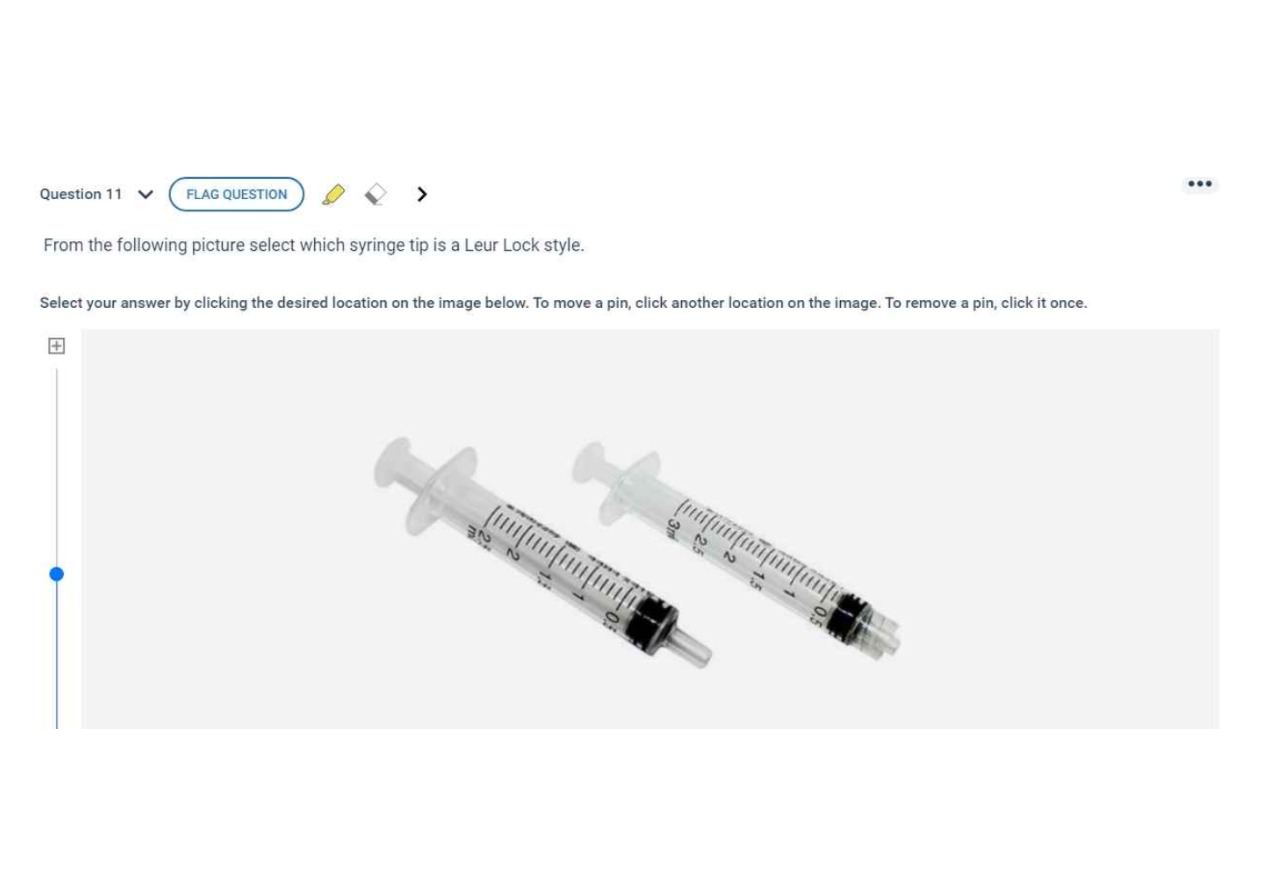
Left syringe tip (the one with the threaded collar)
Right syringe tip (the smooth/tapered tip)
The Correct Answer is A
A. Left syringe tip (the one with the threaded collar): The Luer-Lock design has visible threads or a screw-type collar on the tip that allows the needle hub to be twisted on securely, preventing accidental detachment and leakage.
B. Right syringe tip (the smooth/tapered tip): The slip-tip (or plain) syringe has a smooth, tapered nozzle that the needle hub simply pushes onto; it lacks the threaded collar used for a locking connection.
Nursing Test Bank
Naxlex Comprehensive Predictor Exams
Related Questions
Correct Answer is D
Explanation
A. Risk for impaired nutrition: The Braden Scale is not designed to evaluate nutritional risk specifically, though nutrition affects skin integrity.
B. Risk for falls: The Braden Scale does not assess fall risk; separate tools exist for fall-risk screening.
C. Risk for aspiration: Aspiration risk is not what the Braden Scale measures.
D. Risk for skin breakdown: The Braden Scale evaluates sensory perception, moisture, activity, mobility, nutrition, and friction/shear to determine risk for pressure injury/skin breakdown.
Correct Answer is C
Explanation
A. This is normal for patients who are not turning every 2 hours: Prolonged pressure and lack of repositioning increase risk of pressure injury and tissue necrosis. This is a general statement, not a staging classification.
B. Unstageable pressure injury: An unstageable injury is present when full-thickness tissue loss is suspected but the wound base is obscured by slough or eschar, making depth indeterminate -this description fits wounds covered with thick necrotic tissue.
C. Stage I pressure injury: Stage I involves is characterized by intact skin with non-blanchable redness (erythema) of a localized area, usually over a bony prominence.
D. Eschar: Eschar is dead, leathery, often black or brown tissue that adheres to the wound bed; its presence commonly prompts classification as unstageable until the eschar is removed or the base is visible.
Whether you are a student looking to ace your exams or a practicing nurse seeking to enhance your expertise , our nursing education contents will empower you with the confidence and competence to make a difference in the lives of patients and become a respected leader in the healthcare field.
Visit Naxlex, invest in your future and unlock endless possibilities with our unparalleled nursing education contents today