
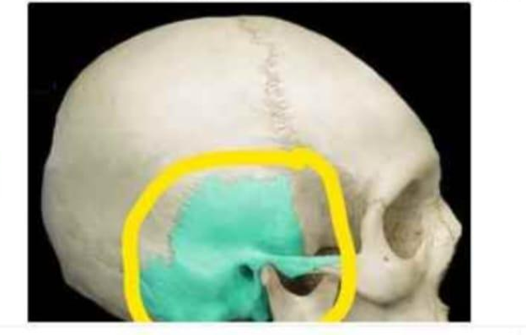
Identify the bone circled and highlighted in the image below.
Sphenoid bone
Temporal bone
Parietal bone
Occipital bone
The Correct Answer is B
The marked structure is the temporal bone, a paired irregular cranial bone forming part of the lateral skull and cranial base. It consists of squamous, petrous, mastoid, and tympanic portions, each with distinct anatomical roles. The temporal bone is clinically significant because it houses the auditory and vestibular apparatus and contributes to the temporomandibular joint (TMJ). It also provides multiple foramina for cranial nerves and vascular structures.
A. Sphenoid bone: The sphenoid bone is a centrally located cranial bone forming part of the middle cranial fossa and posterior orbital wall. It has a complex butterfly shape with greater and lesser wings and contains the sella turcica for the pituitary gland. It contributes to multiple foramina including the optic canal and superior orbital fissure for neurovascular transmission. Unlike the temporal bone, it is midline and not associated with hearing structures or the TMJ.
B. Temporal bone: The temporal bone is a lateral skull bone composed of squamous, petrous, mastoid, and tympanic parts, each serving distinct functions. The petrous portion houses the inner ear structures responsible for hearing and balance. The mastoid air cells assist in pressure regulation, while the tympanic part surrounds the external auditory canal. It articulates with the mandible at the TMJ and transmits cranial nerves VII and VIII, making it the correct answer.
C. Parietal bone: The parietal bone is a flat bone forming the superior and lateral aspects of the cranial vault. It articulates with adjacent bones via sutures including the coronal, sagittal, and lambdoid sutures. Its primary role is protection of the cerebral hemispheres beneath it. It lacks involvement in auditory structures, neurovascular canals, or mandibular articulation.
D. Occipital bone: The occipital bone forms the posterior skull and surrounds the foramen magnum, allowing passage of the spinal cord. It articulates with the atlas vertebra to enable nodding movements of the head. It also provides attachment for nuchal muscles that support head posture. Unlike the temporal bone, it is not involved in hearing or jaw articulation.
Nursing Test Bank
Naxlex Comprehensive Predictor Exams
Related Questions
Correct Answer is A
Explanation
The human body is organized into several major anatomical cavities that house and protect delicate internal organs. These cavities are lined by specific membranes and are categorized based on their location within the body's structural framework. The cranial cavity is a specialized dorsal space that acts as the protective bony container for the central nervous system, ensuring the brain remains shielded from external trauma.
A. The cranial cavity, also known as the endocranium, is the space enclosed by the bones of the skull. It directly houses the brain, the meninges, and the cerebrospinal fluid that cushions the brain. This cavity is continuous with the vertebral canal, forming the dorsal body cavity, which is the primary site of protection for the central nervous system.
B. The thoracic cavity is located in the upper trunk of the body, protected by the rib cage and the sternum. It houses vital organs such as the heart, lungs, esophagus, and trachea. It is separated from the abdominal cavity below by the diaphragm and is completely separate from the cranial cavity shown in the diagram.
C. The abdominal cavity occupies the upper portion of the abdominopelvic cavity. It contains the majority of the digestive organs, including the stomach, liver, intestines, and kidneys. Because it is located in the trunk and holds visceral organs associated with digestion and metabolism, it bears no anatomical relationship to the cranial cavity.
D. The pelvic cavity is the lowermost portion of the abdominopelvic cavity, located within the bony pelvis. It contains the urinary bladder, reproductive organs, and the terminal portions of the gastrointestinal tract. Like the abdominal cavity, it is positioned far from the head and is not involved in housing the brain.
Correct Answer is D
Explanation
Bone is a dynamic tissue that undergoes continuous remodeling throughout life to maintain strength, repair damage, and regulate calcium homeostasis. This remodeling process involves the coordinated activity of specialized bone cells, including osteoblasts, osteocytes, and osteoclasts. Osteoclasts are responsible for bone resorption, a process that removes old or damaged bone tissue. Their activity is essential for skeletal growth, fracture repair, and maintaining normal mineral balance within the body.
A. Bone-forming cells that secrete new bone matrix: This option describes osteoblasts, not osteoclasts. Osteoblasts are responsible for synthesizing and secreting osteoid, the organic component of bone matrix composed primarily of type I collagen. They promote bone formation and mineralization during growth and repair.
B. Mature bone cells that maintain the matrix: This option refers to osteocytes, which are mature bone cells derived from osteoblasts that become trapped within the mineralized matrix. Osteocytes maintain bone tissue, monitor mechanical stress, and help regulate remodeling by communicating with osteoblasts and osteoclasts. Their primary role is maintenance rather than bone resorption.
C. Cartilage cells found in the epiphyseal plate: This option describes chondrocytes, the cells responsible for producing and maintaining cartilage. Chondrocytes are found within structures such as articular cartilage and the epiphyseal growth plate, where they contribute to longitudinal bone growth. They are not involved in bone resorption and are not classified as bone cells.
D. Bone cells that break down bone matrix: osteoclasts are large, multinucleated cells specialized for bone resorption. They attach to the bone surface and release hydrogen ions and lysosomal enzymes that dissolve the mineralized matrix and degrade collagen fibers. This process releases calcium and phosphate into the bloodstream and allows old or damaged bone to be replaced with new bone tissue. Osteoclast activity is essential for normal bone remodeling, skeletal growth, and mineral homeostasis.
Whether you are a student looking to ace your exams or a practicing nurse seeking to enhance your expertise , our nursing education contents will empower you with the confidence and competence to make a difference in the lives of patients and become a respected leader in the healthcare field.
Visit Naxlex, invest in your future and unlock endless possibilities with our unparalleled nursing education contents today