
Provided is an ECG image of sinus bradycardia.
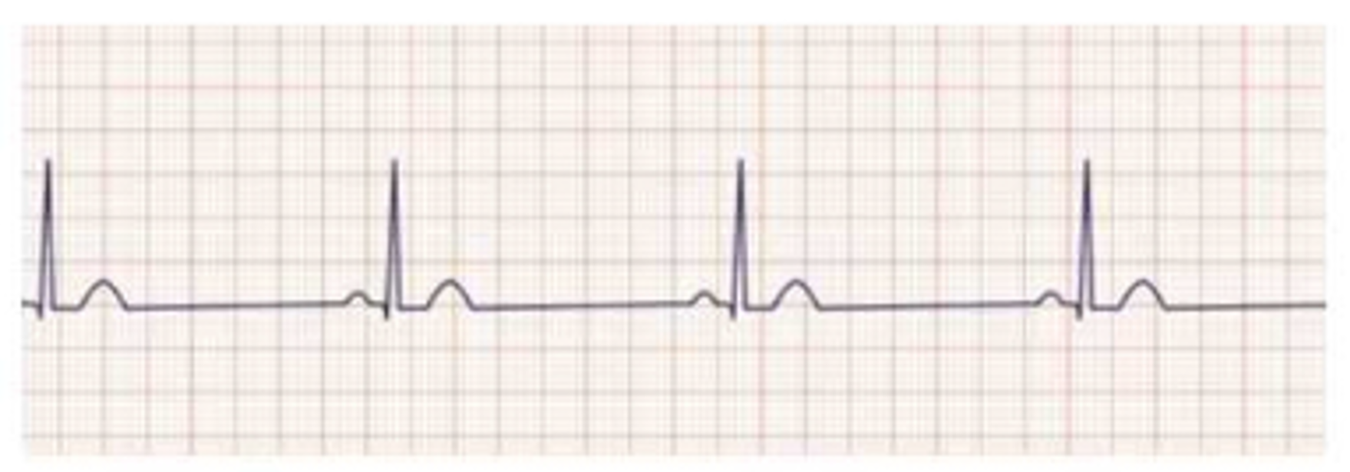
Identify the wave pattern and describe its characteristics.
The wave pattern shows a normal sinus rhythm with a heart rate of less than 60 beats per minute.
The wave pattern shows an absence of P waves and a heart rate of 40 beats per minute.
The wave pattern shows a prolonged PR interval greater than 0.20 seconds with a slow rate.
The wave pattern shows a regular rhythm with a heart rate between 60 and 100 beats per minute.
The Correct Answer is A
Choice A rationale
Sinus bradycardia is defined by a heart rate of less than 60 beats per minute originating from the sinoatrial node. On an ECG, this rhythm must demonstrate all the hallmarks of a normal sinus rhythm, including a P wave preceding every QRS complex, a constant PR interval between 0.12 and 0.20 seconds, and a regular R to R interval. The only abnormality is the slow rate. It can be physiological in athletes or a result of vagal stimulation.
Choice B rationale
An absence of P waves combined with a slow heart rate of 40 beats per minute typically indicates a junctional escape rhythm. In this scenario, the sinoatrial node fails to fire, and the atrioventricular node takes over as the primary pacemaker. Because the atria are not depolarized from the top down, P waves are either absent, inverted, or hidden within the QRS complex. This is distinct from sinus bradycardia, where the sinoatrial node is still functioning as the pacemaker.
Choice C rationale
A prolonged PR interval greater than 0.20 seconds is the defining characteristic of a first-degree atrioventricular block. While this condition can occur alongside sinus bradycardia, the prolongation of the PR interval indicates a delay in conduction through the atrioventricular node rather than a slow discharge rate from the sinoatrial node itself. Simple sinus bradycardia maintains a normal PR interval. Lab values for cardiac output may be monitored if the rate becomes too slow to maintain tissue perfusion.
Choice D rationale
A regular rhythm with a heart rate between 60 and 100 beats per minute is the definition of normal sinus rhythm. In this range, the sinoatrial node is firing at an appropriate physiological frequency for a resting adult. All ECG components, including P waves, QRS complexes, and T waves, are present and occur at regular intervals. Sinus bradycardia specifically requires the rate to drop below the 60 beats per minute threshold while maintaining the other characteristics of sinus rhythm.
Nursing Test Bank
Naxlex Comprehensive Predictor Exams
Related Questions
Correct Answer is B
Explanation
Choice A rationale
Thickening of the ventricular walls and the septum is the hallmark of hypertrophic cardiomyopathy, not pericarditis. In that condition, the muscle tissue becomes abnormally thick, which can make it harder for the heart to pump blood and may lead to arrhythmias. Pericarditis does not involve the growth or thickening of the myocardium itself; it is strictly a disorder of the protective layers surrounding the heart. Explaining the condition this way would be scientifically inaccurate.
Choice B rationale
Acute pericarditis is defined as the inflammation of the pericardium, which is the thin, two-layered membranous sac that encloses the heart. This inflammation often leads to chest pain that worsens with deep breathing or lying flat and may produce a pericardial friction rub. The inflammation can be caused by infections, autoimmune disorders, or trauma. This statement correctly identifies the anatomical location and the pathological process involved, making it the most appropriate explanation for patient education.
Choice C rationale
Excessive stretching of the ventricles is associated with dilated cardiomyopathy, a condition where the heart chambers enlarge and the muscle weakens. This stretching results in a decreased ejection fraction and signs of heart failure. Pericarditis involves the external sac and does not primarily cause the heart muscle to stretch out. Using this description would confuse the patient about the nature of their diagnosis, as it describes a structural muscle failure rather than an inflammatory process.
Choice D rationale
Compression of the myocardium due to fluid accumulation describes a pericardial effusion or cardiac tamponade. While these can be complications of acute pericarditis, they are not the definition of the disease itself. Pericarditis is the inflammation of the membranes, which may or may not lead to significant fluid buildup. It is important to distinguish the primary inflammatory cause from the potential secondary effect of fluid pressure to ensure the patient understands why they have pain.
Correct Answer is A
Explanation
Choice A rationale
For a client in acute heart failure following a myocardial infarction, the administration of 0.9 percent sodium chloride is often contraindicated or requires extreme caution. Acute heart failure involves the heart's inability to pump effectively, leading to pulmonary congestion and systemic fluid volume excess. Adding isotonic saline, which remains in the extracellular space, can worsen pulmonary edema and increase the workload on the failing left ventricle. The nurse should clarify this order to prevent further respiratory distress and cardiac strain.
Choice B rationale
Bumetanide is a potent loop diuretic used to rapidly reduce fluid volume in patients with acute heart failure and pulmonary congestion. A dose of 1 mg IV bolus every 12 hours is a standard intervention aimed at promoting diuresis and reducing preload. This helps clear fluid from the lungs and improves oxygenation. The nurse would monitor urine output and electrolyte levels, specifically looking for hypokalemia, as loop diuretics cause the kidneys to excrete potassium along with water and sodium.
Choice C rationale
Monitoring serum potassium is a critical and appropriate action for a patient with heart failure and a recent myocardial infarction. Potassium levels must stay within 3.5 to 5.0 mEq/L to maintain cardiac electrical stability. Many heart failure treatments, including diuretics and ACE inhibitors, significantly alter potassium levels. In the context of an injured myocardium following an infarct, any electrolyte imbalance can trigger lethal arrhythmias. Therefore, obtaining baseline and serial potassium levels is a standard of care that does not require clarification.
Choice D rationale
Morphine sulfate is frequently used in the treatment of acute heart failure and myocardial infarction. Beyond its analgesic properties for chest pain, morphine acts as a vasodilator, which reduces both preload and afterload. This effect decreases the myocardial oxygen demand and helps alleviate the anxiety associated with dyspnea. A dose of 2 mg IV bolus every 2 hours as needed is a common and appropriate prescription to manage symptoms and improve hemodynamics in the acute phase of cardiac distress.
Whether you are a student looking to ace your exams or a practicing nurse seeking to enhance your expertise , our nursing education contents will empower you with the confidence and competence to make a difference in the lives of patients and become a respected leader in the healthcare field.
Visit Naxlex, invest in your future and unlock endless possibilities with our unparalleled nursing education contents today