
The physician ordered ¼ tsp of a medication instilled into Mr. Beauregard's right ear. Which device should be used to measure and administer this order?
The Correct Answer is ["4"]
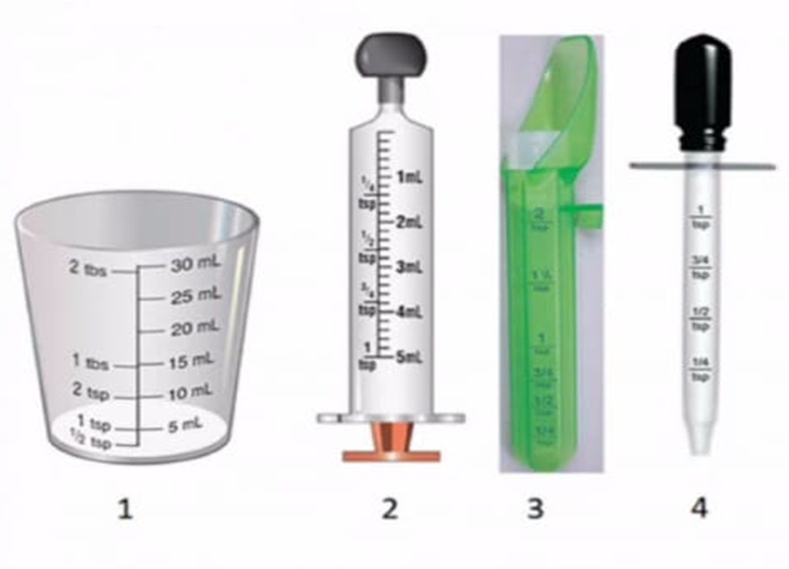
1: This is a medication cup, which is not suitable for measuring a small volume like ¼ teaspoon with a high degree of accuracy. Its large capacity and wide rim make it prone to measurement errors for such a small dose. Additionally, its shape is inappropriate for instilling medication into an ear.
2: This is an oral syringe, which is a good device for accurately measuring small liquid volumes. However, its primary design is for oral administration. While it could be used for instillation, the dropper is more suitable for this order.
3: This is a medication dosing spoon or oral dispenser. While it has markings for fractions of a teaspoon, it is designed for oral administration. Its shape would make it difficult to precisely and safely instill medication into an ear, as the liquid would likely spill.
4: This device is a dropper, which is the most appropriate tool for this medication order. It has clear markings for a quarter-teaspoon, allowing for accurate measurement of the small dose. A dropper is also specifically designed for the ordered route of administration, "instilled into the right ear," enabling the precise and safe delivery of the medication.
Nursing Test Bank
Naxlex Comprehensive Predictor Exams
Related Questions
Correct Answer is B
Explanation
A. XXIIII: While this form was used in ancient times, it is now considered incorrect by modern Roman numeral standards. Roman numerals should follow subtractive notation, where 4 is written as IV, not IIII.
B. XXIV: This is the correct modern Roman numeral for 24. It combines 20 (XX) and 4 (IV) using the proper subtractive rule for the numeral 4.
C. Xxiiii: Roman numerals must be written in uppercase to be considered correct. This option also uses an outdated form (IIII for 4) and mixes cases.
D. xixv: This is not a valid Roman numeral. It incorrectly places symbols and uses lowercase letters, violating both formatting and value rules.
Correct Answer is C
Explanation
Calculation:
D10W stands for Dextrose 10% in Water.2 This means the solution contains 10 grams of dextrose for every 100 mL of solution.
- Calculate the total grams of dextrose in 1,000 mL.
Using a ratio:
10g/100mL =x/1000mL.
To solve for x:
x= (10g×1000mL)/ 100mL
=10g×10
=100grams
Whether you are a student looking to ace your exams or a practicing nurse seeking to enhance your expertise , our nursing education contents will empower you with the confidence and competence to make a difference in the lives of patients and become a respected leader in the healthcare field.
Visit Naxlex, invest in your future and unlock endless possibilities with our unparalleled nursing education contents today