
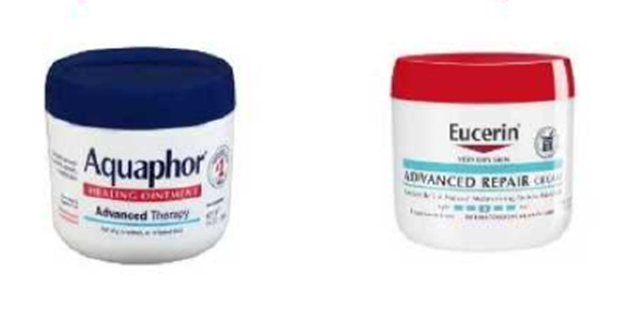
The products shown below are examples of?
Yellow Ointment, USP.
Water-soluble ointment bases.
Absorption ointment bases.
Oleaginous ointment bases.
Water-removable ointment bases.
The Correct Answer is C
Absorption ointment bases are anhydrous preparations that can incorporate significant amounts of water or aqueous solutions to form water-in-oil (w/o) emulsions. Common examples include Aquaphor and Eucerin, which utilize lanolin or petrolatum derivatives as the primary vehicle. These bases are highly emollient, greasy, and difficult to wash off with water, making them ideal for treating severely dry skin or protecting compromised barriers.
Rationale:
A. Yellow Ointment, also known as simple ointment, consists of yellow wax and petrolatum. It is a strictly oleaginous base and does not possess the specific emulsifiers, like lanolin alcohols, found in the products pictured. Yellow Ointment lacks the water-incorporating capacity that characterizes the advanced repair and healing ointments shown in the exhibits.
B. Water-soluble bases, such as Polyethylene Glycol (PEG) ointment, are completely greaseless and consist of only water-soluble components. The products shown, Aquaphor and Eucerin, contain petrolatum, which is a lipid-based ingredient. Therefore, they are not water-soluble and cannot be categorized as greaseless, washable vehicles in a pharmaceutical context.
C. Absorption ointment bases is the correct classification for these products because they are designed to absorb aqueous fluids into the lipid phase. Aquaphor is an anhydrous absorption base that forms an emulsion when water is added, providing a protective occlusive layer. These bases are essential for rehydrating the stratum corneum by preventing transepidermal water loss.
D. Oleaginous ointment bases, such as white petrolatum or Vaseline, are strictly oily and contain no emulsifiers to pick up water. While absorption bases are lipid-heavy, they differ by their ability to internalize water. The products pictured contain specialized ingredients that allow them to function as emulsion precursors, distinguishing them from simple hydrocarbons.
E. Water-removable ointment bases are oil-in-water emulsions, commonly referred to as "vanishing creams." These can be easily rinsed from the skin with water because the aqueous phase is external. The pictured ointments are greasy and occlusive, meaning they stay on the skin surface and resist simple water rinsing, unlike water-removable creams.
Nursing Test Bank
Naxlex Comprehensive Predictor Exams
Related Questions
Correct Answer is C
Explanation
Tinnitus is a phantom auditory perception characterized by the sensation of sound in the absence of an external stimulus. It is often a symptom of underlying pathology within the auditory pathway, ranging from the inner ear to the auditory cortex. Causes include noise-induced hearing loss, vascular disorders, and certain medications. Persistent tinnitus can significantly impact quality of life, leading to sleep disturbances, anxiety, and impaired concentration in affected individuals.
Rationale:
A. Ototoxicity refers to the toxic effect that certain drugs, like aminoglycosides or loop diuretics, have on the inner ear. While tinnitus is a common symptom of ototoxicity, the two terms are not synonymous. Ototoxicity is the causative mechanism or condition, whereas tinnitus is a specific sensory manifestation that may or may not be present in ototoxic cases.
B. Enhanced sensitivity to sound is known as hyperacusis, not tinnitus. Hyperacusis involves a lowered tolerance for everyday environmental noises, making them seem uncomfortably loud or painful. While hyperacusis and tinnitus often co-occur in patients with cochlear damage, they represent distinct physiological phenomena related to auditory processing and gain control within the brain.
C. Perception of noise or ringing in the ears is the clinical definition of tinnitus. It may be described by patients as buzzing, hissing, or whistling sounds. It results from aberrant neural activity in the auditory system that the brain interprets as sound. This definition accurately captures the subjective nature of the condition as described in the medical literature.
D. Tinnitus is a symptom, not a pathogenic disease caused by bacteria. While an ear infection (otitis media) caused by bacteria can lead to tinnitus due to pressure changes or inflammation, the tinnitus itself is not the infection. Most cases of tinnitus are related to sensorineural changes or mechanical issues rather than an active bacterial invasion of the tissues.
Correct Answer is A
Explanation
Ischemia is the critical restriction of blood flow to tissues, resulting in a deficit of oxygen and nutrients necessary for cellular metabolism. If the perfusion pressure remains insufficient for a prolonged period, irreversible cellular injury occurs, leading to necrosis. This pathological process can be complicated by bacterial putrefaction or remain relatively sterile, depending on the environment and the speed at which the vascular supply was compromised.
Rationale:
A. Gangrene is the medical term for the death of body tissue caused by a lack of blood flow or a serious bacterial infection. It typically affects the extremities or internal organs and is classified as "dry," "wet," or "gas" gangrene. The primary physiological driver is tissue ischemia, which leads to cellular necrosis and the eventual decomposition of the affected anatomical structure.
B. An abscess is a localized collection of pus that has built up within the tissue of the body. It is typically the result of an inflammatory response to a pyogenic bacterial infection rather than a primary loss of blood supply. While tissue damage occurs within an abscess, the defining feature is the accumulation of white blood cells and necrotic debris in a contained cavity.
C. Eczema is a chronic inflammatory skin condition characterized by pruritus, erythema, and vesicular lesions. It is an immune-mediated or atopic response often related to barrier dysfunction or environmental triggers. It does not involve the death of deep tissue or a significant loss of macrovascular blood supply, making it an incorrect classification for necrotic tissue death.
D. A furuncle, commonly known as a boil, is a deep-seated infection of a hair follicle, usually caused by the bacterium Staphylococcus aureus. It manifests as a painful, swollen area with a core of pus and inflammation. Like an abscess, it is primarily infectious and inflammatory in nature, rather than a result of systemic or localized vascular occlusion leading to tissue death.
Whether you are a student looking to ace your exams or a practicing nurse seeking to enhance your expertise , our nursing education contents will empower you with the confidence and competence to make a difference in the lives of patients and become a respected leader in the healthcare field.
Visit Naxlex, invest in your future and unlock endless possibilities with our unparalleled nursing education contents today