
This patient hand is demonstrating which type of position?
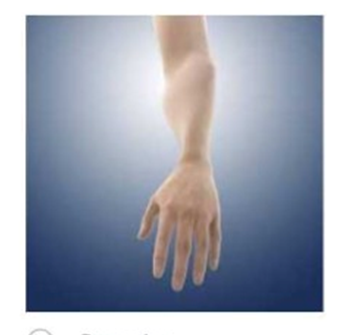
Pronation
Extension
Supination
Flexion
The Correct Answer is A
Pronation of the hand occurs when the radius rotates medially around its longitudinal axis, crossing over the ulna. This movement results in the palm facing posteriorly (downward) and the thumb pointing toward the body's midline. It is controlled by the pronator teres and pronator quadratus muscles and is a key component of the neurological motor exam.
A. Pronation: The image in "image_b56957.png" displays the hand with the dorsum (back) facing the viewer and the palm facing downward. This is the hallmark anatomical position of a pronated forearm. It is the correct term for the orientation shown.
B. Extension: Extension at the wrist would involve moving the hand toward the dorsal surface of the forearm. While the hand is straight, "extension" describes a joint angle rather than the rotational orientation of the palm. It does not describe the specific cross-over of the forearm bones seen here.
C. Supination: Supination is the opposite of the position shown; it would feature the palm facing upward (anteriorly) with the radius and ulna parallel. Since the back of the hand is visible and the palm is hidden, the hand is not in supination.
D. Flexion: Wrist flexion involves bending the palm toward the ventral surface of the forearm. The hand in the image is held in a neutral, straight line with the arm. Therefore, the term "flexion" does not apply to the position depicted.
Nursing Test Bank
Naxlex Comprehensive Predictor Exams
Related Questions
Correct Answer is B
Explanation
The spleen is a highly vascular lymphoid organ situated in the left upper quadrant (LUQ) protected by the 9th through 11th ribs. Under normal physiological conditions, it is not palpable; however, splenomegaly from infection or trauma can cause it to descend below the costal margin. Deep palpation in this region targets the splenic notch and the fundus of the stomach.
A. Gallbladder: The gallbladder is located on the inferior surface of the liver within the right upper quadrant. Tenderness in this area, specifically a positive Murphy's sign, indicates cholecystitis. It is anatomically distant from the left upper quadrant and would not be the source of pain in the LUQ.
B. Spleen: The spleen occupies the leftmost superior portion of the abdominal cavity. Tenderness elicited here during deep palpation is a classic clinical finding for splenic enlargement or inflammation. This matches the anatomical location described in the question for a 20-year-old patient.
C. Appendix: The vermiform appendix is located in the right lower quadrant at McBurney's point. While referred pain can occur, localized tenderness from appendicitis is almost exclusively found on the right side. It is not a resident structure of the left upper quadrant.
D. Sigmoid colon: The sigmoid colon is a terminal portion of the large intestine primarily located in the left lower quadrant. While it can extend superiorly, it is generally associated with pain in the lower abdomen. It is less likely than the spleen to be the primary structure involved in high LUQ tenderness.
Correct Answer is D
Explanation
Hypothyroidism is a metabolic state resulting from deficient thyroxine (T4) and triiodothyronine (T3) production. It causes a generalized slowing of physiological processes, leading to myxedema and bradycardia. Clinical signs often include delayed relaxation of deep tendon reflexes and non-pitting edema.
A. Exophthalmos: Bulging of the eyes is a classic sign of Graves' disease, which is the most common cause of hyperthyroidism. It is an infiltrative ophthalmopathy driven by autoimmune activity. It is not found in the hypometabolic state of hypothyroidism.
B. Tachycardia: An increased heart rate is a hallmark of hyperthyroidism or thyrotoxicosis due to increased beta-adrenergic sensitivity. Hypothyroidism typically presents with bradycardia, reflecting the decreased metabolic demand on the cardiovascular system.
C. Hyperreflexia: Overactive reflexes indicate a hypermetabolic state or upper motor neuron irritation. Hypothyroidism is associated with hyporeflexia and specifically a slow recovery phase in the Achilles reflex. Reflex activity is diminished, not increased, in thyroid deficiency.
D. Velvet skin: While hypothyroid skin is typically described as dry, "velvet" or smooth, warm skin is actually more characteristic of hyperthyroidism. However, within the provided options for hypothyroidism, it is the only skin descriptor, though medical jargon usually favors "coarse" for this condition.
Whether you are a student looking to ace your exams or a practicing nurse seeking to enhance your expertise , our nursing education contents will empower you with the confidence and competence to make a difference in the lives of patients and become a respected leader in the healthcare field.
Visit Naxlex, invest in your future and unlock endless possibilities with our unparalleled nursing education contents today