
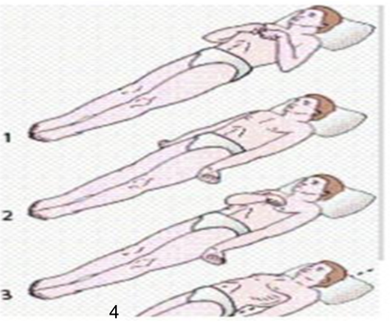
Use the attached image. During change-of-shift report, the nurse learns that a patient with a head injury has decorticate posturing to noxious stimulation. Which positioning shown in the accompanying figure will the nurse expect to observe?
3
2
4
1
The Correct Answer is D
A. Decorticate posturing involves flexion of the arms, wrists, and fingers with extension of the legs, indicating damage to the corticospinal tract above the brainstem. In the image, positioning 1 shows the patient with arms flexed at the elbows and wrists, hands toward the chest, and legs extended, which is characteristic of decorticate posturing. This occurs in response to noxious stimuli in patients with cortical or corticospinal tract injury.
B. This shows the decerebrate posturing involves extension and pronation of the arms and legs, indicating more severe brainstem injury. It usually occurs in people who are unconscious and unable to control their movements. It reflects serious injury to the brainstem or widespread brain dysfunction.
C. Decorticate posturing is an abnormal reflex body position that indicates severe brain injury or disruption of brain activity. Key Features include arms flexed tightly toward the chest, wrists and fingers clenched, legs extended straight and rigid as shown in image 1.
D. Decorticate posturing involves flexion of the arms, wrists, and fingers with extension of the legs, indicating damage to the corticospinal tract above the brainstem. In the image, positioning 1 shows the patient with arms flexed at the elbows and wrists, hands toward the chest, and legs extended, which is characteristic of decorticate posturing. This occurs in response to noxious stimuli in patients with cortical or corticospinal tract injury.
Nursing Test Bank
Naxlex Comprehensive Predictor Exams
Related Questions
Correct Answer is C
Explanation
A. Obtain 24-hour dietary intake: While monitoring dietary intake is important for long-term management of diabetes insipidus, it does not address the acute and potentially life-threatening fluid and electrolyte imbalance caused by excessive water loss. This is not the immediate priority.
B. Administer corticosteroids: Corticosteroids may be used in cases of secondary DI due to adrenal insufficiency, but they are not first-line therapy for the majority of DI patients. Immediate management focuses on correcting dehydration and hypernatremia rather than starting steroids.
C. Administer IV fluids: Patients with DI excrete large volumes of dilute urine, leading to dehydration and hypernatremia. Rapid IV fluid replacement is critical to restore circulating volume, correct electrolyte imbalances, and prevent hypovolemic shock. This intervention addresses the most urgent physiologic threat.
D. Obtain blood cultures: Blood cultures are indicated if infection is suspected but are not part of the immediate management of DI. Delaying fluid resuscitation to obtain cultures could worsen dehydration and hemodynamic instability.
Correct Answer is A
Explanation
A. Administer an injection of epinephrine stat: The patient’s symptoms are classic signs of anaphylaxis, a severe IgE-mediated hypersensitivity reaction. Epinephrine is the first-line treatment because it stimulates alpha-1 receptors (causing vasoconstriction to reduce edema and hypotension) and beta-2 receptors (producing bronchodilation). Immediate intramuscular administration prevents airway obstruction and cardiovascular collapse.
B. Administer oxygen 4 liters via nasal cannula: Supplemental oxygen supports oxygenation during respiratory distress but does not reverse the underlying pathophysiology of anaphylaxis. It does not address airway edema, bronchospasm, or vasodilation. Oxygen is an important adjunct after epinephrine, but it is not the priority intervention in a rapidly progressing allergic reaction.
C. Administer albuterol 2 puffs stat: Albuterol is a beta-2 agonist that provides bronchodilation and may help relieve bronchospasm. However, it does not reduce laryngeal edema or counteract systemic vasodilation and hypotension. In anaphylaxis, albuterol is considered secondary therapy and should not delay epinephrine administration.
D. Have the patient in high Fowler's position in the bed: Positioning may help ease breathing effort by optimizing lung expansion. However, it does not treat airway edema, bronchoconstriction, or the systemic vasodilatory effects of anaphylaxis. Supportive measures such as positioning are important but must follow immediate administration of epinephrine.
Whether you are a student looking to ace your exams or a practicing nurse seeking to enhance your expertise , our nursing education contents will empower you with the confidence and competence to make a difference in the lives of patients and become a respected leader in the healthcare field.
Visit Naxlex, invest in your future and unlock endless possibilities with our unparalleled nursing education contents today