
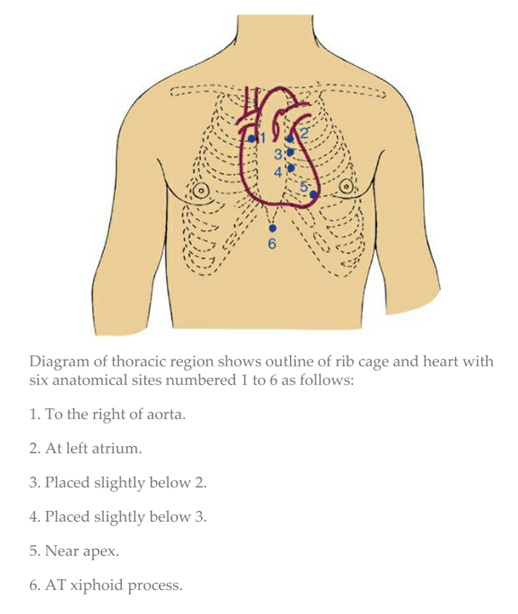
Which number corresponds to the area of the chest where you would auscultate for the tricuspid valve?
1
2
3
4
5
The Correct Answer is D
Auscultation of the heart involves listening to specific valve areas over the chest to assess the function and detect abnormalities in heart sounds. These valve areas do not correspond precisely to the anatomical position of the valves, but rather to where the sounds are best heard.
Rationale for correct answer:
4. Placed slightly below 3 (Lower Left Sternal Border): Number 4 represents the 4th or 5th left intercostal space at the lower left sternal border, the traditional location for auscultating the tricuspid valve.
Rationale for incorrect answers:
1. To the right of aorta: This is the 2nd right intercostal space, where the aortic valve is auscultated.
2. At left atrium (2nd left intercostal space): This is the pulmonic valve area, not the tricuspid. Located at the 2nd left intercostal space, this site is used for auscultating pulmonic valve sounds.
3. Placed slightly below 2: This is near Erb’s point (3rd left intercostal space), where both aortic and pulmonic murmurs may be heard equally well-but it's not specific to the tricuspid valve.
5. Near apex: This is the mitral valve area, located at the 5th intercostal space at the midclavicular line, where mitral valve sounds are best heard (especially mitral regurgitation or stenosis murmurs).
6. At xiphoid process: It may be useful for detecting certain low-frequency heart sounds in children but is not used for valve assessment in adults.
Take home points:
- The tricuspid valve is best auscultated at the lower left sternal border in the 4th or 5th intercostal space.
- Knowing the auscultation sites for all four heart valves (aortic, pulmonic, tricuspid, and mitral) helps identify specific murmurs and cardiac abnormalities more accurately.
Nursing Test Bank
Naxlex Comprehensive Predictor Exams
Related Questions
Correct Answer is ["B","C","D","E"]
Explanation
Heart disease remains the leading cause of death worldwide, but many cases are preventable through lifestyle modifications and early risk-factor management. Nurses play a critical role in educating patients about strategies to reduce their risk of cardiovascular disease.
Rationale for correct answer:
2. Talk with your health care provider about taking a daily low dose of aspirin: Daily low-dose aspirin therapy may be beneficial for certain individuals at high risk for heart disease (e.g., those with a history of heart attack or stroke).
3. Work with your health care provider to develop a regular exercise program: Regular physical activity helps reduce blood pressure, control weight, improve cholesterol levels, and boost cardiovascular fitness.
4. Limit saturated and trans fats, sodium, red meats, sweets, and sugar-sweetened beverages: A heart-healthy diet includes reducing intake of saturated and trans fats (which raise LDL cholesterol), processed foods high in sodium, red meat, and added sugars.
5. Review strategies to encourage the patient to quit smoking: Smoking is a major modifiable risk factor for heart disease. Nurses should assess readiness to quit, provide resources such as counseling or nicotine replacement, and refer to cessation programs.
Rationale for incorrect answer:
1.Add salt to every meal: Excessive sodium intake is associated with high blood pressure, a major risk factor for heart disease and stroke. Rather than adding salt, patients should be encouraged to limit sodium intake to <2,300 mg/day (or lower if hypertensive).
Take home points
- Heart disease prevention focuses on lifestyle changes, such as diet, exercise, smoking cessation, and individualized risk assessments (e.g., aspirin use).
- Patient education should emphasize what to limit (e.g., sodium, fats, smoking) and what to increase (e.g., activity, healthy food choices) to promote cardiovascular health.
Correct Answer is C
Explanation
In physical assessment, client positioning is crucial for accurate inspection, palpation, percussion, and auscultation. The nurse selects positions that provide the best access to anatomical areas while maintaining client comfort and dignity.
Rationale for correct answer:
3. Breast: Palpation of the breasts is commonly performed with the client in multiple positions, including sitting upright, particularly during inspection and palpation of the axillary (underarm) area and lymph nodes.
Rationale for incorrect answers:
1. Abdomen: The abdomen is best palpated with the client in the supine position, lying flat with knees slightly flexed. This relaxes the abdominal muscles and provides optimal access to all four quadrants for light and deep palpation.
2. Genitals: Genital examination typically requires the lithotomy position for females (lying on back with legs elevated and supported) or standing or supine for males, depending on the purpose (e.g., hernia exam or testicular palpation).
4. Head and neck: While inspection of the head and neck is commonly done with the client sitting upright, palpation (e.g., of lymph nodes, thyroid gland) is often performed with the client sitting but with the head slightly tilted or extended, not strictly upright.
Take home points
- The sitting upright position is used during breast palpation, especially when assessing axillary tissue and lymph nodes.
- Proper positioning varies by assessment area.
Whether you are a student looking to ace your exams or a practicing nurse seeking to enhance your expertise , our nursing education contents will empower you with the confidence and competence to make a difference in the lives of patients and become a respected leader in the healthcare field.
Visit Naxlex, invest in your future and unlock endless possibilities with our unparalleled nursing education contents today