
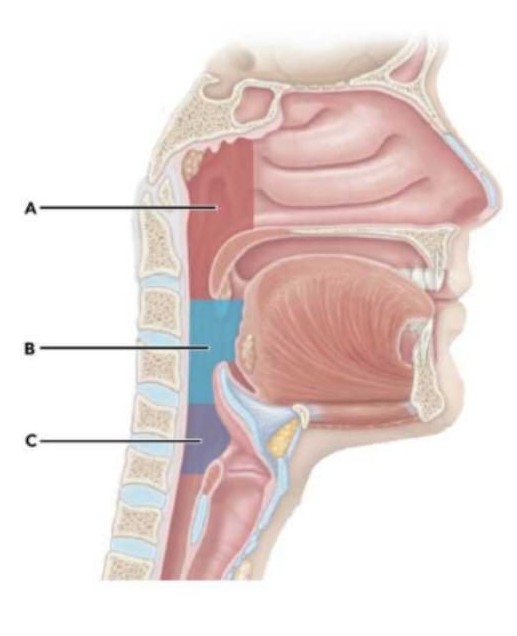
Which section of the pharynx contains the epiglottis?
A
B
C
The Correct Answer is C
A: Nasopharynx: The nasopharynx, labelled as A, is the upper portion of the pharynx, located behind the nasal cavity. It serves primarily as an airway and contains the pharyngeal tonsils (adenoids), but it does not house the epiglottis.
B: Oropharynx: The oropharynx, B in the diagram, lies posterior to the oral cavity and serves as a passageway for both air and food. While it contains the palatine and lingual tonsils, the epiglottis is not located here.
C: Laryngopharynx- The laryngopharynx is the lower part of the pharynx, labelled as C, that lies posterior to the larynx and extends from the hyoid bone to the esophagus. It contains the epiglottis, which functions to cover the glottis during swallowing and prevent food or liquid from entering the trachea.
Nursing Test Bank
Naxlex Comprehensive Predictor Exams
Related Questions
Correct Answer is A
Explanation
A. The movement of air into and out of the lungs: Pulmonary ventilation refers to the mechanical process of inhalation and exhalation, moving air between the atmosphere and the alveoli. This process ensures that fresh oxygen reaches the lungs for gas exchange and that carbon dioxide is expelled from the body, forming the foundation of effective respiration.
B. The contraction of diaphragm muscles only: While diaphragm contraction is a key component of inspiration, pulmonary ventilation encompasses the entire process of airflow, including both inhalation and exhalation, and involves additional muscles such as intercostals, not just the diaphragm.
C. The oxygen content in arterial blood: Oxygen content in arterial blood reflects oxygen transport and gas exchange efficiency but is not the same as pulmonary ventilation. Ventilation is the mechanical movement of air, whereas oxygen content is a measure of delivery to the blood.
D. The exchange of gases in the alveoli: Gas exchange occurs in the alveoli and is termed external respiration. Pulmonary ventilation is distinct, as it describes the movement of air to and from the alveoli, providing the necessary medium for that gas exchange to occur.
Correct Answer is C
Explanation
A. Hemoglobin directly absorbs oxygen from alveolar fluid: Hemoglobin does not extract oxygen directly from alveolar fluid. Instead, oxygen diffuses across the respiratory membrane into the plasma first, then binds to hemoglobin within erythrocytes. The process relies on partial pressure gradients rather than direct absorption.
B. Erythrocytes produce oxygen in response to carbon dioxide: Red blood cells do not synthesize oxygen. Their role is to carry oxygen bound to hemoglobin, and they respond to CO₂ levels primarily by facilitating gas exchange and buffering pH, not generating oxygen.
C. There is a significant difference in oxygen pressure between alveoli and blood: Oxygen moves into the bloodstream due to the partial pressure gradient between alveolar air (high PaO₂) and deoxygenated blood in pulmonary capillaries (lower PaO₂). This diffusion follows Fick’s law, allowing efficient oxygen transfer across the thin respiratory membrane.
D. The respiratory membrane creates a vacuum effect: No vacuum is created by the respiratory membrane. Gas exchange occurs via passive diffusion driven by pressure gradients, not suction. The thin structure of the alveolar-capillary barrier facilitates rapid oxygen movement without creating negative pressure.
Whether you are a student looking to ace your exams or a practicing nurse seeking to enhance your expertise , our nursing education contents will empower you with the confidence and competence to make a difference in the lives of patients and become a respected leader in the healthcare field.
Visit Naxlex, invest in your future and unlock endless possibilities with our unparalleled nursing education contents today