
Hyperbilirubinemia
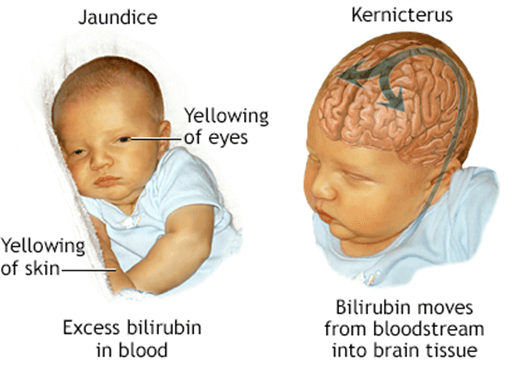
- Definition: Elevated serum bilirubin level that causes jaundice (yellowish skin color)
- Causes: Physiologic jaundice due to breakdown of fetal red blood cells and immaturity of liver enzymes that occurs after 24 hours of age; pathologic jaundice due to blood incompatibility between mother and baby or infection that occurs within 24 hours of age or lasts longer than 7 days; kernicterus due to untreated hyperbilirubinemia that causes brain damage
- Signs and symptoms: Yellowish skin color that progresses from head to toe; yellowish sclerae (whites of eyes); lethargy; poor feeding; dark urine; pale stools; high-pitched cry; seizures
- Assessment: Perform transcutaneous bilirubin measurement using a device that measures skin reflectance at multiple wavelengths; confirm with laboratory serum bilirubin test if abnormal; monitor vital signs and neurological status; observe for signs of jaundice; note the time that jaundice set in to determine whether physiologic or pathologic
- Nursing interventions
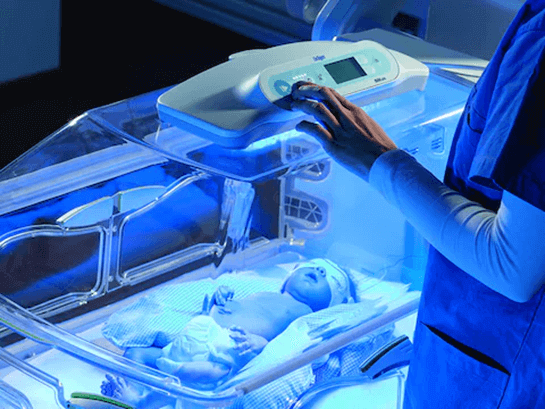
- Provide phototherapy as ordered if newborn’s bilirubin level is above 15 mg/dL before 48 hours of age or above 18 mg/dL before 72 hours of age or above 20 mg/dL at any point; place eye mask on baby, keep newborn undressed, cover genitalia; avoid applying lotions; remove newborn from phototherapy every 4 hours, remove eye mask; reposition newborn every 2 hours; bronze discoloration or rash is not a serious complication; monitor for dehydration by checking sunken fontanels and number of diapers produced per day; feed newborn frequently to promote bilirubin excretion through stool; administer IV fluids or blood transfusion if needed; educate parents on signs of hyperbilirubinemia and how to care for the baby
Nursing Test Bank
Test Bank #1: RN Pharmacology Exams
Test Bank #2: RN Medical-Surgical Exams
Test Bank #3: RN Fundamentals Exams
Test Bank #4: RN Maternal-Newborn Exams
Test Bank #5: RN Anatomy and Physiology Exams
Test Bank #6: RN Obstetrics and Pediatrics Exams
Test Bank #7: RN Fluid and Electrolytes Exams
Test Bank #9: RN Adult Health
Test Bank #10: RN Dosage Calculation
Test Bank #11: RN Community Health Exams
Test Bank #12: RN Psychology Exams
Test Bank #13: RN Nursing Care Of Children
Test Bank #14: RN Foundations of Nursing Exams
Naxlex Comprehensive Predictor Exams
Exam #1: RN Comprehensive predictor 2023 proctored exam
Exam #2: Ati rn vati comprehensive predictor proctored exam
Exam #3: Ati Rn Comprehensive Predictor Proctored Exam 2023
Exam #4: Rn Comprehensive Predictor 2023 Proctored Exam - St. Joseph
Exam #5: RN Comprehensive Predictor Proctored Exam (National U CA San Diego)
Exam #6: Ati rn comprehensive predictor 2023 retake proctored exam
Exam #7: RN Hesi Exit Proctored Exam
Exam #8: Hesi RN Exit proctored exam
Exam #9: Hesi rn exit proctored exam
Exam #10: Hesi Rn compass exit B proctored exam
Questions on Hyperbilirubinemia
Correct Answer is C
Explanation
It includes choices A and B, which are incorrect.
Correct Answer is C
Explanation
Observing the newborn’s urine and stool color is not a reliable way to detect jaundice.
The color of urine and stool may vary depending on the hydration status, feeding type and other factors of the newborn. Moreover, urine and stool color may not change until the bilirubin level is very high.