
Gastrointestinal Changes in pregnancy
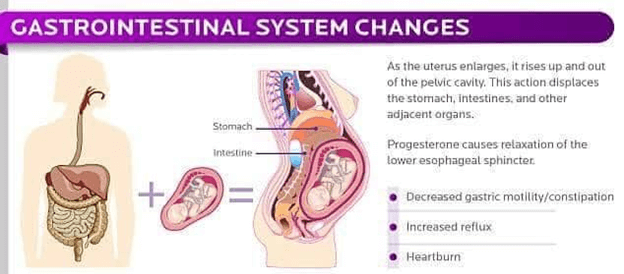
- The gastrointestinal system undergoes significant changes to meet the increased nutritional needs of pregnancy and to accommodate the growing uterus.
- The main gastrointestinal changes include:
- Decreased gastric motility: The movement of food through the stomach and intestines slows down during pregnancy. This is due to increased progesterone levels that relax the smooth muscle of the gastrointestinal tract and decrease the tone of the lower esophageal sphincter (the valve that prevents reflux of stomach contents into the esophagus). The gastric motility decreases progressively throughout pregnancy and reaches its lowest point at term.
- Decreased gastric acid secretion: The amount of acid produced by the stomach decreases during pregnancy. This is due to increased progesterone levels that inhibit the secretion of gastrin (the hormone that stimulates acid production) and increase the secretion of bicarbonate (the substance that neutralizes acid). The gastric acid secretion decreases progressively throughout pregnancy and reaches its lowest point at term.
- Increased nausea and vomiting: The sensation of nausea and the act of vomiting increase during pregnancy. This is due to increased human chorionic gonadotropin (hCG) levels that stimulate the vomiting center in the brain and increase the sensitivity to smells, tastes, or sights. The nausea and vomiting peak at 8 to 12 weeks of gestation and then subside by 16 to 20 weeks of gestation. The normal range of nausea and vomiting in pregnancy is less than five episodes per day or less than 5% weight loss.
- Increased appetite and food cravings: The desire to eat and the preference for certain foods increase during pregnancy. This is due to increased metabolic rate, increased nutritional needs, and hormonal fluctuations that affect the taste buds and olfactory receptors. The appetite and food cravings vary throughout pregnancy and may differ among individuals. The normal range of appetite and food cravings in pregnancy is based on the individual’s pre-pregnancy weight, height, and activity level.
- Increased constipation and hemorrhoids: The difficulty in passing stool and the swelling of the veins in the anus increase during pregnancy. This is due to decreased gastric motility, increased progesterone levels, increased pressure of the gravid uterus on the rectum, and increased iron intake. The constipation and hemorrhoids peak at late pregnancy and then improve by the postpartum period. The normal range of constipation and hemorrhoids in pregnancy is less than three bowel movements per week or less than 2+ on grading scale.
- Increased gallbladder dysfunction: The function of the gallbladder (the organ that stores and releases bile) decreases during pregnancy. This is due to increased progesterone levels that decrease the contractility of the gallbladder and increase the cholesterol content of the bile. The gallbladder dysfunction peaks at late pregnancy and then resolves by the postpartum period. The normal range of gallbladder dysfunction in pregnancy is asymptomatic or mild symptoms such as bloating, indigestion, or right upper quadrant pain.
- The gastrointestinal changes result in increased nutrient absorption (the process by which nutrients are taken up from the food into the blood) and decreased gastric emptying (the time it takes for food to leave the stomach) that meet the increased nutritional needs of pregnancy and accommodate the growing uterus
- The gastrointestinal changes may cause symptoms such as heartburn, flatulence, belching, or diarrhea that are normal or abnormal depending on the severity, duration, and frequency
Nursing Test Bank
Test Bank #1: RN Pharmacology Exams
Test Bank #2: RN Medical-Surgical Exams
Test Bank #3: RN Fundamentals Exams
Test Bank #4: RN Maternal-Newborn Exams
Test Bank #5: RN Anatomy and Physiology Exams
Test Bank #6: RN Obstetrics and Pediatrics Exams
Test Bank #7: RN Fluid and Electrolytes Exams
Test Bank #9: RN Adult Health
Test Bank #10: RN Dosage Calculation
Test Bank #11: RN Community Health Exams
Test Bank #12: RN Psychology Exams
Test Bank #13: RN Nursing Care Of Children
Test Bank #14: RN Foundations of Nursing Exams
Naxlex Comprehensive Predictor Exams
Exam #1: RN Comprehensive predictor 2023 proctored exam
Exam #2: Ati rn vati comprehensive predictor proctored exam
Exam #3: Ati Rn Comprehensive Predictor Proctored Exam 2023
Exam #4: Rn Comprehensive Predictor 2023 Proctored Exam - St. Joseph
Exam #5: RN Comprehensive Predictor Proctored Exam (National U CA San Diego)
Exam #6: Ati rn comprehensive predictor 2023 retake proctored exam
Exam #7: RN Hesi Exit Proctored Exam
Exam #8: Hesi RN Exit proctored exam
Exam #9: Hesi rn exit proctored exam
Exam #10: Hesi Rn compass exit B proctored exam
Questions on Gastrointestinal Changes in pregnancy
Correct Answer is A
Explanation
Avoiding physical activity can lead to constipation. Being active helps stool move through the intestines.
Getting regular exercise, with a doctor’s approval, can help relieve constipation. If exercising is not possible, try to fit in a gentle walk each day.
Correct Answer is B
Explanation
Hyponatremia is not a common complication of HG. Hyponatremia may occur in severe cases of dehydration or if excessive intravenous fluids are given without adequate sodium replacement.
Correct Answer is A
Explanation
Decreased bile production is not a factor in nausea and vomiting in pregnancy, but rather a possible cause of gallstones, which are more common in pregnant women due to hormonal changes and increased cholesterol levels.