
Ultrasound
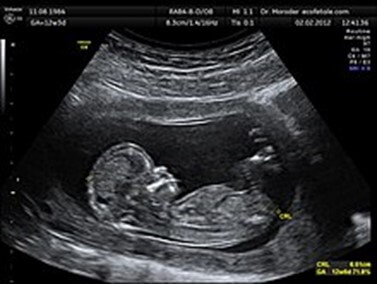
- Ultrasound is a prenatal screening test that uses high-frequency sound waves to create images of the fetus and its surroundings.
- Ultrasound can assess fetal growth, development, anatomy, position, movement, heart rate, and placental location
- Ultrasound can also estimate gestational age, due date, fetal weight, and amniotic fluid volume
- Ultrasound can detect fetal anomalies such as neural tube defects, cardiac defects, cleft lip/palate, skeletal dysplasia, .
- Ultrasound can also detect multiple gestations, placenta previa, placental abruption, ectopic pregnancy, .
- Ultrasound can be performed at any time during pregnancy but is usually done at specific intervals depending on the purpose and indication
- Ultrasound can be done by two methods: transabdominal or transvaginal
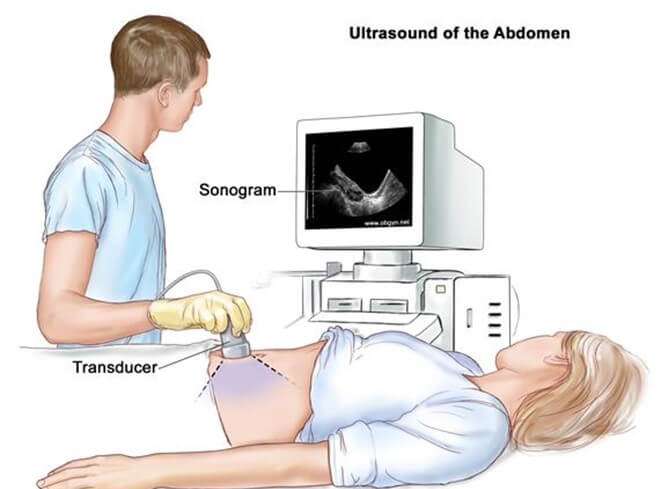
- Transabdominal ultrasound involves placing a transducer coated with gel on the pregnant person’s abdomen and moving it to obtain images of the fetus and its surroundings
- Transvaginal ultrasound involves inserting a transducer covered with a condom and gel into the pregnant person’s vagina and obtaining images of the fetus and its surroundings
- Ultrasound has no known risks or complications for the pregnant person or the fetus
-
- The patient should have a full bladder for a transabdominal US and an empty bladder for a transvaginal US.
- The patient should wear loose-fitting clothing and lie supine on an examination table.
- A gel is applied to the abdomen or the vaginal probe to facilitate sound transmission.
- The sonographer moves the transducer over the abdomen or inserts it into the vagina to obtain images of the fetus and the placenta.
- The images are displayed on a monitor and recorded for interpretation by a radiologist or an obstetrician.
- The procedure usually takes 15 to 30 minutes, depending on the type and purpose of the US.
- Dating Ultrasound: Typically performed between 8 and 12 weeks of gestation. It is used to estimate the due date, confirm the number of fetuses, and assess early pregnancy development.
- Nuchal Translucency (NT) Ultrasound: Conducted between 11 and 14 weeks of gestation. It measures the thickness of the fluid-filled space at the back of the baby's neck to screen for chromosomal abnormalities, such as Down syndrome.
- Anatomy Ultrasound (Anomaly scan): Usually performed between 18 and 22 weeks of gestation. It provides a detailed examination of the baby's organs, limbs, and overall anatomy, helping to detect any structural abnormalities.
- Growth Ultrasound: This ultrasound may be performed at various intervals throughout the pregnancy, depending on individual circumstances. It assesses the baby's growth, including measurements of the head, abdomen, and femur length, and compares them to standardized growth charts.
- Doppler Ultrasound: It can be performed at different gestational ages as needed. Doppler ultrasound measures blood flow in the umbilical cord, placenta, and fetal vessels to evaluate the baby's circulation and oxygenation.
- Third-Trimester Biophysical Profile (BPP): Typically conducted during the third trimester, usually after 28 weeks of gestation. The BPP combines ultrasound with a non-stress test to evaluate the baby's well-being by assessing various parameters, such as fetal movement, breathing, muscle tone, amniotic fluid volume, and heart rate patterns.
Preparation and Procedure of Prenatal Ultrasound
Different types of Prenatal Ultrasounds
Nursing Test Bank
Test Bank #1: RN Pharmacology Exams
Test Bank #2: RN Medical-Surgical Exams
Test Bank #3: RN Fundamentals Exams
Test Bank #4: RN Maternal-Newborn Exams
Test Bank #5: RN Anatomy and Physiology Exams
Test Bank #6: RN Obstetrics and Pediatrics Exams
Test Bank #7: RN Fluid and Electrolytes Exams
Test Bank #9: RN Adult Health
Test Bank #10: RN Dosage Calculation
Test Bank #11: RN Community Health Exams
Test Bank #12: RN Psychology Exams
Test Bank #13: RN Nursing Care Of Children
Test Bank #14: RN Foundations of Nursing Exams
Naxlex Comprehensive Predictor Exams
Exam #1: RN Comprehensive predictor 2023 proctored exam
Exam #2: Ati rn vati comprehensive predictor proctored exam
Exam #3: Ati Rn Comprehensive Predictor Proctored Exam 2023
Exam #4: Rn Comprehensive Predictor 2023 Proctored Exam - St. Joseph
Exam #5: RN Comprehensive Predictor Proctored Exam (National U CA San Diego)
Exam #6: Ati rn comprehensive predictor 2023 retake proctored exam
Exam #7: RN Hesi Exit Proctored Exam
Exam #8: Hesi RN Exit proctored exam
Exam #9: Hesi rn exit proctored exam
Exam #10: Hesi Rn compass exit B proctored exam
Questions on Ultrasound
Correct Answer is D
Explanation
The transducer covered with a condom and gel will be inserted into your vagina. This is because a transvaginal ultrasound is an internal scan of the female reproductive organs that involves inserting a small ultrasound probe into the vagina to produce images of the cervix, uterus, fallopian tubes and ovaries.
Correct Answer is A
Explanation
The ultrasound can estimate gestational age, due date, fetal weight, and amniotic fluid volume, but these are not the only or most important aspects of the ultrasound. They are also not very accurate measurements and may vary depending on the type and timing of the ultrasound
Correct Answer is D
Explanation
Between 8 and 12 weeks of gestation. A dating ultrasound is an ultrasound scan done between 8 and 14 weeks of pregnancy to help estimate your baby’s due date. It is the most accurate method to establish or confirm gestational age in the first trimester. It is based on the size of the embryo or fetus, which is measured from the top of the head (crown) to the bottom of the spine (rump) (CRL).