
naxlex image logo

Naxlex

  • Nursing School Content
  • TEAS Content
  • HESI Content
  • Register
  • Sign Up
How it Works
Naxlex
  • Mental Health
  • Eating and Obsessive-Compulsive Disorders
  • Obsessive-compulsive disorders
Try Naxlex NCLEX-RN (14-day Free-Trial)

Obsessive-compulsive disorders
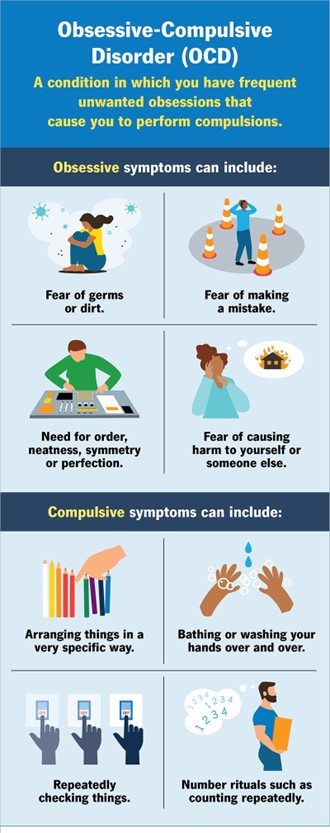
- Obsessive-compulsive disorders (OCDs) are a group of mental disorders characterized by recurrent and persistent thoughts, urges, or images (obsessions) that cause anxiety or distress, and repetitive behaviors or mental acts (compulsions) that are performed to reduce or neutralize the anxiety or distress.

- OCDs include obsessive-compulsive disorder (OCD), hoarding disorder, body dysmorphic disorder, trichotillomania (hair-pulling disorder), and excoriation (skin-picking) disorder

- OCD can cause significant impairment in social, occupational, or other important areas of functioning.

- OCDs are often comorbid with other mental disorders, such as anxiety disorders, mood disorders, eating disorders, tic disorders, personality disorders, and substance use disorders

Nursing Test Bank

Test Bank #1: RN Pharmacology Exams Test Bank #2: RN Medical-Surgical Exams Test Bank #3: RN Fundamentals Exams Test Bank #4: RN Maternal-Newborn Exams Test Bank #5: RN Anatomy and Physiology Exams Test Bank #6: RN Obstetrics and Pediatrics Exams Test Bank #7: RN Fluid and Electrolytes Exams Test Bank #9: RN Adult Health Test Bank #10: RN Dosage Calculation Test Bank #11: RN Community Health Exams Test Bank #12: RN Psychology Exams Test Bank #13: RN Nursing Care Of Children Test Bank #14: RN Foundations of Nursing Exams

Naxlex Comprehensive Predictor Exams

Exam #1: RN Comprehensive predictor 2023 proctored exam Exam #2: Ati rn vati comprehensive predictor proctored exam Exam #3: Ati Rn Comprehensive Predictor Proctored Exam 2023 Exam #4: Rn Comprehensive Predictor 2023 Proctored Exam - St. Joseph Exam #5: RN Comprehensive Predictor Proctored Exam (National U CA San Diego) Exam #6: Ati rn comprehensive predictor 2023 retake proctored exam Exam #7: RN Hesi Exit Proctored Exam Exam #8: Hesi RN Exit proctored exam Exam #9: Hesi rn exit proctored exam Exam #10: Hesi Rn compass exit B proctored exam

Questions on Obsessive-compulsive disorders

Correct Answer is C

Explanation

<p>Avoiding mirrors might be counterproductive. For some individuals with trichotillomania, avoiding mirrors might increase anxiety and preoccupation, as they may feel disconnected from their appearance. It&#39;s important to address the underlying behavior rather than avoiding triggers.</p>

Correct Answer is B

Explanation

"SSRIs are reserved for individuals who have ego-syntonic obsessions and compulsions." This statement is incorrect. Ego-syntonic obsessions and compulsions are those that are consistent with a person's self-image and beliefs, and individuals may not feel a strong need to resist or change them. SSRIs are used to treat both ego-dystonic (inconsistent with self-image) and ego-syntonic obsessions and compulsions in OCD, as these medications target the underlying neurochemical imbalances that contribute to the disorder's symptoms.

Correct Answer is C

Explanation

Organizing possessions meticulously to maintain a clutter-free environment is not consistent with hoarding disorder. People with hoarding disorder struggle with organization and often have difficulty maintaining clutter-free spaces due to the accumulation of possessions.

Correct Answer is ["A","B","E"]

Explanation

<p>Acknowledging the client&#39;s efforts in therapy fosters a positive therapeutic relationship and boosts their self-esteem. Recognizing progress and hard work encourages continued engagement in treatment.</p>

Correct Answer is C

Explanation

Praise the client for decreasing the frequency of handwashing. While positive reinforcement can be useful, it may not be the priority intervention for someone with OCD. The focus should be on structured interventions that challenge and reduce the compulsive behaviors over time.

Correct Answer is B

Explanation

Taking a warm bath before bed can promote relaxation and potentially aid in sleep, but it might not be as effective in resolving the client's specific sleep problems related to SSRI use.

Correct Answer is B

Explanation

Focusing only on situations that are easy to tolerate would not be effective in exposure therapy. The essence of exposure therapy is to confront situations that provoke anxiety gradually, starting with less anxiety-provoking situations and progressing to more challenging ones. This process helps the individual build resilience against anxiety triggers.

Correct Answer is D

Explanation

The type and severity of OCD, along with the client's preferences and tolerance, are key factors that influence the choice of medication for treating OCD. OCD symptoms can vary widely between individuals, and different medications may be more effective for specific symptom profiles. Additionally, the severity of symptoms and potential side effects of medications should be carefully considered. Client preferences and tolerances play a crucial role in treatment adherence and success. Collaborative decision-making between the client and healthcare provider ensures that the chosen medication aligns with the individual's needs and goals.

Correct Answer is A

Explanation

<p>Brain tumor is an organic condition that can cause neurological and psychological symptoms. However, brain tumors are not a common or primary cause of OCD. The focus in the etiology of OCD is on neurotransmitter imbalances, genetic factors, and brain circuitry, rather than structural brain abnormalities like tumors.</p>

Correct Answer is ["B","D"]

Explanation

<p>This choice indicates a symptom of BDD. Avoiding social situations due to the fear of being negatively evaluated or judged based on one&#39;s perceived flaws is a classic sign of BDD. Individuals with BDD often believe that others are fixated on their perceived defects.</p>

Correct Answer is C

Explanation

"In exposure and response prevention, we eliminate all exposure to the situations that cause distress and anxiety." This statement is incorrect. ERP involves controlled exposure to distressing situations or triggers, not complete avoidance. The goal is to help individuals build tolerance to the anxiety triggered by these situations while resisting the urge to perform compulsions.

Correct Answer is ["B","C","E"]

Explanation

Coordinating medication adjustments is a collaborative action as medications are often managed by healthcare professionals such as doctors or nurse practitioners. Adjustments should be made collectively to ensure the best outcome for the patient.

Correct Answer is D

Explanation

This choice is the correct answer. Individuals with OCD recognize that their obsessions and compulsions are irrational and excessive, but they struggle to control them. This recognition is a hallmark of OCD and helps differentiate it from other conditions where the person might not be aware of the irrationality of their behavior.

Correct Answer is D

Explanation

The correct answer. In OCD, individuals are aware that their obsessions and compulsions are irrational and excessive. This self-awareness differentiates OCD from other disorders where the beliefs and behaviors might be seen as reasonable by the individual.

Correct Answer is ["A","C","E"]

Explanation

<p>Cognitive therapy within CBT aims to challenge and modify cognitive distortions and unrealistic beliefs that underlie OCD. Individuals with OCD often have distorted thought patterns, such as catastrophic thinking or black-and-white reasoning. Cognitive therapy helps individuals recognize and reframe these distorted thoughts, leading to more adaptive and realistic thinking patterns.</p>

Correct Answer is A

Explanation

This option is incorrect. The symptoms of OCD should not be better explained by the symptoms of another mental disorder. While comorbidities can exist, OCD has its own unique set of obsessions and compulsions that differentiate it from other mental disorders.

Correct Answer is B

Explanation

Offering to "help you wash your hands" reinforces the client's compulsion rather than addressing the root cause of their anxiety. Enabling their compulsive behavior can contribute to the maintenance of their OCD symptoms.

Correct Answer is ["B","C","D"]

Explanation

The strong desire to organize items by color, shape, and size is more indicative of perfectionism or certain personality traits rather than a typical theme in OCD. OCD usually involves distressing and unwanted thoughts (obsessions) and the corresponding rituals or repetitive behaviors (compulsions) aimed at reducing the distress.

<p>Obsessions and compulsions cause impairment in daily functioning. This statement accurately describes another characteristic of OCD. The obsessions and compulsions associated with OCD can be time-consuming and interfere significantly with a person&#39;s daily activities, relationships, and overal

The statement "I keep having thoughts that my family will get hurt if I don't touch the doorknob three times" reflects an obsession. The distressing thought of family harm is the unwanted obsession, and the ritual of touching the doorknob three times is the compulsion aimed at reducing the anxiety c

Thought stopping involves interrupting obsessive thoughts by using cues or distractions. This technique is not as effective in treating OCD as exposure and response prevention, which directly addresses the connection between obsessions and compulsions. Thought stopping may not provide the individual

Participating in team meetings. This is a correct answer. Participating in team meetings is vital for effective collaboration in the care of clients with eating disorders. These meetings provide an opportunity to discuss the client's progress, adjust treatment plans, and share insights from differen

No explanation

Respiratory function optimization is unrelated to the outcomes of patients with OCD. This outcome is more relevant to conditions affecting the respiratory system, such as asthma or chronic obstructive pulmonary disease (COPD), and not to OCD.

Providing relaxation techniques can be helpful for managing anxiety, but for someone with OCD who is avoiding situations due to contamination fears, the primary intervention should focus on exposure therapy to address the specific OCD-related fears.

Initiating exposure therapy sessions might exacerbate the client's distress at this point. Exposure therapy involves deliberately confronting feared situations, and it's important to prepare the client for this type of intervention before initiating it. Starting with relaxation techniques is a more

The statement "I'll stop taking my medication if I experience any discomfort" indicates a need for further education. Discomfort is a broad term that could encompass various mild side effects or adjustments that might be necessary when starting a new medication. It's important not to discontinue med

Obsessive-compulsive disorder. This choice describes the client's condition rather than a nursing diagnosis. Nursing diagnoses are used to identify specific client problems that nurses can address through care and interventions.

The statement that medication will eliminate the need for any psychotherapeutic interventions is overly optimistic. A comprehensive treatment approach for OCD often includes a combination of medication and psychotherapy for optimal results.

The ventral tegmental circuit involving the substantia nigra and ventral tegmental area is primarily associated with the brain's reward system and the regulation of mood and motivation. It is not a key player in OCD's pathophysiology.

The statement "I'm not sure if I'm really sick or if I'm just imagining it" suggests uncertainty and doubt, which are common features of OCD. However, this choice does not emphasize the typical compulsions that accompany OCD. It focuses more on self-doubt rather than specific ritualistic behaviors.

Educating about nutrition is not a priority intervention for OCD patients. While maintaining overall health is important, nutritional education is not a central component of managing obsessive-compulsive disorder.

<p>Dopamine agonists are not commonly used for OCD treatment. In fact, they can potentially exacerbate symptoms, as imbalances in dopamine transmission are implicated in the pathophysiology of OCD. Using dopamine agonists without a clear rationale could worsen the condition.</p>

Cognitive-behavioral therapy (CBT) is actually recommended as one of the most effective treatments for OCD. CBT, including exposure and response prevention, helps individuals learn to manage their symptoms by changing maladaptive thought patterns and behaviors associated with OCD. Therefore, stating

This is the correct choice. Collaboratively developing strategies to gradually reduce compulsive behaviors is a standard approach in treating OCD. This method is aligned with exposure and response prevention therapy, a well-established treatment for OCD. By gradually facing the situations that trigg

Dismissing the client's worries by saying there's no need to worry about the thoughts undermines their feelings and doesn't address the distress caused by the thoughts.
Try Naxlex NCLEX-RN
(14 Day Free-Trial)

Search Here

More on Nursing

  • Abuse, Violence, Trauma, and Stressor Related Disorders
  • Disorders of Anxiety
  • Mood Disorders and Suicide
  • Somatic Symptom Illnesses and Sleep/Wakefulness Disorders

Free Nursing Study Materials

Access to all study guides and practice questions for nursing for free.

  • Free Nursing Study Trials
  • Free Nursing Video tutorials
  • Free Nursing Practice Tests
  • Free Exam and Study Modes
  • Free Nursing Revision Quizlets
Join Us Today
naxlex-logo-footer

Designed to assess a student's preparedness for entering the health science fields.

Email Address: [email protected]

Company

  • Contact us
  • How it Works
  • Blog

Resources

  • Privacy Policy
  • Terms of use
  • Help Center

© 2026 Naxlex.com