
Personal Protective Equipment (PPE)
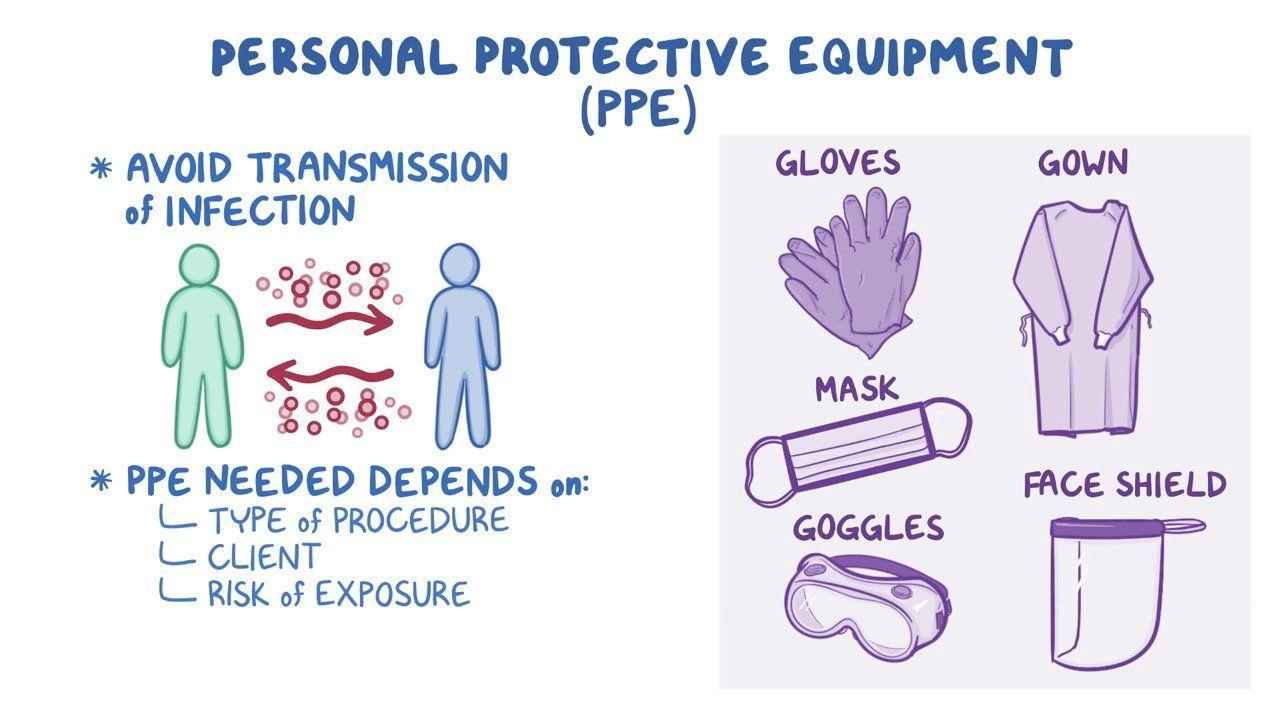
PPE should be used based on the anticipated exposure to blood, bodily fluids, secretions, or excretions.
Gloves should be worn when touching blood, body fluids, or contaminated surfaces, and they should be changed between patient contacts.
Gowns should be worn during procedures and patient care activities that may generate splashes or sprays of blood, body fluids, secretions, or excretions.
Masks and eye protection should be used when there is a risk of droplet or airborne transmission.
Nursing Test Bank
Test Bank #1: RN Pharmacology Exams
Test Bank #2: RN Medical-Surgical Exams
Test Bank #3: RN Fundamentals Exams
Test Bank #4: RN Maternal-Newborn Exams
Test Bank #5: RN Anatomy and Physiology Exams
Test Bank #6: RN Obstetrics and Pediatrics Exams
Test Bank #7: RN Fluid and Electrolytes Exams
Test Bank #9: RN Adult Health
Test Bank #10: RN Dosage Calculation
Test Bank #11: RN Community Health Exams
Test Bank #12: RN Psychology Exams
Test Bank #13: RN Nursing Care Of Children
Test Bank #14: RN Foundations of Nursing Exams
Naxlex Comprehensive Predictor Exams
Exam #1: RN Comprehensive predictor 2023 proctored exam
Exam #2: Ati rn vati comprehensive predictor proctored exam
Exam #3: Ati Rn Comprehensive Predictor Proctored Exam 2023
Exam #4: Rn Comprehensive Predictor 2023 Proctored Exam - St. Joseph
Exam #5: RN Comprehensive Predictor Proctored Exam (National U CA San Diego)
Exam #6: Ati rn comprehensive predictor 2023 retake proctored exam
Exam #7: RN Hesi Exit Proctored Exam
Exam #8: Hesi RN Exit proctored exam
Exam #9: Hesi rn exit proctored exam
Exam #10: Hesi Rn compass exit B proctored exam
Questions on Personal Protective Equipment (PPE)
Correct Answer is D
Explanation
<p><strong>D) Wearing goggles only when there is a risk of splashing:</strong></p>
<p><strong>Goggles or face shields should be used when there is a risk of splashing or spraying of blood, body fluids, secretions, or excretions. This is appropriate use of PPE to protect the eyes and mucous membranes from exposure to potentially infectious materials.</strong></p>
Correct Answer is C
Explanation
<p>N95 respirators are only necessary when caring for patients with airborne infections.</p>
Correct Answer is A
Explanation
<p><strong>D) The mask should be removed before the goggles or face shield: This is incorrect. The mask should be the last item removed to prevent inhalation of any contaminants. Goggles or face shields are removed before the mask to maintain protection until the final step.</strong></p>