
A 39 week and 2 day client is currently in the second stage of labor. The nurse is explaining to the client and support partner what is seen on the external fetal monitor.
What deceleration pattern is a normal finding in the second stage of labor.
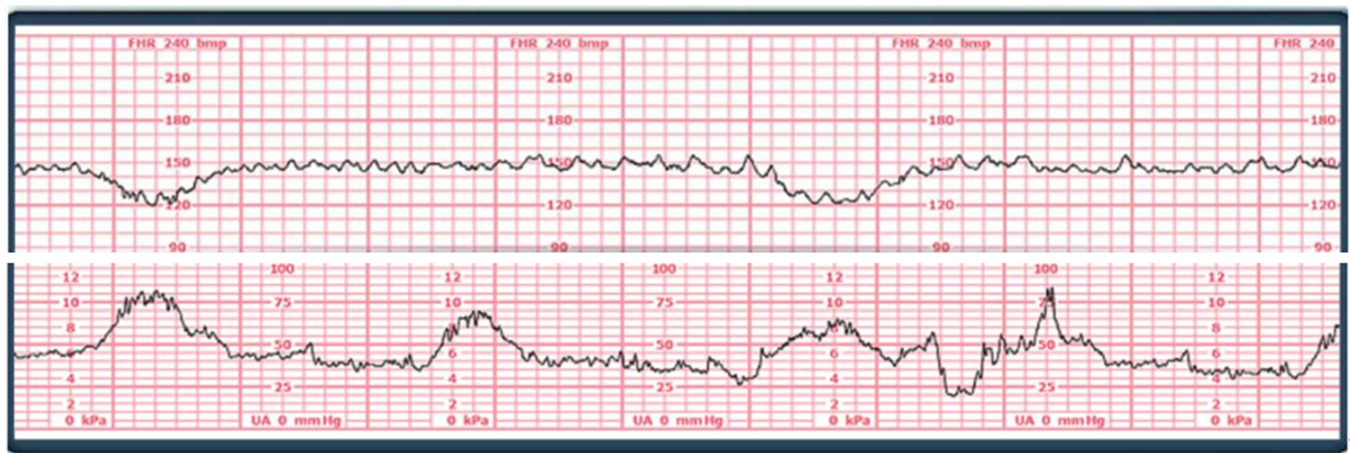
Early deceleration indicative of fetal increased intracranial pressure.
Present decelerations indicative of passage through the cervix.
Absent deceleration indicative of good fetal movement.
Variable deceleration indicative of umbilical cord compression.
The Correct Answer is D
Choice A rationale
Early decelerations are not indicative of increased fetal intracranial pressure. They are characterized by a gradual decrease in fetal heart rate (FHR) that mirrors the contraction, with the nadir of the deceleration occurring at the peak of the contraction. This pattern is considered benign and is caused by fetal head compression during a uterine contraction, which stimulates the vagus nerve and results in a transient, brief decrease in FHR.
Choice B rationale
The term "present decelerations" is not a recognized classification for fetal heart rate patterns. Fetal heart rate (FHR) decelerations are categorized as early, late, or variable, each corresponding to a different underlying physiological cause. Passage through the cervix is a mechanical process; while it causes head compression, the resulting FHR change is the early deceleration pattern.
Choice C rationale
The term "absent deceleration" is not a specific fetal heart rate pattern. A baseline fetal heart rate that remains within the normal range of 110 to 160 beats per minute (bpm) with no periodic changes (decelerations or accelerations) is a normal finding. Fetal movement is primarily assessed by accelerations in the FHR, which are increases of at least 15 bpm lasting 15 seconds or more.
Choice D rationale
Variable decelerations are characterized by an abrupt decrease in FHR, often V or W-shaped, varying in duration and depth, and not consistently related to uterine contractions. They are the most common pattern in the second stage and indicate a transient occlusion of the umbilical cord, leading to a temporary decrease in umbilical blood flow and thus fetal oxygenation.
Nursing Test Bank
Naxlex Comprehensive Predictor Exams
Related Questions
Correct Answer is B
Explanation
Choice A rationale
The Anthropoid pelvis is characterized by an oval inlet with a greater anteroposterior diameter than the transverse diameter. While a variant of the female pelvis, it is less ideal for childbirth compared to the gynecoid type because its shape can sometimes lead to a persistent occiput posterior position, making the labor process potentially longer and more difficult.
Choice B rationale
The Gynecoid pelvis is considered the classic female pelvis and is the most common and most favorable for vaginal delivery. It possesses a rounded inlet, a wide and deep posterior segment, a wide pubic arch (usually >90°), and walls that are straight. This structure allows the fetal head to easily descend and rotate through the birth canal, making it ideal for childbirth.
Choice C rationale
The Android pelvis, typically considered the male pelvis type, has a characteristic heart-shaped or triangular inlet and a narrow pubic arch. Its structure is less favorable for labor as the contracted planes can impede the fetal head's descent and rotation, often leading to a need for operative delivery or a cesarean section due to pelvic disproportion.
Choice D rationale
The Platypelloid pelvis is characterized by a distinctive flat, oval shape with a narrow anteroposterior diameter and a widened transverse diameter. This shape is the least common and is considered the least favorable for vaginal birth because the severely restricted anteroposterior space often prevents the fetal head from entering the pelvis in the optimal transverse or oblique position, often requiring a cesarean section.
Correct Answer is A
Explanation
Choice A rationale
Oxytocin is a potent uterotonic agent, meaning it stimulates myometrial smooth muscle contraction. Administering oxytocin immediately after the placenta is delivered, or during the third stage of labor, prevents postpartum hemorrhage (PPH). PPH is often caused by uterine atony, where the uterus fails to contract effectively to compress the maternal spiral arteries and arrest blood loss. By promoting firm uterine contraction, oxytocin effectively clamps these vessels and minimizes profuse bleeding, which is the desired outcome.
Choice B rationale
Limiting labor pain is the function of analgesic or anesthetic agents like epidural or opioids, not oxytocin. Oxytocin's primary mechanism is inducing or augmenting uterine contractions via activation of G-protein-coupled receptors on myometrial cells, leading to increased intracellular calcium. Although contractions cause pain, oxytocin's therapeutic use in the third stage is purely for hemostasis and minimizing bleeding risk.
Choice C rationale
Oxytocin does play a role in the milk ejection reflex (let-down), causing contraction of myoepithelial cells surrounding the alveoli in the breast. However, this is a separate effect from its primary use during the third stage of labor. The immediate goal in the third stage is uterine contraction to prevent hemorrhage, not initiating lactation, which is a process beginning postpartum.
Choice D rationale
This statement is incorrect as oxytocin's function is to stimulate strong uterine contractions, not relaxation. Uterine relaxation (atony) is the problem that oxytocin is administered to correct or prevent, as relaxation allows for unchecked blood flow from the placental implantation site. The stimulated, firmly contracted uterus is essential for physiologic hemostasis following placental expulsion.
Whether you are a student looking to ace your exams or a practicing nurse seeking to enhance your expertise , our nursing education contents will empower you with the confidence and competence to make a difference in the lives of patients and become a respected leader in the healthcare field.
Visit Naxlex, invest in your future and unlock endless possibilities with our unparalleled nursing education contents today