
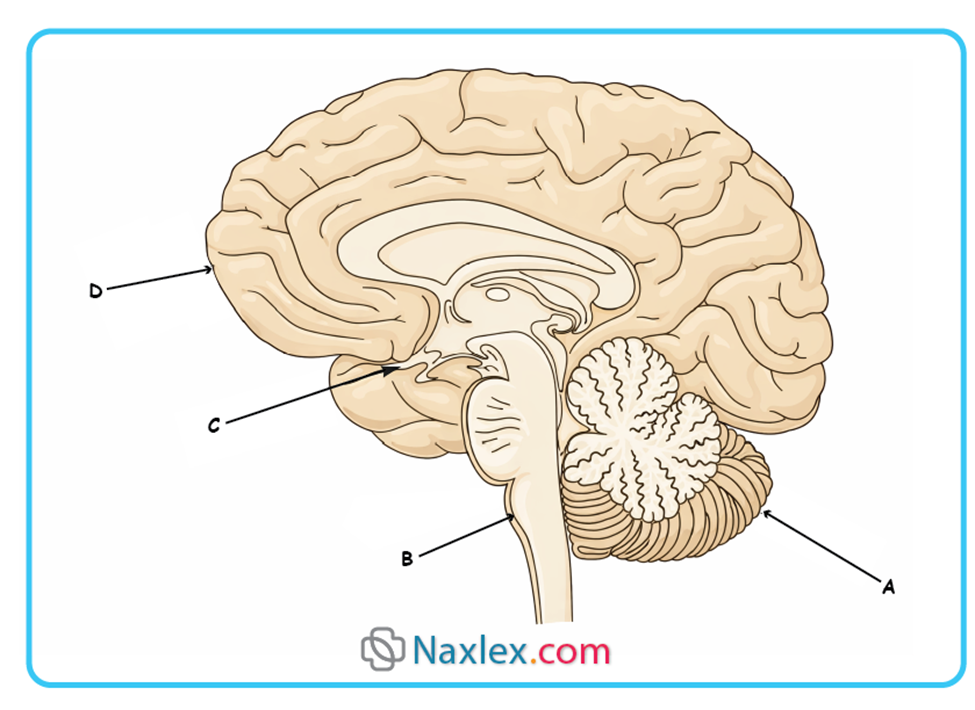
A client is admitted for a sleep disorder. The nurse knows that the reticular activating system (RAS) is involved in the sleep/ wake cycle. In the accompanying illustration, which letter indicates the location of the RAS?
A
B
C
D
The Correct Answer is B
The reticular activating system is a complex network of neurons located within the brainstem that essentializes the transition between sleep and wakefulness. It functions as a filter for sensory input, selectively allowing stimuli to reach the cerebral cortex to maintain a state of cortical alertness. Dysregulation of this system can lead to profound circadian disturbances or prolonged states of unconsciousness such as a coma. The system's primary neurotransmitters, including norepinephrine and acetylcholine, are critical for the maintenance of high-frequency electroencephalogram activity associated with alertness.
Rationale for correct answer
2. The letter B points to the brainstem, specifically the region housing the midbrain, pons, and medulla where the reticular formation resides. This area acts as the physiological “on/off switch” for consciousness by relaying activating signals upward to the diencephalon and cortex. It is the primary site for the reticular activating system involved in the sleep-wake cycle.
Rationale for incorrect answers
1. The letter A indicates the cerebellum, which is primarily responsible for the coordination of voluntary motor movement, balance, and posture. While it has some connections to the brainstem, it does not serve as the central regulator for the sleep-wake cycle or cortical arousal. Damage here typically results in ataxia rather than primary sleep disorders.
3. Letter C identifies the hypothalamus, specifically near the optic chiasm and pituitary region, which contains the suprachiasmatic nucleus. While the hypothalamus regulates the circadian rhythm via light-dark signals, the actual Reticular Activating System (RAS) is structurally located lower in the brainstem core. The hypothalamus acts more as a master clock than the primary arousal system.
4. Letter D points to the frontal lobe of the cerebral cortex, the area responsible for executive function, decision making, and voluntary motor control. The cortex is the recipient of arousal signals from the RAS but does not contain the RAS itself. Disorders of the frontal lobe affect personality and cognition rather than the fundamental biological mechanism of wakefulness.
Test-taking strategy
- Anatomical Localization: Identify the core structure associated with the RAS, which is the brainstem. In the provided diagram, only B points directly to the brainstem column.
- Functional Mapping: Differentiate between the “Master Clock” (Hypothalamus - C) and the “Arousal System” (Brainstem - B). The RAS is always associated with the reticular formation of the brainstem.
- Elimination of Major Structures: Rule out the cerebellum (A) and the cerebrum (D) as they are the endpoints or accessory structures rather than the origin of the reticular activating system.
- Visual Cues: Look for the central “trunk” of the brain. The brainstem (B) is the vertical pathway through which all ascending arousal signals must pass to reach the higher centers.
- Neuroanatomy Basics: Remember that the “reticular” (net-like) formation is a characteristic histological feature of the brainstem's central core.
Take home points
- The Reticular Activating System (RAS) is located in the brainstem and is responsible for regulating wakefulness and sleep-to-wake transitions.
- The suprachiasmatic nucleus of the hypothalamus works in tandem with the RAS by utilizing melatonin to signal the timing of sleep.
Nursing Test Bank
Naxlex Comprehensive Predictor Exams
Related Questions
Correct Answer is A
Explanation
Preschoolers aged 3 to 5 years typically require 10 to 13 hours of sleep per 24-hour period to support neurodevelopmental growth and emotional regulation. While many children in this age group begin to relinquish their afternoon naps, their total nocturnal sleep duration must increase to compensate for the loss of daytime rest. Inadequate sleep in pediatrics often manifests as hyperactivity, irritability, and diminished cognitive performance during waking hours.
Rationale for correct answer
1. The child is currently only receiving 8.5 hours of sleep, which is significantly below the recommended duration for a 4-year-old. Moving the bedtime to 8 or 9 pm aligns the child's schedule with physiological needs, ensuring they achieve at least 10 to 11 hours of rest. This intervention addresses the sleep deficit while respecting the child's natural transition away from napping.
Rationale for incorrect answers
2. While quiet rest is beneficial, insisting on a nap for a child who has outgrown the need can create caregiver-child conflict and may not solve the underlying sleep debt. The primary issue is the insufficient nocturnal duration, not the lack of a daytime nap. Increasing nighttime sleep is a more effective strategy for this developmental stage.
3. Recommending the child sleep later in the morning is often impractical due to family schedules or future school requirements. Consistency in wake times is a pillar of sleep hygiene and helps regulate the circadian rhythm. Adjusting the bedtime is generally more sustainable and developmentally appropriate than altering the morning routine.
4. Reassuring the parent that 8.5 hours is normal is factually incorrect and constitutes clinical misinformation. While the child might have outgrown the nap, the current total sleep volume is inadequate for a preschooler's metabolic and neurological demands. The nurse must intervene to prevent the long-term effects of chronic pediatric sleep deprivation.
Test-taking strategy
- Knowledge of growth and development: Success in pediatric nursing questions requires knowing exact physiological ranges; 10 to 13 hours is the target for preschoolers.
- Mathematical assessment: Calculate the total hours of sleep provided in the stem (10:30 pm to 7:00 am = 8.5 hours) and compare it to the standard.
- Developmental transitions: Recognize that napping often ceases at age 4, but the total sleep requirement remains high, shifting the focus to earlier bedtimes.
- Clinical accuracy: Rule out options that validate insufficient care (Choice 4) or suggest impractical schedule changes (Choice 3).
- Prioritize sleep volume: The most effective way to close a sleep gap when napping has ceased is to move the bedtime earlier in the evening.
Take home points
- Chronic sleep deprivation in preschoolers is linked to behavioral issues that can be mistaken for attention-deficit/hyperactivity disorder (ADHD).
- A consistent bedtime routine (e.g., bath, reading) helps lower cortisol levels and prepares the child's brain for the transition to sleep.
- By age 5, only about 15% to 30% of children still require a daily afternoon nap, provided they get enough sleep at night.
Correct Answer is B
Explanation
Human body temperature is governed by the suprachiasmatic nucleus in the hypothalamus, which regulates a distinct diurnal variation over a 24-hour period. Temperature typically reaches its lowest point, or nadir, between 2 and 4 am, and climbs to its peak, or acme, in the late afternoon between 4 and 6 pm. This rhythmic fluctuation reflects changes in metabolic rate and peripheral vasomotor activity associated with the sleep-wake cycle. A reading of 37.2°C during this peak period often represents a physiological norm rather than a febrile state.
Rationale for correct answer
2. A temperature of 37.2°C in the late afternoon is a classic manifestation of the circadian rhythm where body temperature naturally peaks. The nurse must recognize that normal fluctuations can vary by as much as 0.5°C to 1.0°C throughout the day. This finding does not require clinical intervention as it aligns with the expected biological clock patterns.
Rationale for incorrect answers
1. While 37.2°C is slightly above the morning average, it lacks the specificity to be classified as a sign of infection without concurrent symptoms. Infection-related fevers typically present with higher elevations or lack the diurnal pattern seen in healthy individuals. Attributing this specific afternoon reading to pathology would be a clinical misinterpretation.
3. Hyperpyrexia is defined as an extreme elevation in body temperature, typically exceeding 41.0°C (105.8°F), which constitutes a medical emergency. 37.2°C is well within the sub-febrile range and is nowhere near the threshold for life-threatening heat illness. Using this term for a near-normal reading is a misuse of medical jargon.
4. Although a warm environment can influence surface temperature, the body’s homeostatic mechanisms usually maintain a stable core temperature in healthy adults. Circadian rhythm is a more predictable and likely cause for a routine afternoon elevation than environmental heat stress. This choice is less scientifically precise than the biological rhythm explanation.
Test-taking strategy
- Time of Day Recognition: In temperature questions, always note the specific time; “late afternoon” is the primary cue for the circadian peak.
- Identify Physiological Ranges: Differentiate between “normal variation” and “fever”; 37.2°C (99°F) is frequently the upper limit of the normal afternoon range.
- Terminology Hierarchy: Eliminate “Hyperpyrexia” immediately as it refers to extreme, dangerous temperatures (≥41°C).
- Pattern Analysis: Choose the answer that explains the “why” based on internal biological processes (circadian rhythm) over external factors (warm environment) when the value is marginally elevated.
- Clinical Prioritization: Focus on the most common and likely physiological cause before assuming a pathological process like infection.
Take home points
- Fever (pyrexia) is generally not clinically significant in an adult until it exceeds 38.0°C (100.4°F).
- Circadian rhythms affect not only temperature but also the secretion of cortisol, growth hormone, and catecholamines.
Whether you are a student looking to ace your exams or a practicing nurse seeking to enhance your expertise , our nursing education contents will empower you with the confidence and competence to make a difference in the lives of patients and become a respected leader in the healthcare field.
Visit Naxlex, invest in your future and unlock endless possibilities with our unparalleled nursing education contents today