
A clinic nurse assesses an infant diagnosed with thrush. Place an X on the photograph illustrating a thrush infection.
The Correct Answer is "{\"xRanges\":[68.85497218878695,72.730941181035],\"yRanges\":[82.19695813728102,85.9848369251598]}"
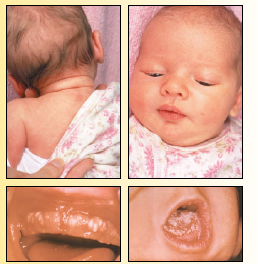
Oral thrush, also called oral candidiasis, is a fungal infection in the mouth caused by Candida albicans, a type of yeast that normally lives in the body but can overgrow under certain conditions. They appear as creamy white patches on the tongue, inner cheeks, gums, or roof of the mouth. The patches resemble cottage cheese and don’t wipe off easily.
Take home points
- White patches in the mouth that resemble cottage cheese and don’t wipe off easily are a hallmark sign of oral thrush.
- Feeding difficulties or fussiness may indicate discomfort caused by the infection, especially in infants.
Nursing Test Bank
Naxlex Comprehensive Predictor Exams
Related Questions
Correct Answer is B
Explanation
A cardiac examination in childrenis a focused assessment of the heart and circulatory system, adapted to the child’s age, developmental stage, and clinical presentation. It’s essential for detecting congenital heart defects, acquired heart diseases, and circulatory abnormalities.
Rationale for correct answer:
B.In children under 7 years old, the heart lies higher and more horizontally in the thorax compared to adults. The PMI is found at the 4th intercostal space, slightly lateral to the midclavicular line. After age 7, the PMI moves to the adult position at the 5th intercostal space at the midclavicular line.
Rationale for incorrect answers:
A.The 3rd intercostal spaceis too high for a normal PMI location in infants or adults.
C.The 5th intercostal space at the midclavicular lineis the adult PMI location, typical after age 7, not at 11 months.
D.The 6th intercostal space near the axillais far too lateral and low for the PMI in any age group and would suggest pathology if palpated there.
Take home points
- PMI location changes with age:
- <7 years: 4th intercostal space, lateral to MCL
- ≥7 years: 5th intercostal space, at MCL
- The higher, more lateral PMI in infants is due to the anatomical position of the heart in the developing thorax.
- Deviation from expected PMI location for age may indicate cardiac enlargement or other pathology.
Correct Answer is A
Explanation
Effective pediatric assessmentincludes not only age-appropriate interaction but also a solid understanding of developmental physiology. Therapeutic communication complements accurate assessment by helping nurses explain procedures and results in ways appropriate to the child’s age and developmental stage.
Rationale for correct answer:
A. Accurate interpretation of BPin pediatric patients requires an understanding of age-specific norms. Blood pressure gradually increases with age, so a reading of 95/58 mm Hg may be normal for a toddler but hypotensive for a school-age child. Using correct reference values ensures appropriate identification of hypotension or hypertension.
Rationale for incorrect answers:
B. While cuff size is crucial, it should be based on limb circumference, not length. The cuff bladder width should be approximately 40% of the arm circumference, and the length should cover 80–100% of the arm. Using the wrong size can yield inaccurate readings.
C. A child is normotensiveif their BP is below the 90th percentilefor age, sex, and height. Readings between the 90th and 95th percentiles are considered prehypertensive, while readings above the 95th percentile suggest hypertension.
D. In conditions like coarctation of the aorta, upper-extremity BP is higherthan lower-extremity BP. A lower BP in the legscompared to the arms is a classic sign of this condition, not the reverse.
Take home points
- Know age-specific BP norms to detect abnormalities in pediatric clients.
- Use the correct cuff size, measured by arm circumference, for accurate readings.
- Interpret BP percentiles properly: Normal is below the 90th percentile.
- Compare upper and lower extremity BPs in suspected cardiac conditions like coarctation of the aorta, not aortic stenosis.
Whether you are a student looking to ace your exams or a practicing nurse seeking to enhance your expertise , our nursing education contents will empower you with the confidence and competence to make a difference in the lives of patients and become a respected leader in the healthcare field.
Visit Naxlex, invest in your future and unlock endless possibilities with our unparalleled nursing education contents today