
A nurse is assessing a client who has diabetic ketoacidosis. The client's respirations are deep and regular, with a respiratory rate of 28 and an oxygen saturation of 99% on room air. How should the nurse interpret this finding?
The client is experiencing orthopnea.
The client is in respiratory distress.
The client is exhibiting bradypnea.
The client is exhibiting Kussmaul's breathing.
The Correct Answer is D
Choice A reason: Orthopnea refers specifically to dyspnea that occurs when an individual is in a recumbent position and is typically relieved by sitting or standing. This condition is frequently associated with left-sided heart failure or pulmonary edema rather than the metabolic acid-base imbalances characteristic of diabetic ketoacidosis.
Choice B reason: While the respiratory rate is elevated at 28 breaths per minute, the oxygen saturation remains at 99% on room air. Respiratory distress usually involves hypoxia, cyanosis, or significant work of breathing with low saturation, whereas this compensatory hyperpnea is a physiologic response to metabolic acidosis.
Choice C reason: Bradypnea is defined as a respiratory rate that is lower than the expected reference range, typically less than 12 breaths per minute in adults. The client in this scenario has a respiratory rate of 28, which is tachypneic, making the term bradypnea clinically inaccurate and contradictory.
Choice D reason: Kussmaul's breathing is a deep, rapid, and labored respiratory pattern specifically triggered by metabolic acidosis, such as diabetic ketoacidosis. The body attempts to compensate for a low serum pH by increasing the exhalation of carbon dioxide, which acts as a volatile acid, to restore acid-base homeostasis.
Nursing Test Bank
Naxlex Comprehensive Predictor Exams
Related Questions
Correct Answer is A
Explanation
Choice A reason: Fine crackles are characterized as brief, discontinuous, high-pitched sounds. They are typically heard at the end of inspiration and are caused by the explosive opening of small airways (bronchioles and alveoli) that were previously collapsed by fluid or exudate, common in pneumonia or early heart failure.
Choice B reason: Low-pitched snoring or rattling sounds are known as rhonchi (or sonorous wheezes). These are caused by airflow obstruction or secretions in the larger airways, such as the bronchi. They are distinct from fine crackles in their pitch, duration, and anatomical location of origin.
Choice C reason: Reduced intensity describes "diminished" or "absent" breath sounds. This occurs when air movement is restricted (as in a pneumothorax) or when there is an increased distance between the lungs and the stethoscope (as in obesity or pleural effusion), rather than being a description of crackles.
Choice D reason: Low-pitched grating or creaking sounds describe a pleural friction rub. This sound is produced by the friction between the visceral and parietal pleura when they are inflamed and lack lubrication. It is not related to the "popping" mechanism of fine crackles in the alveoli.
Correct Answer is B
Explanation
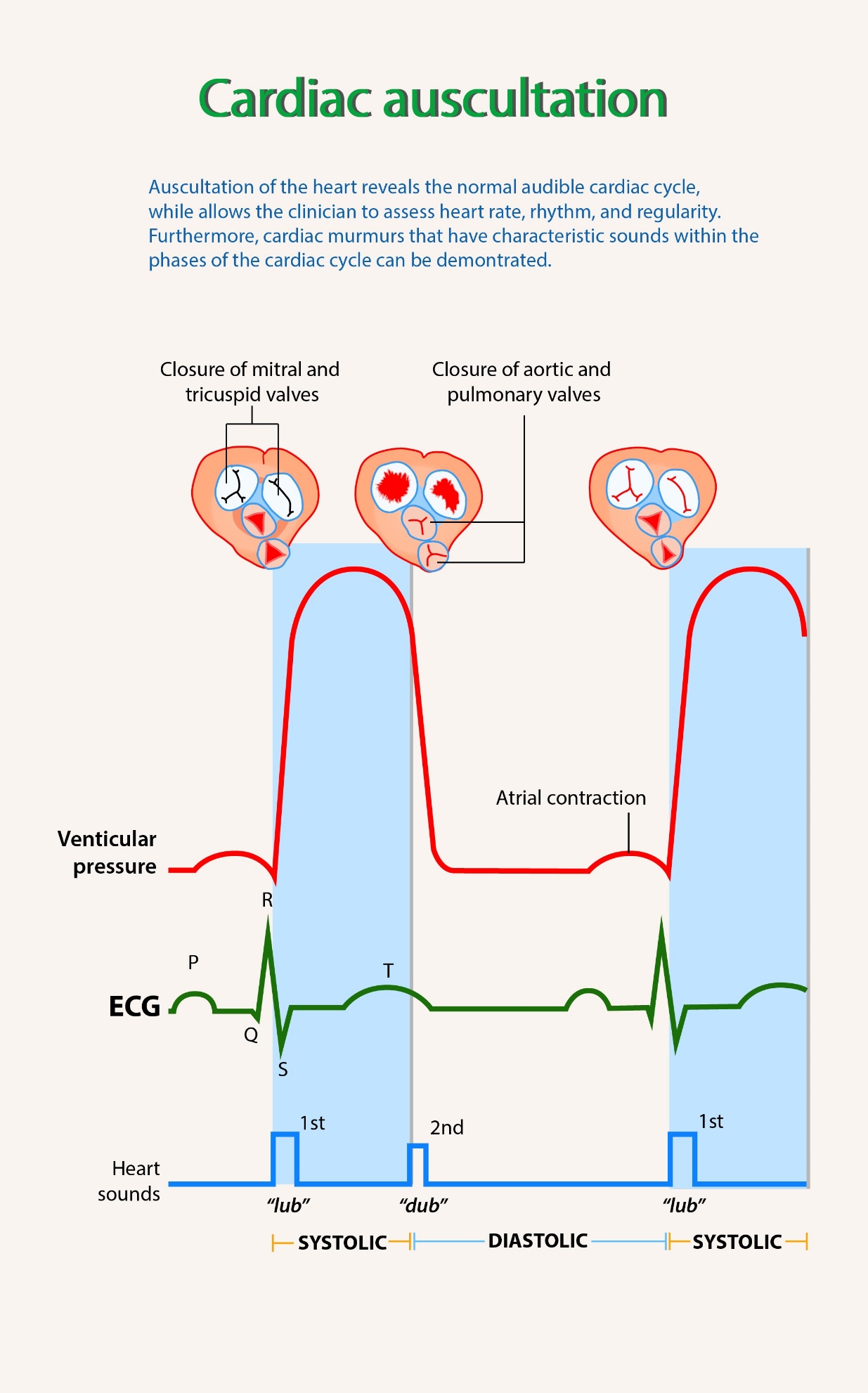
correct answer is: b) S1.
Shutterstock
Reasoning: Choice A reason: The S2 heart sound, often described as "dub," is produced by the closure of the semilunar valves (aortic and pulmonic) at the end of ventricular systole. It marks the beginning of diastole, which is the period when the ventricles relax and fill with blood before the next contraction. Choice B reason: The S1 heart sound, or "lub," is created by the simultaneous closure of the mitral and tricuspid valves. This occurs when ventricular pressure exceeds atrial pressure at the start of ventricular contraction, effectively signaling the onset of systole and the pumping of blood into the systemic and pulmonary circuits. Choice C reason: S4 is an abnormal diastolic sound, also known as an atrial gallop, that occurs just before S1. It is caused by the atria contracting and pushing blood into a stiff or non-compliant ventricle, which is often a sign of long-standing hypertension or left ventricular hypertrophy. Choice D reason: S3 is a diastolic sound, often called a ventricular gallop, that occurs early in the filling phase. It results from a large volume of blood hitting a compliant or dilated ventricle, which is a classic clinical finding in patients with fluid volume overload or congestive heart failure.
Whether you are a student looking to ace your exams or a practicing nurse seeking to enhance your expertise , our nursing education contents will empower you with the confidence and competence to make a difference in the lives of patients and become a respected leader in the healthcare field.
Visit Naxlex, invest in your future and unlock endless possibilities with our unparalleled nursing education contents today