
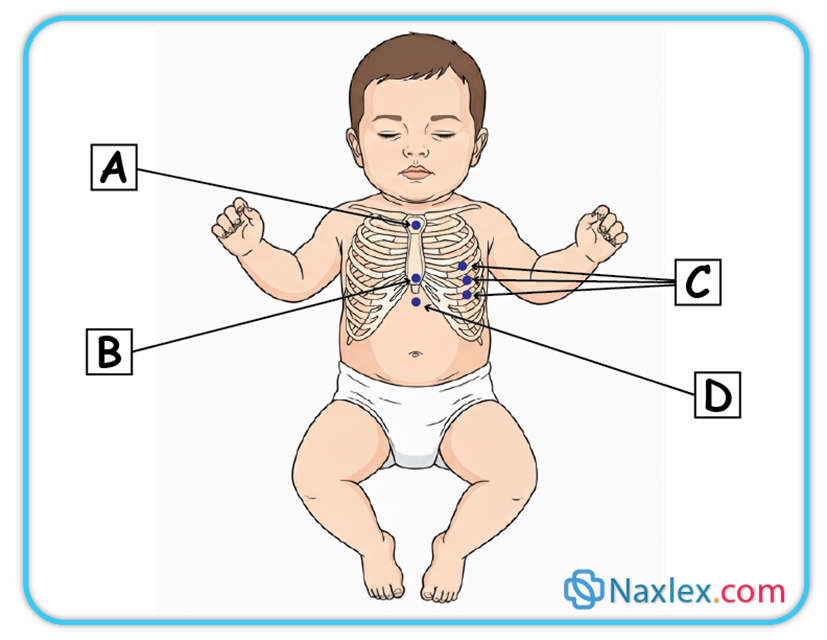
A nurse notes substernal retractions when assessing a child. At which area on the illustration did the nurse make this observation?
A
B
C
D
The Correct Answer is D
Retractions are a clinical sign of increased work of breathing, often seen in infants and children. They occur when soft tissues around the chest wall are pulled inward during inspiration due to negative intrathoracic pressure, usually because the child is struggling to get enough air into the lungs.
Rationale for correct answer:
4. D: Substernal retractions are inward pulling of the soft tissue just beneath the sternum/xiphoid (subxiphoid/epigastric area). This reflects increased negative intrathoracic pressure and is common in moderate- severe respiratory distress.
Rationale for incorrect answers:
1. A: This represents suprasternal retractions, typically seen at the sternal notch with upper-airway obstruction (e.g., croup, laryngomalacia). Not “substernal.”
2. B: The xiphoid itself is the bony tip; retractions are named for the soft tissue below it (subxiphoid/substernal). At the xiphisternum isn’t the same as below the sternum.
3. C: Those are intercostal retractions along the lateral chest wall, not beneath the sternum.
Take home points
- Retractions are classified by location: suprasternal (above sternum), intercostal (between ribs), subcostal (below ribs), and substernal (below sternum).
- The more severe the respiratory distress, the more locations you may see retractions in simultaneously.
- Substernal retractions often point to lower airway or lung pathology (e.g., bronchiolitis, asthma, pneumonia).
Nursing Test Bank
Naxlex Comprehensive Predictor Exams
Related Questions
Correct Answer is B
Explanation
Lymphoid tissues such as the tonsils and adenoids form part of the Waldeyer’s ring and play a vital role in local immune surveillance of the upper respiratory tract, detecting and responding to inhaled or ingested pathogens.
Rationale for correct answer:
2. Lymphoid tissue like tonsils and adenoids provide local immune surveillance and defense. These structures contain immune cells (B and T lymphocytes) that detect antigens entering through the nose and mouth, initiating immune responses to help prevent infection spread.
Rationale for incorrect answers:
1. Alveolar macrophages are part of the innate immune system, not adaptive immunity. They engulf and destroy pathogens and debris but do not produce specific antibodies.
3. Infants’ cough and sneeze reflexes are actually less forceful and less coordinated than adults’, making clearance of secretions less efficient.
4. Secretory Immunoglobulin A (sIgA) is part of the active mucosal immune system, not passive immunity. Passive immunity is typically acquired via maternal antibodies (e.g., IgG via placenta, IgA via breast milk).
Take home points
- The pediatric respiratory tract uses multiple defense layers: mechanical (mucociliary clearance), reflexive (cough/sneeze), and immune (lymphoid tissue, sIgA, macrophages).
- Tonsils and adenoids are particularly important in early childhood but can also be a site of chronic infection or hypertrophy leading to obstruction.
Correct Answer is A
Explanation
The mucociliary clearance system is a key innate defense mechanism of the respiratory tract, designed to trap and remove inhaled particles, pathogens, and debris before they reach the lower airways and alveoli.
Rationale for correct answer:
1. The respiratory epithelium contains mucus-producing goblet cells and ciliated cells. Mucus traps inhaled contaminants, and coordinated ciliary beating moves the mucus upward toward the pharynx, where it can be swallowed or expectorated. This process helps prevent infections and maintains airway cleanliness.
Rationale for incorrect answers:
2. While moisture in the alveoli facilitates gas exchange, this is not the main role of the mucociliary clearance system, alveolar moisture regulation is handled by surfactant and fluid balance mechanisms, not cilia and mucus.
3. Adaptive immunity involves lymphocytes and antigen-specific responses, which are separate from the mechanical clearance provided by the mucociliary system.
4. Angiotensin-converting enzyme (ACE) production occurs mainly in the pulmonary capillary endothelium, not as part of mucociliary clearance.
Take home points
- The mucociliary escalator is an essential first-line defense in the respiratory tract.
- Smoking, dehydration, and certain diseases (e.g., cystic fibrosis, primary ciliary dyskinesia) can impair this system, increasing infection risk.
- Efficient mucociliary function is especially important in children, whose immune systems are still developing.
Whether you are a student looking to ace your exams or a practicing nurse seeking to enhance your expertise , our nursing education contents will empower you with the confidence and competence to make a difference in the lives of patients and become a respected leader in the healthcare field.
Visit Naxlex, invest in your future and unlock endless possibilities with our unparalleled nursing education contents today