
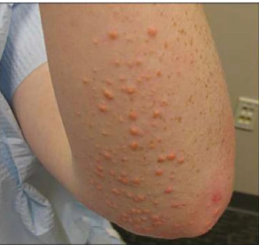
An advanced practice registered nurse (APRN) is assessing a patient who reports a rash. Which two descriptors should the APRN include in the documentation for the rash seen in the photo? Select All That Apply.
Plaques
Papular
Erythematous
Macular
Correct Answer : B,C
Accurate dermatologic documentation requires describing primary lesion morphology (flat vs raised), color changes, and distribution. Papules are small, raised, solid lesions, while erythema describes redness caused by increased blood flow in superficial capillaries. Correct identification of lesion type helps narrow differential diagnoses such as allergic reactions, inflammatory dermatoses, or infectious processes. In this image, multiple small raised red lesions are scattered over the extensor surface of the arm.
Rationale:
A. Plaques are elevated, flat-topped lesions that are typically larger than 1 cm in diameter and often formed by confluence of papules. The lesions shown are discrete, small, and not coalescing into broad raised areas. Therefore, plaque formation is not the correct descriptor for this rash.
B. Papular describes small, raised, solid lesions that are less than 1 cm in size. The image shows multiple discrete elevated bumps consistent with papules distributed over the skin surface. This morphology is typical of inflammatory or hypersensitivity reactions affecting the skin.
C. Erythematous refers to redness of the skin due to increased capillary blood flow, often associated with inflammation. The lesions and surrounding skin demonstrate a red appearance consistent with an inflammatory process. This descriptor appropriately captures the color change seen in the rash.
D. Macular lesions are flat, non-palpable areas of color change that are not elevated or depressed compared to surrounding skin. The lesions in the image are clearly raised, which excludes a macular description. Therefore, macular is not an appropriate descriptor in this case.
Nursing Test Bank
Naxlex Comprehensive Predictor Exams
Related Questions
Correct Answer is C
Explanation
Basal cell carcinoma is the most common form of skin cancer and usually develops in sun-exposed areas such as the face, nose, and eyelids, especially in older adults. It typically presents as a small, pearly or pink papule with raised borders and visible telangiectasias on the surface. These lesions grow slowly but can cause significant local tissue destruction if untreated. Early recognition and biopsy are important for diagnosis and definitive treatment.
Rationale:
A. Sebaceous hyperplasia usually appears as small, soft, yellowish papules with a central umbilication, commonly found on the forehead or cheeks of older adults. These lesions are benign enlargements of sebaceous glands and do not typically present with prominent telangiectasias or suspicious malignant features. Their appearance is usually more waxy and less concerning than basal cell carcinoma.
B. Fibrous papules are benign, firm, dome-shaped lesions commonly found on the nose and are usually skin-colored rather than pink with visible telangiectasias. They are generally stable, asymptomatic, and do not have the classic pearly rolled border associated with basal cell carcinoma. Biopsy may be done for confirmation, but the description is more consistent with malignancy.
C. Basal cell carcinoma commonly presents as a small pink or pearly papule with overlying telangiectasias and a raised appearance, especially on sun-exposed facial areas such as the nasojugal fold. It often develops in older adults due to cumulative ultraviolet exposure. The lesion’s appearance and location strongly support suspicion for basal cell carcinoma, making biopsy necessary for diagnosis.
D. Actinic keratosis usually presents as a rough, scaly, flat or slightly raised lesion rather than a smooth pink papule with telangiectasias. It is considered a precancerous lesion caused by chronic sun exposure and often feels like sandpaper on palpation. The described lesion is more characteristic of basal cell carcinoma than actinic keratosis.
Correct Answer is C
Explanation
Peripheral pulse characteristics provide important clues about underlying cardiovascular function, particularly stroke volume and vascular resistance. A bounding pulse reflects an increased stroke volume with rapid ejection of blood into the arterial system followed by a rapid fall in pressure. This pattern is commonly seen in conditions that increase systolic output or reduce diastolic pressure. Recognizing pulse quality helps the clinician identify specific valvular or systemic cardiovascular disorders.
Rationale:
A. Mitral stenosis is a condition characterized by obstruction of blood flow from the left atrium to the left ventricle, resulting in reduced left ventricular filling and decreased cardiac output. This leads to a weak, thready pulse rather than a bounding one. The diminished stroke volume does not produce the forceful arterial expansion seen in bounding pulses.
B. Hypothyroidism is associated with a slowed metabolic state and decreased cardiac output due to reduced heart rate and contractility. Patients typically present with a slow, weak, and sometimes delayed pulse rather than a bounding pulse. The decreased sympathetic stimulation results in reduced pulse amplitude.
C. Aortic regurgitation is the condition most associated with a bounding radial pulse due to backflow of blood from the aorta into the left ventricle during diastole. This leads to increased stroke volume and widened pulse pressure, producing a forceful, “water hammer” or bounding pulse. The rapid rise and fall in arterial pressure is a hallmark finding in this valvular disorder.
D. Arterial embolism causes sudden obstruction of blood flow to a distal extremity, resulting in absent or markedly diminished pulses in the affected area. It is associated with pain, pallor, and coolness rather than increased pulse amplitude. The interruption of arterial flow makes a bounding pulse impossible in the affected limb.
Whether you are a student looking to ace your exams or a practicing nurse seeking to enhance your expertise , our nursing education contents will empower you with the confidence and competence to make a difference in the lives of patients and become a respected leader in the healthcare field.
Visit Naxlex, invest in your future and unlock endless possibilities with our unparalleled nursing education contents today