
Based on the information in the electronic health record, complete the following sentences using the drop-down lists.
The nurse reads the telemetry strip and interprets the client's cardiac rhythm as
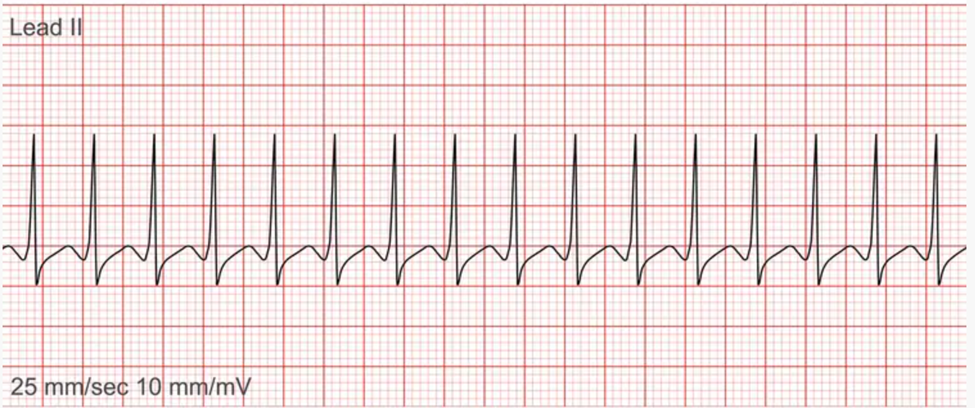
The Correct Answer is {"dropdown-group-1":"C","dropdown-group-2":"B"}
Rationale for Correct Answers:
Supraventricular tachycardia: The telemetry strip shows a rapid, regular rhythm originating above the ventricles, consistent with supraventricular tachycardia (SVT), and the heart rate is above 150 beats per minute. SVT can cause palpitations, dizziness, or hypotension if sustained, making accurate identification critical for timely intervention.
Administering adenosine: Adenosine is the first-line pharmacologic treatment for stable SVT. It transiently blocks AV nodal conduction, which can terminate the reentrant tachycardia and restore normal sinus rhythm. Administration requires rapid IV push with immediate saline flush and continuous monitoring due to potential transient bradycardia or brief asystole.
Rationale for Incorrect Answers
Atrial fibrillation: This rhythm is irregularly irregular with no identifiable P waves. SVT is regular and very rapid.
Sinus tachycardia: This has a normal P wave before every QRS complex and is typically caused by pain, fever, dehydration, or anxiety. It is not treated with adenosine.
Defibrillation: This is used for life-threatening rhythms such as ventricular fibrillation or pulseless ventricular tachycardia, not stable SVT.
Administering diltiazem: This is commonly used to control ventricular rate in atrial fibrillation, not as first-line treatment for SVT.
Nursing Test Bank
Naxlex Comprehensive Predictor Exams
Related Questions
Correct Answer is D
Explanation
A. Position flat in bed with sandbags at head: After a transsphenoidal hypophysectomy, the patient’s head is typically elevated to reduce intracranial pressure and minimize the risk of cerebrospinal fluid (CSF) leakage. Lying flat with sandbags would increase ICP and is contraindicated.
B. Cough vigorously and deep breathe every 2 hours: Forceful coughing and straining increase intracranial pressure and can disrupt the surgical site, leading to CSF leakage or bleeding. Patients are usually instructed to avoid coughing, sneezing, or straining postoperatively.
C. Take replacement growth hormone for a few months: Hormone replacement depends on which pituitary hormones are affected and is individualized. Some patients may require lifelong hormone therapy, not just a few months, and preoperative teaching focuses on surgical precautions rather than post-op medication timing.
D. Report clear drainage from nose: Clear, watery nasal drainage may indicate CSF leak, a serious postoperative complication that increases the risk of meningitis. Prompt reporting allows early assessment and intervention, making this a critical teaching point for patient safety.
Correct Answer is A
Explanation
A. Administer small increments of IVP medication over 5 minutes, flush with normal saline: Digoxin IV push must be administered slowly, typically over at least 5 minutes, to reduce the risk of severe bradycardia, hypotension, or cardiac arrhythmias. Administering in small increments allows careful monitoring of the patient’s cardiac response. Flushing with normal saline before and after ensures the full dose is delivered and prevents drug interaction.
B. Inject IVP medication into a primary IV bag and infuse over 5 minutes: Mixing digoxin directly into a primary IV fluid is not recommended because compatibility issues may occur, and the exact dose delivered can be difficult to control. IV push through a controlled line ensures accurate dosing and safety.
C. Flush with normal saline over 5 minutes, administer IVP medication: Flushing before administering digoxin is unnecessary unless verifying line patency. Administering the flush first alone does not prevent complications if the drug is injected too rapidly; careful, slow IV push of the digoxin itself is the critical safety measure.
D. Administer IVP medication, wait 5 minutes, flush with normal saline: Waiting after IV push without flushing may leave residual medication in the line, leading to incomplete dosing. Flushing immediately after administration ensures the patient receives the full prescribed dose safely and reduces risk of line incompatibility.
Whether you are a student looking to ace your exams or a practicing nurse seeking to enhance your expertise , our nursing education contents will empower you with the confidence and competence to make a difference in the lives of patients and become a respected leader in the healthcare field.
Visit Naxlex, invest in your future and unlock endless possibilities with our unparalleled nursing education contents today