
Cervical vertebrae have which landmark that's not found on any other?
Spinous Process.
Transvers Processes.
Costal Facets.
Transverse Foramina.
The Correct Answer is D
The transverse foramina are openings in the transverse processes of the cervical vertebrae that allow the passage of the vertebral arteries and veins.
They are not found on any other vertebrae.
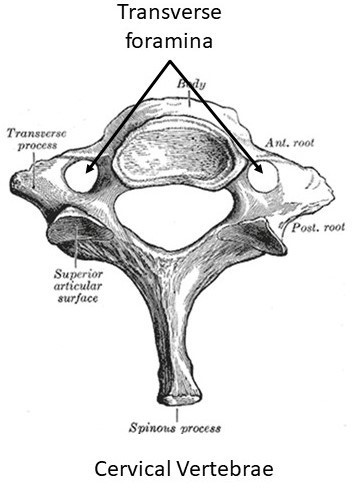
Choice A is incorrect because spinous processes are bony projections on the posterior aspect of all vertebrae that serve as attachment sites for muscles and ligaments.
Choice B is incorrect because transverse processes are lateral projections on all vertebrae that serve as attachment sites for muscles and ribs.
Choice C is incorrect because costal facets are articular surfaces on the thoracic vertebrae that articulate with the heads of the ribs.
They are found on all thoracic vertebrae except T11 and T123.
Nursing Test Bank
Naxlex Comprehensive Predictor Exams
Related Questions
Correct Answer is D
Explanation
Bone marrow is the soft, spongy tissue that fills the medullary cavity of long bones.
Bone marrow contains hematopoietic stem cells that produce blood cells, as well as fat cells and other supportive cells.
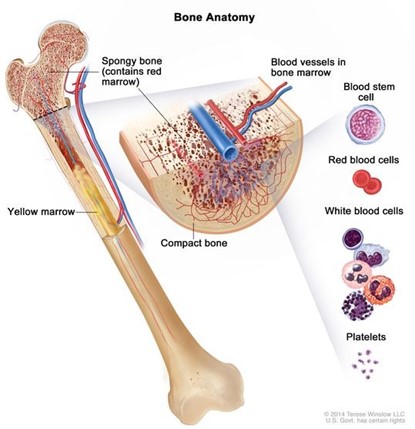
Choice A is incorrect because spongy bone is not the tissue that fills the medullary cavity, but the type of bone tissue that surrounds it.
Spongy bone has a porous structure that provides strength and flexibility to the bone.
Choice B is incorrect because compact bone is not the tissue that fills the medullary cavity, but the type of bone tissue that forms the outer wall of the diaphysis.
Compact bone has a dense and hard structure that provides protection and support to the bone.
Choice C is incorrect because none of these is not a valid answer.
The medullary cavity of long bones does contain a specific type of tissue, which is bone marrow.
Correct Answer is ["Scaphoid bone"]
Explanation
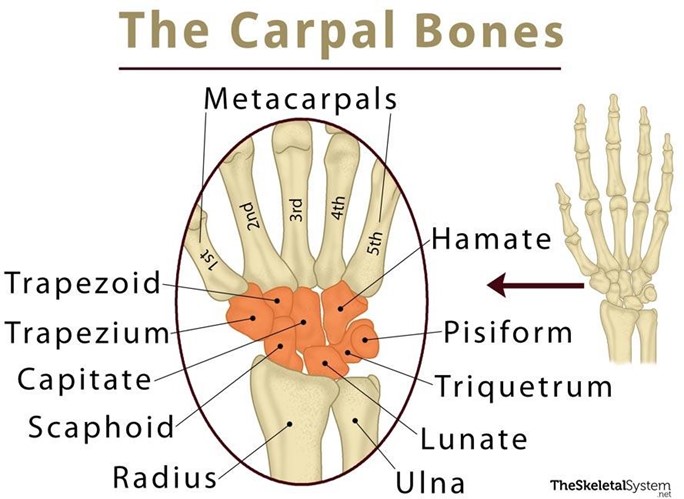
The carpal bones, also known as the wrist bones, are a group of eight small bones located in the wrist joint.
They are arranged in two rows of four bones each, with the rows separated by a space known as the carpal tunnel.
The carpal bones are held together by ligaments, and their shape and arrangement allow for a wide range of wrist movements.
The names of the carpal bones, from the proximal row to the distal row, are the scaphoid, lunate, triquetrum, and pisiform, and the trapezium, trapezoid, capitate, and hamate.
Each bone has a unique shape and surface features that allow it to articulate with adjacent bones, forming a complex network of joints that are important for wrist and hand movements.
The carpal bones are important because they provide stability to the wrist joint, allowing for precise movements of the hand and fingers.
They also help to transfer forces from the hand to the forearm, and vice versa.
Injuries to the carpal bones can result in wrist pain, instability, and decreased function of the hand and fingers.
Additionally, the arrangement of the carpal bones can affect the function of the median nerve, which runs through the carpal tunnel.
Compression or irritation of this nerve can result in carpal tunnel syndrome, a condition characterized by pain, numbness, and tingling in the hand and fingers.
Whether you are a student looking to ace your exams or a practicing nurse seeking to enhance your expertise , our nursing education contents will empower you with the confidence and competence to make a difference in the lives of patients and become a respected leader in the healthcare field.
Visit Naxlex, invest in your future and unlock endless possibilities with our unparalleled nursing education contents today