
Identify the structure in the diagram below
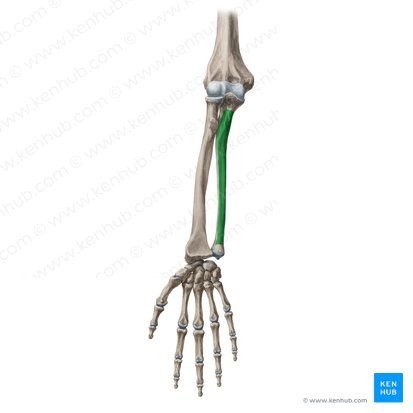
The Correct Answer is ["Ulna bone"]
The ulna is one of the two bones of the forearm, located on the medial (inner) side of the arm.
It is a long bone that runs parallel to the radius bone, extending from the elbow joint to the wrist joint.
The ulna features several surface landmarks, including the olecranon process, which forms the bony tip of the elbow.
The bone is also involved in the formation of the elbow joint, where it articulates with the humerus bone, and the wrist joint, where it articulates with the radius bone and several carpal bones.
The ulna is an important site for the attachment of muscles involved in forearm and wrist movements.
Nursing Test Bank
Naxlex Comprehensive Predictor Exams
Related Questions
Correct Answer is A
Explanation
The cervical vertebrae are the only vertebrae that have transverse foramina, which are openings in the transverse processes that allow the passage of the vertebral arteries and veins.
Choice B is incorrect because lumbar vertebrae do not have transverse foramina.
They have large bodies and short, thick transverse processes that serve as attachment sites for muscles.
Choice C is incorrect because thoracic vertebrae do not have transverse foramina.
They have costal facets on their transverse processes that articulate with the tubercles of the ribs.
Choice D is incorrect because sacral vertebrae do not have transverse foramina.
They are fused together to form the sacrum, which has four pairs of sacral foramina on each side that transmit sacral nerves and vessels.
Correct Answer is C
Explanation
Osteoclasts are the type of cells that increase their activity in response to parathyroid hormone (PTH) and break down bone tissue to release calcium into the blood.
PTH helps maintain the right balance of calcium in the body by stimulating osteoclasts.
Choice A is incorrect because osteoblasts are the type of cells that form new bone tissue by depositing calcium into the bone matrix.
PTH inhibits osteoblasts and reduces bone formation.
Choice B is incorrect because canaliculi are not cells, but small channels within the bone matrix that allow osteocytes to communicate with each other and exchange nutrients and waste.
PTH does not affect canaliculi directly.
Choice D is incorrect because osteocytes are the type of cells that are mature bone cells trapped within the bone matrix.
PTH can stimulate osteocytes to release calcium from the bone, but not as much as osteoclasts.
Whether you are a student looking to ace your exams or a practicing nurse seeking to enhance your expertise , our nursing education contents will empower you with the confidence and competence to make a difference in the lives of patients and become a respected leader in the healthcare field.
Visit Naxlex, invest in your future and unlock endless possibilities with our unparalleled nursing education contents today