
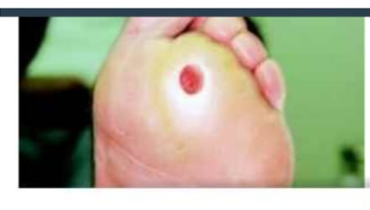
During a routine office visit, a patient takes off their sock and says "this awful sore won't heal." On inspection, the nurse notes the following:
Deep-vein thrombophlebitis
Venous stasis ulcer
Arterial ulcer
Neuropathic ulcer
The Correct Answer is D
A. Deep-vein thrombophlebitis: Deep-vein thrombophlebitis involves clot formation in a deep vein, usually in the lower extremity, and presents with swelling, warmth, and tenderness. It does not cause an open, “punched-out” lesion with callus formation, which differentiates it from the wound observed.
B. Venous stasis ulcer: Venous stasis ulcers are typically located on the medial lower leg near the ankle and are shallow with irregular borders. They are associated with hemosiderin staining and chronic venous insufficiency, unlike the plantar, callus-bordered lesion seen here.
C. Arterial ulcer: Arterial ulcers generally occur on distal areas such as the toes or lateral malleolus and have well-defined, often deep, necrotic bases with minimal exudate. Pain is often severe, and peripheral pulses are diminished, which does not match the classic neuropathic ulcer features.
D. Neuropathic ulcer: Neuropathic ulcers, often seen in patients with diabetes, occur on pressure-bearing areas of the foot such as the plantar surface. They are “punched-out” in appearance with a surrounding callus because the patient continues to walk on the area, often without noticing due to sensory neuropathy. The location and thick reactive tissue, confirm the diagnosis of a neuropathic ulcer.
Nursing Test Bank
Naxlex Comprehensive Predictor Exams
Related Questions
Correct Answer is B
Explanation
A. Annual pap smear: Routine Pap smears are generally not recommended for women older than 65 who have had adequate prior screening and are not at high risk for cervical cancer. Continuing Pap smears in this age group offers minimal benefit for disease prevention, making it a lower priority compared with vaccinations that prevent life-threatening infections.
B. Pneumococcal immunization: Pneumococcal vaccination is highly recommended for adults aged 65 and older because aging increases susceptibility to pneumococcal infections, including pneumonia, bacteremia, and meningitis. Immunization significantly reduces morbidity and mortality in this population, making it the highest priority in older adults.
C. Annual mammogram: While mammography is important for early detection of breast cancer, current guidelines typically recommend individualized decision-making for women aged 70 and older, especially if life expectancy is limited or comorbidities exist. Vaccinations provide broader population-level protection against serious infections and thus take precedence.
D. Human papilloma virus (HPV) immunization: HPV vaccination is primarily targeted toward adolescents and young adults up to age 26, with some recommendations extending to 45. For adults over 70, HPV immunization does not provide meaningful protection, as exposure risk is low and immune response may be diminished, making it irrelevant for this age group.
Correct Answer is D
Explanation
A. Altered Impulse translation: Impulse translation refers to the processing and interpretation of sensory input by the brain. While cataracts affect vision, the primary problem is not with brain interpretation but with how light reaches the retina, making this option less directly related to the patient’s behavior.
B. Altered nerve impulse conduction: Nerve impulse conduction involves the transmission of signals along nerves. In cataracts, the optic nerve and neural pathways are typically intact; the issue lies in light obstruction from the lens opacity rather than impaired conduction of impulses.
C. Altered stimulation: Altered stimulation would suggest that the environment is insufficiently stimulating the senses. However, the patient’s behavior, sitting close to the television, indicates a compensatory response to difficulty seeing, not a lack of environmental stimulation.
D. Altered sensory reception: Cataracts cause clouding of the lens, reducing the eye’s ability to receive and focus light properly, which directly affects visual sensory reception. Sitting close to the television is a compensatory behavior to improve visual input, reflecting the impact of altered sensory reception on functional activity.
Whether you are a student looking to ace your exams or a practicing nurse seeking to enhance your expertise , our nursing education contents will empower you with the confidence and competence to make a difference in the lives of patients and become a respected leader in the healthcare field.
Visit Naxlex, invest in your future and unlock endless possibilities with our unparalleled nursing education contents today