
How would the nurse document the heart rhythm shown on this EKG strip?
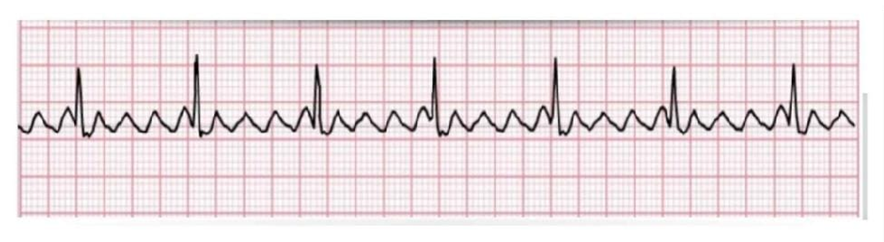
Atrial flutter.
Supraventricular Tachycardia.
Atrial fibrillation.
Sinus rhythm
The Correct Answer is A
A. Atrial flutter: The baseline shows a rapid, regular, and "saw-tooth" pattern of atrial activity. These are referred to as F-waves (flutter waves). Atrial flutter is characterized by rapid, regular atrial depolarizations with a consistent ventricular response. The rhythm is usually regular or regularly irregular depending on the AV conduction ratio.
B. Supraventricular Tachycardia: Supraventricular tachycardia (SVT) is a rapid, regular rhythm originating above the ventricles, often with a narrow QRS, but it does not display the characteristic sawtooth flutter waves seen in atrial flutter. SVT documentation would be incorrect if the flutter waves are clearly visible.
C. Atrial fibrillation: Atrial fibrillation presents with an irregularly irregular rhythm and absence of distinct P waves, replaced by chaotic fibrillatory waves. Unlike atrial flutter, atrial fibrillation does not show organized, repetitive atrial activity, making this label inaccurate for the described EKG.
D. Sinus rhythm: Sinus rhythm is defined by a normal P wave before each QRS complex with consistent rate and rhythm. Atrial flutter deviates from normal sinus activity due to abnormal atrial depolarizations and cannot be documented as sinus rhythm.
Nursing Test Bank
Naxlex Comprehensive Predictor Exams
Related Questions
Correct Answer is A
Explanation
A. Prepare for transcutaneous pacing: The client is symptomatic with sinus bradycardia, hypotension, syncope, and weakness, indicating hemodynamic instability. Transcutaneous pacing provides temporary electrical stimulation to increase heart rate and maintain adequate perfusion until definitive treatment can be initiated.
B. Administer an antiarrhythmic medication: Antiarrhythmic drugs are used to treat tachyarrhythmias, not symptomatic bradycardia. Administering such medications could worsen the bradycardia and further compromise cardiac output.
C. Prepare for synchronized cardioversion: Synchronized cardioversion is indicated for unstable tachyarrhythmias, such as atrial fibrillation or ventricular tachycardia with a pulse. It is not appropriate for bradycardia and could be harmful.
D. Administer a thrombolytic medication: Thrombolytic therapy is used for acute myocardial infarction or thromboembolic events, not for bradycardia. There is no evidence of an occlusive clot causing the current hemodynamic instability.
Correct Answer is A
Explanation
A. Hoarseness and difficulty swallowing: A thoracic aortic aneurysm can compress adjacent structures such as the recurrent laryngeal nerve and esophagus. Compression of the nerve can cause hoarseness, while pressure on the esophagus can result in dysphagia. These are classic symptoms associated with TAA rather than abdominal aneurysms.
B. Bruit and thrill in upper abdomen: A bruit or thrill in the abdomen is more characteristic of an abdominal aortic aneurysm (AAA), not a thoracic aortic aneurysm. TAAs are usually located in the chest and may not produce abdominal auscultatory findings.
C. Disruption of bowel patterns: Bowel pattern changes are generally unrelated to thoracic aortic aneurysms. They may occur in abdominal pathology or mesenteric ischemia but are not typical manifestations of a TAA.
D. Abdominal, flank, or back pain: While abdominal or back pain is a hallmark of AAA, a TAA more commonly produces chest pain, back pain localized to the thoracic region, or symptoms from compression of mediastinal structures. Abdominal pain is not a primary finding in TAA.
Whether you are a student looking to ace your exams or a practicing nurse seeking to enhance your expertise , our nursing education contents will empower you with the confidence and competence to make a difference in the lives of patients and become a respected leader in the healthcare field.
Visit Naxlex, invest in your future and unlock endless possibilities with our unparalleled nursing education contents today