
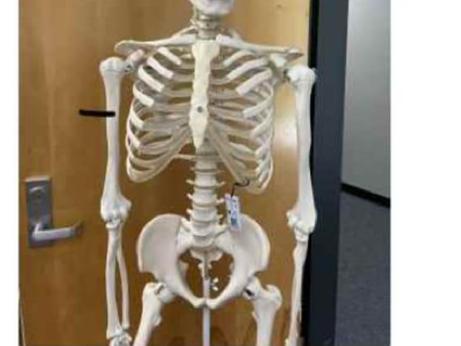
Identify the bone marked in the image below.
Humerus
Radius
Ulna
Femur
The Correct Answer is A
The marked structure is the humerus, which is the long bone of the upper arm extending from the shoulder to the elbow joint. It articulates proximally with the scapula at the glenohumeral joint and distally with the radius and ulna at the elbow. The humerus plays a key role in upper limb movement, serving as an attachment site for multiple muscles involved in flexion, extension, rotation, and lifting. It is essential for both gross motor function and fine upper extremity coordination.
A. Humerus: The humerus is the long bone of the upper arm located between the shoulder and elbow joints. It articulates proximally with the scapula and distally with both the radius and ulna. It serves as the primary lever for upper limb movement and muscle attachment for the biceps, triceps, and deltoid.
B. Radius; The radius is one of the two forearm bones, located on the lateral (thumb) side of the forearm. It primarily articulates with the humerus at the elbow and with the carpal bones at the wrist, enabling pronation and supination. Unlike the humerus, it does not form the upper arm structure but instead functions in forearm rotation. This makes it anatomically distal to the marked upper arm bone.
C. Ulna: The ulna is the medial forearm bone, positioned on the side of the little finger. It forms the primary hinge joint with the humerus at the elbow, providing stability during flexion and extension. However, it does not extend into the upper arm region and is not involved in shoulder articulation. Compared to the humerus, it is a forearm stabilizing bone rather than the main upper limb shaft.
D. Femur: The femur is the long bone of the thigh and the strongest bone in the body, extending from the hip joint to the knee joint. It supports weight-bearing and locomotion in the lower extremity. Although it is also a long bone like the humerus, it is located in the lower limb and has no anatomical relationship to the upper arm region.
Nursing Test Bank
Naxlex Comprehensive Predictor Exams
Related Questions
Correct Answer is A
Explanation
Carbohydrates are one of the four major biomolecules essential for human physiology, along with proteins, lipids, and nucleic acids. They are primarily composed of carbon, hydrogen, and oxygen in a characteristic ratio that reflects their general chemical structure. Their main biological role is to provide a readily available source of energy for cellular metabolism. They exist in simple forms such as glucose and complex forms such as starch and glycogen, all of which are metabolized to produce ATP.
A. They contain C6H12O6 with a 2:1 hydrogen-to-oxygen ratio and are primary energy sources: carbohydrates typically follow the empirical formula (CH2O)n, reflecting a 2:1 hydrogen-to-oxygen ratio similar to water. Glucose (C6H12O6) is a classic example and serves as the primary fuel for cellular respiration. Carbohydrates are metabolized through glycolysis and the citric acid cycle to generate ATP, which is essential for cellular function. Their structure and function make them the body’s most immediate and efficient energy source.
B. They contain C6H12O2 with twice as many hydrogen as oxygen atoms: the molecular formula is inaccurate and does not represent known carbohydrate structures. Carbohydrates consistently follow a general ratio of C:H:O close to 1:2:1, not the altered composition shown here. The reduced oxygen content would not support standard carbohydrate chemistry or metabolic pathways. Therefore, this does not describe true carbohydrate structure.
C. Some will contain nitrogen and phosphate groups: carbohydrates are defined primarily by carbon, hydrogen, and oxygen atoms. While carbohydrate derivatives may be modified with nitrogen or phosphate groups (such as in glycoproteins or phosphorylated sugars), these are not pure carbohydrates. Such modifications occur in specialized biomolecules rather than basic carbohydrate structures.
D. They are made primarily of amino acids linked by peptide bonds: This option describes proteins, not carbohydrates. Amino acids are the monomer units of proteins, and they are linked by peptide bonds to form polypeptide chains. Carbohydrates, in contrast, are composed of monosaccharides linked by glycosidic bonds. This statement represents protein structure rather than carbohydrate structure.
Correct Answer is C
Explanation
The marked structure is the xiphoid process, the smallest and most inferior portion of the sternum. It is a thin, elongated structure located below the body of the sternum and serves as an important anatomical landmark in the thorax. During early life, the xiphoid process is composed primarily of hyaline cartilage and gradually ossifies with age. It provides attachment sites for the diaphragm, rectus abdominis, and transversus thoracis muscles, contributing to respiration, trunk movement, and stabilization of the anterior thoracic wall.
A. Manubrium: The manubrium is the broad, superior portion of the sternum that articulates with the clavicles and the first pair of ribs. It contains the jugular notch and clavicular notches, making it an important landmark for identifying thoracic structures. Its primary function is to provide attachment and support for the pectoral girdle and upper ribs. Unlike the xiphoid process, it is located at the superior end of the sternum rather than the inferior tip.
B. Body of sternum: The body of the sternum is the largest and longest portion of the sternum, situated between the manubrium and xiphoid process. It articulates with the costal cartilages of ribs 2 through 7 and contributes significantly to protection of the heart, lungs, and major thoracic vessels. Compared with the xiphoid process, it is much larger and forms the central portion of the anterior thoracic cage.
C. Xiphoid process: The xiphoid process is the small, inferior segment of the sternum located immediately below the sternal body. It serves as an attachment point for the diaphragm, rectus abdominis, and transversus thoracis muscles, making it important in respiration and trunk stabilization. Clinically, it is used as a landmark during cardiopulmonary resuscitation (CPR), as incorrect hand placement over the xiphoid can result in fracture and injury to underlying organs. Since the highlighted structure is the inferior terminal part of the sternum, it corresponds to the xiphoid process.
D. Costal cartilage: Costal cartilage consists of bars of hyaline cartilage that connect the anterior ends of the ribs to the sternum. These cartilages provide elasticity to the thoracic cage, allowing expansion and recoil during breathing. They are paired structures extending laterally from the sternum rather than a single midline structure. Unlike the xiphoid process, costal cartilage is not a component of the sternum itself but serves as a connection between ribs and sternum.
Whether you are a student looking to ace your exams or a practicing nurse seeking to enhance your expertise , our nursing education contents will empower you with the confidence and competence to make a difference in the lives of patients and become a respected leader in the healthcare field.
Visit Naxlex, invest in your future and unlock endless possibilities with our unparalleled nursing education contents today