
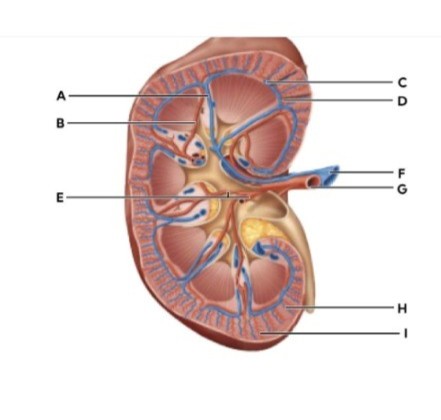
Identify the following structures.
|
|
|
|
Renal artery |
dropdown
|
|
Interlobar vein |
dropdown
|
|
Cortical radiate vein |
dropdown
|
The Correct Answer is {"dropdown-group-1":"G","dropdown-group-2":"A","dropdown-group-3":"E"}
Renal artery → Label G
The renal artery is the thick-walled vessel entering the kidney at the hilum. It carries oxygenated blood from the abdominal aorta into the kidney. In the diagram, G is positioned at the hilum and has the appearance of a robust arterial vessel.
Interlobar vein → Label A
Interlobar veins run between the renal pyramids, draining blood toward the renal vein. In the diagram, A is shown coursing between the medullary pyramids, consistent with the location of interlobar vessels.
Cortical radiate vein → Label I
Cortical radiate veins (interlobular veins) drain blood from the cortex into arcuate veins. In the diagram, I is located in the renal cortex, radiating outward toward the capsule, which matches the expected position of cortical radiate veins.
Nursing Test Bank
Naxlex Comprehensive Predictor Exams
Related Questions
Correct Answer is D
Explanation
A. Semipermeable walls of the renal tubule: Reabsorption and secretion occur across the tubular walls, but the initial barrier to protein entry is located within the renal corpuscle. By the time fluid reaches the tubules, it should already be an ultrafiltrate. The tubules do not perform primary filtration.
B. Absence of blood supply in Bowman's capsule: Bowman's capsule is intimately associated with the glomerulus, which is a high-density capillary network. It receives a massive blood supply specifically to facilitate filtration. The absence of blood would mean no filtrate or urine could ever be produced.
C. Active protein pumps: The filtration of blood at the glomerulus is a passive process driven by hydrostatic and oncotic pressures. There are no active metabolic pumps that move proteins against a gradient in the filtration barrier. The exclusion of protein is based on size and charge.
D. Podocyte processes and capillary endothelial fenestrations: The three-layered barrier consists of fenestrated endothelium, the glomerular basement membrane, and podocyte slit diaphragms. These structures provide a mechanical sieve and a negative charge. They prevent the passage of large cells and anionic plasma proteins like albumin.
Correct Answer is C
Explanation
A. It increases water reabsorption by directly stimulating ADH release: ADH release is triggered by hypothalamic osmoreceptors sensing sodium concentrations and blood volume. Urea itself is not the primary physiological trigger for the neurohypophyseal release of ADH. It is a metabolic byproduct that aids the osmotic gradient.
B. It promotes active sodium reabsorption in the distal tubule: Urea transport is largely passive or facilitated and does not drive the active transport of sodium. Sodium reabsorption in the distal tubule is primarily regulated by aldosterone. Urea's role is restricted to the osmotic environment of the inner medulla.
C. It contributes to the medullary osmotic gradient through recycling: Urea is reabsorbed from the inner medullary collecting ducts and moves into the thin limbs of the loop of Henle. This recycling traps urea in the medulla, accounting for nearly 50% of its hypertonicity. This high osmolarity facilitates maximal water reabsorption.
D. It reduces the permeability of the collecting ducts to water: Urea does not alter the intrinsic water permeability of the ductal epithelium. Water permeability is strictly controlled by the presence of ADH-induced aquaporins. Urea provides the osmotic "pull" that makes that permeability effective for water recovery.
Whether you are a student looking to ace your exams or a practicing nurse seeking to enhance your expertise , our nursing education contents will empower you with the confidence and competence to make a difference in the lives of patients and become a respected leader in the healthcare field.
Visit Naxlex, invest in your future and unlock endless possibilities with our unparalleled nursing education contents today