
Identify the structure pointed by the line
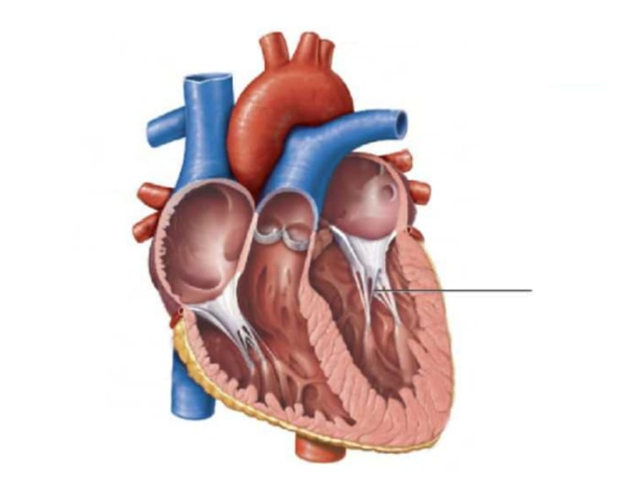
chordae tendinae
Papillary Muscles
Septal leaflet
Pulmonary vein
The Correct Answer is A
A. Chordae tendinae: The structure pointed to by the line is the chordae tendineae. The chordae tendineae are strong, fibrous collagen cords that connect the atrioventricular valve leaflets (mitral and tricuspid valves) to the papillary muscles within the ventricles. They prevent valve prolapse during ventricular systole. When the ventricles contract, papillary muscles also contract, maintaining tension on the chordae tendineae to keep the valves closed and prevent backflow into the atria.
B. Papillary Muscles: Papillary muscles are cone-shaped projections from the ventricular walls that anchor chordae tendineae. During ventricular contraction, they prevent valve prolapse by maintaining tension on valve leaflets, ensuring unidirectional blood flow
C. Septal leaflet: The septal leaflet is part of the tricuspid valve attached to the interventricular septum. Chordae tendineae connect it to papillary muscles, stabilizing the valve during systole and preventing backflow into the right atrium.
D: Pulmonary vein: Pulmonary veins are vessels transporting oxygenated blood from the lungs to the left atrium. They are not directly connected to chordae tendineae but are adjacent to atrial structures influencing left atrial filling and valve dynamics.
Nursing Test Bank
Naxlex Comprehensive Predictor Exams
Related Questions
Correct Answer is A
Explanation
A. The semilunar valves close, preventing backflow into the heart: During ventricular diastole, the ventricles relax and ventricular pressure falls below the pressure in the aorta and pulmonary trunk. This pressure gradient causes the aortic and pulmonary semilunar valves to close, preventing blood from flowing backward into the ventricles.
B. The electrical impulse initiates ventricular depolarization: Ventricular depolarization occurs during the onset of systole, not diastole. It is triggered by the action potential conducted through the bundle branches and Purkinje fibers, leading to contraction. Depolarization does not directly cause semilunar valve closure.
C. The atrioventricular valves close, preventing backflow into the atria: The atrioventricular (tricuspid and mitral) valves close at the beginning of ventricular systole when ventricular pressure exceeds atrial pressure. This prevents regurgitation into the atria and generates the first heart sound (S1), distinct from the semilunar valve closure occurring later in diastole.
D. The ventricles contract, forcing blood into the great arteries: Ventricular contraction occurs during systole when ventricular pressure rises above aortic and pulmonary pressures to open the semilunar valves. Closure of these valves happens during diastole when the ventricles relax, not during active ejection.
Correct Answer is {"dropdown-group-1":"C","dropdown-group-2":"B"}
Explanation
Correct answer:
- Interventricular septum
- Atrioventricular (AV) bundle / Bundle of His
The highlighted area represents the interventricular septum, the thick muscular wall that separates the right and left ventricles. It forms the medial wall of both ventricles and extends from the atrioventricular valves superiorly to the apex inferiorly. Its primary physiologic function is to prevent mixing of oxygenated blood in the left ventricle with deoxygenated blood in the right ventricle while also contributing to ventricular contraction. The electrical conduction structure that passes through this area is the atrioventricular (AV) bundle / Bundle of His. The Bundle of His passes from the atrioventricular node into the membranous portion of the interventricular septum. It then divides into the right and left bundle branches, which travel along the septum toward the apex to distribute electrical impulses to both ventricles. This allows coordinated ventricular depolarization and synchronized contraction.
Whether you are a student looking to ace your exams or a practicing nurse seeking to enhance your expertise , our nursing education contents will empower you with the confidence and competence to make a difference in the lives of patients and become a respected leader in the healthcare field.
Visit Naxlex, invest in your future and unlock endless possibilities with our unparalleled nursing education contents today