
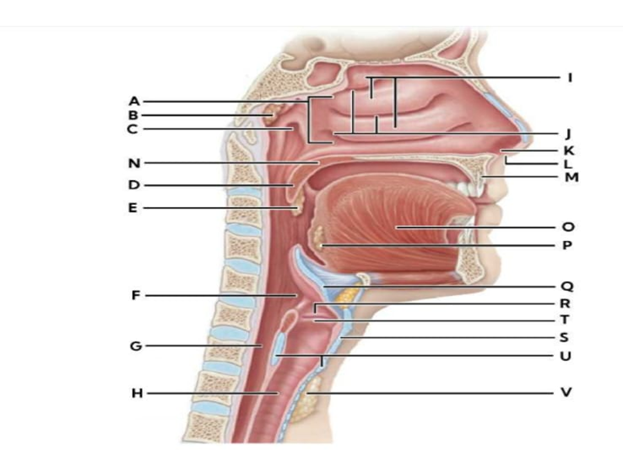
Identify the structures labelled by the following letters:
|
|
|
|
D M H T
|
dropdown
dropdown
dropdown
dropdown
|
The Correct Answer is {"dropdown-group-1":"A","dropdown-group-2":"B","dropdown-group-3":"C","dropdown-group-4":"D"}
D: Uvula- The uvula is a small, conical projection of soft tissue hanging from the posterior edge of the soft palate. It helps close off the nasopharynx during swallowing to prevent food or liquid from entering the nasal cavity and plays a minor role in speech articulation.
M: Hard palate- The hard palate forms the anterior bony roof of the mouth and separates the oral cavity from the nasal cavity. It provides a rigid surface against which the tongue can press during chewing and speech and contributes to proper airflow and resonance during respiration.
H: Trachea- The trachea, or windpipe, is a tubular structure composed of C-shaped cartilaginous rings and smooth muscle that connects the larynx to the bronchi. It provides a rigid but flexible airway, ensuring continuous airflow to the lungs while allowing slight expansion during swallowing.
T: Vocal cord- The vocal cords (true vocal folds) are paired, elastic structures within the larynx that vibrate as air passes through them, producing sound. They also help protect the airway by closing during swallowing and regulating airflow during breathing.
Nursing Test Bank
Naxlex Comprehensive Predictor Exams
Related Questions
Correct Answer is A
Explanation
Correct answer: True
Ventilation-perfusion (V/Q) matching is essential for efficient gas exchange in the lungs. Factors such as gravity influence blood flow, causing more perfusion in the lower lung regions compared with the upper regions, while ventilation may not perfectly match. Blocked alveolar ducts, as seen in mucus plugs or obstructive conditions, prevent air from reaching alveoli, creating areas of low ventilation relative to perfusion. Diseases such as pneumonia, pulmonary embolism, or chronic obstructive pulmonary disease can further disrupt the balance, leading to hypoxemia. Therefore, these factors collectively demonstrate how ventilation-perfusion mismatch can occur.
Correct Answer is D
Explanation
A. Lack of oxygen: While low oxygen levels (hypoxemia) can stimulate breathing, peripheral chemoreceptors respond to hypoxia mainly when oxygen drops significantly. In healthy individuals, oxygen levels are usually sufficient, so hypoxia is not the primary driver of the normal respiratory urge.
B. Activity of the respiratory muscles: Respiratory muscles, such as the diaphragm and intercostals, execute breathing but do not generate the neural drive for ventilation. Their activity is a result of signals from the respiratory centers rather than the cause of the urge to breathe.
C. Need for ATP: Cellular ATP demand indirectly influences respiration by increasing metabolic rate, which produces more carbon dioxide. However, the body’s primary immediate cue to adjust ventilation is not ATP itself, but the byproducts of metabolism, particularly carbon dioxide.
D. Accumulation of carbon dioxide: Rising carbon dioxide levels in the blood increase hydrogen ion concentration, lowering pH and stimulating central chemoreceptors in the medulla. This feedback mechanism is the main driver of the body’s urge to breathe, prompting faster and deeper respiration to maintain acid-base balance and remove CO₂ efficiently.
Whether you are a student looking to ace your exams or a practicing nurse seeking to enhance your expertise , our nursing education contents will empower you with the confidence and competence to make a difference in the lives of patients and become a respected leader in the healthcare field.
Visit Naxlex, invest in your future and unlock endless possibilities with our unparalleled nursing education contents today