
(Select all that apply) A nurse is performing a nonstress test (NST) for a client who is at 32 weeks of gestation and has gestational diabetes mellitus.
The nurse uses vibroacoustic stimulation to elicit fetal movement and acceleration of FHR.
What are the indications for using this method?
The fetus is in a breech presentation
The fetus has not moved for 40 minutes.
The baseline FHR variability is minimal.
The client has a history of stillbirth.
The test result is nonreactive after 40 minutes.
Correct Answer : E
The test result is nonreactive after 40 minutes. Vibroacoustic stimulation (VAS) is the application of a vibratory sound stimulus to the abdomen of a pregnant woman to induce fetal heart rate (FHR) accelerations. VAS is typically used during a nonstress test (NST) to elicit fetal movement and reactivity when the baseline FHR variability is minimal or the test result is nonreactive after 40 minutes. VAS can shorten the testing time and reduce the incidence of non-reactive cardiotocography.
Choice A is wrong because the fetus’s presentation does not affect the use of VAS.
Choice B is wrong because VAS is not indicated for a fetus that has not moved for 40 minutes, unless the NST result is also nonreactive.
Choice C is wrong because minimal baseline FHR variability is not a sufficient indication for VAS, unless the NST result is also nonreactive.
Choice D is wrong because a history of stillbirth does not affect the use of VAS.
Nursing Test Bank
Naxlex Comprehensive Predictor Exams
Related Questions
Correct Answer is B
Explanation
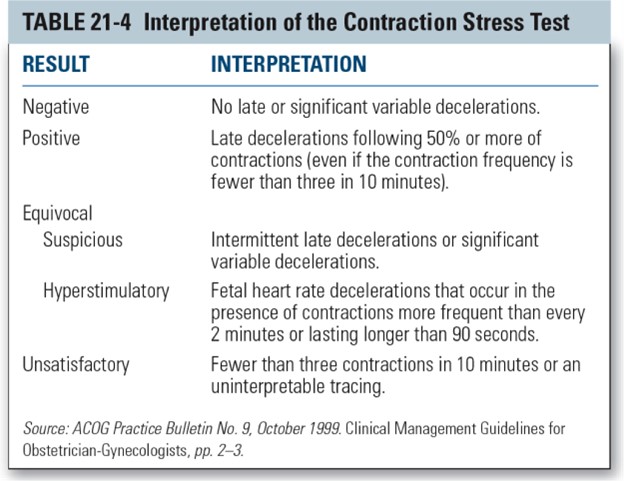
Negative CST.A negative CST means that the fetal heart rate does not slow down (decelerate) after a contraction, which indicates that the baby can tolerate the stress of labor.
This is a normal and reassuring result.
Choice A is wrong because a positive CST means that the fetal heart rate slows down and stays slow after more than half of the contractions, which indicates that the baby may be at risk for problems during labor.
This is an abnormal and concerning result.
Choice C is wrong because an unsatisfactory CST means that there are not enough contractions to produce a reliable result.
This may happen if the medication or nipple stimulation does not induce enough contractions, or if there are other factors that interfere with the test, such as maternal movement or fetal sleep.
Choice D is wrong because a suspicious CST means that the results are unclear or inconsistent.This may happen if the fetal heart rate slows down after some but not all of the contractions, or if there are other types of decelerations that are not clearly related to the contractions.
A suspicious CST may need to be repeated in a couple of days.
Correct Answer is C
Explanation
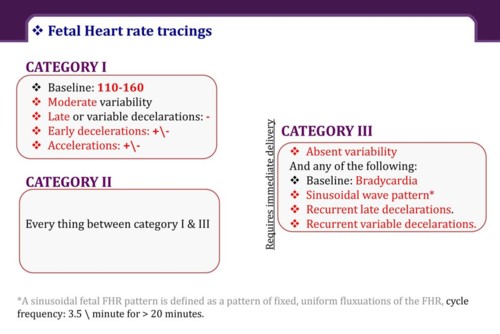
Category III.This category of FHR tracing represents an abnormal pattern that is predictive of fetal acidemia and requires prompt evaluation and intervention.A category III pattern is defined by any of the following criteria:
• Absent baseline FHR variability and any of the following:
➤ Recurrent late decelerations
➤ Recurrent variable decelerations
➤ Bradycardia
• Sinusoidal pattern
Choice A is wrong because category I is a normal pattern that is predictive of normal fetal acid-base balance at the time of observation.A category I pattern is defined by all of the following criteria:
• Baseline rate of 110 to 160 bpm
• Moderate baseline FHR variability
• No late or variable decelerations
• Early decelerations may be present or absent
• Accelerations may be present or absent
Choice B is wrong because category II is an indeterminate pattern that is not predictive of abnormal fetal acid-base balance but requires continued surveillance and reevaluation.A category II pattern includes all FHR tracings that are not category I or III.
Choice D is wrong because there is no category IV in the NICHD classification system for FHR tracings.
Whether you are a student looking to ace your exams or a practicing nurse seeking to enhance your expertise , our nursing education contents will empower you with the confidence and competence to make a difference in the lives of patients and become a respected leader in the healthcare field.
Visit Naxlex, invest in your future and unlock endless possibilities with our unparalleled nursing education contents today