
The most common syringe used for IM injections is a standard 3-mL size, marked in milliliters to the nearest tenth. Select the standard gauge range of the injection needle for an IM injection.
50-100G
28-31G
25-27G
18-25G
The Correct Answer is D
A. 50-100G: This range of gauge sizes is not used for standard injection needles. As the gauge number increases, the needle diameter decreases; a 50G needle would be extremely fine, likely too small to effectively administer viscous IM medications.
B. 28-31G: This range of small gauges is typically used for intradermal or subcutaneous injections, particularly for insulin (30-31G) or tuberculin testing. They are generally too small for the deeper penetration and often thicker viscosity of IM medications.
C. 25-27G: The smaller part of this range (27G) is often used for intradermal or very small subcutaneous injections. While 25G can sometimes be used for IM injections in thin individuals or with non-viscous medications, the range is generally too small to be considered the standard for IM.
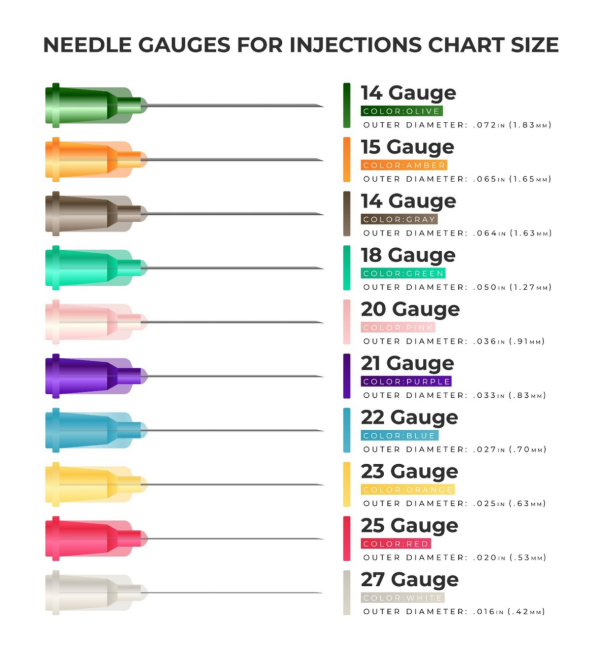
D. 18-25G: This broad range includes the standard gauges for IM injections. 22G-25G is commonly used for less viscous medications, while 18G-21G may be used for highly viscous (thicker) medications or for rapid fluid administration.
Nursing Test Bank
Naxlex Comprehensive Predictor Exams
Related Questions
Correct Answer is C
Explanation
A. Needle:The needle is the hollow, sharp metal part that pierces the skin or vial stopper. It draws fluid into the syringe, but the needle itself does not hold the medication.
B. Plunger:The plunger is the interior rod that is pushed or pulled to move the fluid. It creates the pressure differential, but the plunger itself does not hold the medication.
C. Barrel:The barrel is the hollow, cylindrical part of the syringe that is marked with measurement calibrations (mL, units, etc.) and is the chamber where the medication is held.
D. Tip:The tip is the end of the barrel where the needle is attached. While fluid passes through the tip, it is not the main storage compartment for the medication.
Correct Answer is A
Explanation
The reconstituted concentration is 3 grams in 30 mL.
- Convert to grams per mL: 3 g ÷ 30 mL = 0.1 g/mL.
- Ordered dose is 1.5 g.
- Volume needed = 1.5 g ÷ 0.1 g/mL = 15 mL.
- Therefore, the nurse should administer 15 mLper dose.
Whether you are a student looking to ace your exams or a practicing nurse seeking to enhance your expertise , our nursing education contents will empower you with the confidence and competence to make a difference in the lives of patients and become a respected leader in the healthcare field.
Visit Naxlex, invest in your future and unlock endless possibilities with our unparalleled nursing education contents today