
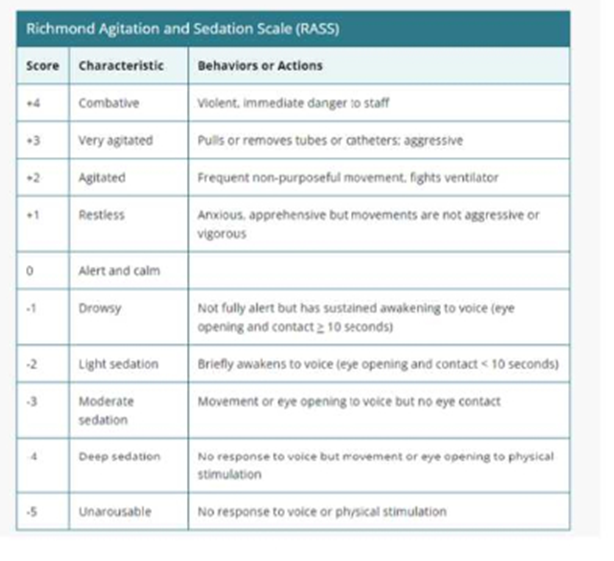
The nurse is assessing the level of sedation for a patient who is intubated and receiving mechanical ventilation. The nurse observes that the patient's RASS (see RASS tool below or in the attachment) is +2. What is the nurse's best action?
Place restraints on the patient
Instruct the patient to be calm
Call the provider
Increase the rate of the patient's sedative drip
The Correct Answer is D
A. Place restraints on the patient: While physical restraints may be used for safety if the patient is at risk of removing the endotracheal tube or lines, this does not address the underlying issue of agitation. Restraints are adjunctive, not a primary intervention for managing sedation levels.
B. Instruct the patient to be calm: Verbal reassurance alone is often insufficient for mechanically ventilated patients who are experiencing agitation or anxiety, especially when sedation is inadequate. The patient may be unable to respond effectively due to intubation.
C. Call the provider: Consulting the provider may be necessary if sedation adjustments are outside protocol limits or if complications arise, but bedside nurses can typically titrate sedatives per established protocols based on RASS assessment. Immediate action at the bedside is appropriate first.
D. Increase the rate of the patient's sedative drip: A RASS of +2 indicates the patient is restless and agitated, which may compromise safety, comfort, and ventilator synchrony. Per sedation protocols, the nurse’s best action is to increase the sedative infusion rate to achieve the target sedation level, improving patient comfort and preventing accidental extubation.
Nursing Test Bank
Naxlex Comprehensive Predictor Exams
Related Questions
Correct Answer is ["B","C","D","G"]
Explanation
A. Increased urine output: COPD primarily affects the respiratory system and gas exchange, not renal function directly. Increased urine output is not a typical symptom of COPD and may indicate other conditions such as diuretic therapy or kidney disease.
B. Sudden onset of shortness of breath: Dyspnea is a hallmark symptom of COPD due to airway obstruction, air trapping, and reduced oxygenation. Acute worsening may indicate an exacerbation or complication such as a pneumothorax or infection.
C. Chest pain that worsens with deep breathing: Pleuritic chest pain can occur in COPD patients, particularly if they develop complications such as pneumothorax, pulmonary embolism, or severe coughing episodes. Pain is often exacerbated by deep inspiration.
D. Muscle weakness: Chronic hypoxia and hypercapnia, along with decreased activity tolerance, can lead to fatigue and generalized muscle weakness in COPD patients. This is common in advanced disease and during exacerbations.
E. Hypotension: COPD itself does not typically cause hypotension. Hypotension may appear only in cases of severe hypoxemia, right-sided heart failure, or shock, which are not standard symptoms.
F. Decreased heart rate: COPD is more commonly associated with tachycardia due to hypoxia and increased work of breathing. Bradycardia is not a typical feature unless there are other cardiac complications.
G. Coughing up blood: Hemoptysis can occur in COPD due to chronic bronchitis, infection, or ruptured bronchial vessels. While not always present, it is a recognized symptom in exacerbations or complications.
Correct Answer is B
Explanation
A. Adenosine 6 mg IV: The provided rhythm strip shows clear ST-segment elevation. Adenosine is used to treat paroxysmal supraventricular tachycardia (PSVT) by temporarily blocking AV node conduction. It is not indicated for acute ST-elevation myocardial infarction (STEMI) and would not address the patient’s ischemic chest pain.
B. Nitroglycerin 0.4 mg sublingual: Sublingual nitroglycerin is the priority medication for immediate relief of ischemic chest pain in acute coronary syndrome, including STEMI. It dilates coronary arteries, improves myocardial oxygen supply, and reduces preload and myocardial oxygen demand, which directly targets the patient’s presenting symptoms.
C. Metoprolol 5 mg IV: Metoprolol, a beta-blocker, can reduce heart rate, myocardial oxygen demand, and blood pressure in acute coronary syndrome. While important in STEMI management, it is not the first-line priority for immediate pain relief; pain and myocardial perfusion take precedence.
D. Ondansetron 4 mg sublingual: Ondansetron is an antiemetic used to relieve nausea. While helpful for patient comfort, it does not address myocardial ischemia or reduce cardiac workload, and is therefore not a priority in the acute management of STEMI.
Whether you are a student looking to ace your exams or a practicing nurse seeking to enhance your expertise , our nursing education contents will empower you with the confidence and competence to make a difference in the lives of patients and become a respected leader in the healthcare field.
Visit Naxlex, invest in your future and unlock endless possibilities with our unparalleled nursing education contents today