
The nurse is reviewing the client's heart rhythm strip. Based on this strip, which interpretation should the nurse make?
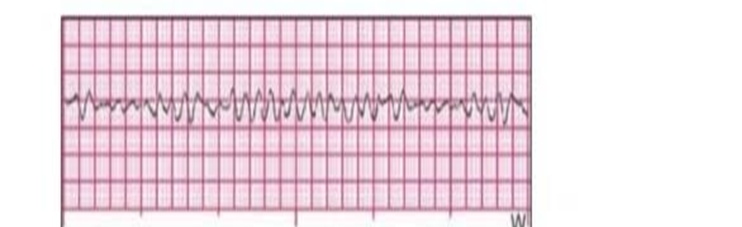
Ventricular tachycardia.
Ventricular fibrillation.
Atrial fibrillation.
Third degree heart block.
The Correct Answer is B
Rationale
A. Ventricular tachycardia (VT): VT is characterized by a rapid heart rate, usually 100 to 250 beats/minute, with wide and bizarre QRS complexes that are regular in rhythm. The rhythm strip provided is completely chaotic and irregular, without identifiable QRS complexes or a discernible rate, therefore it is not ventricular tachycardia.
B. Ventricular fibrillation (VF): This rhythm is characterized by chaotic, erratic electrical activity in the ventricles, resulting in a quivering but non-pumping heart. The ECG strip shows total disorganization of ventricular electrical activity, with no recognizable P waves, QRS complexes, or T waves, appearing as a chaotic, wavy baseline.
C. Atrial fibrillation (A-fib): A-fib is characterized by an irregularly irregular rhythm with no discernible P waves. However, the QRS complexes are typically narrow and still present. The rhythm strip shown lacks any recognizable QRS complexes and is too chaotic to be A-fib.
D. Third degree heart block (Complete Heart Block): Third-degree heart block is characterized by complete dissociation between the atria and ventricles, meaning the P waves and QRS complexes march out independently. While the rate is usually slow, both P waves and QRS complexes are still visible on the strip
Nursing Test Bank
Naxlex Comprehensive Predictor Exams
Related Questions
Correct Answer is C
Explanation
Rationale:
A. Comatose with no score using GCS: Even in unresponsive clients, the Glasgow Coma Scale provides a numerical score to quantify neurological status. Saying “no score” does not accurately reflect the client’s assessment and lacks standardization.
B. Unable to assess client using GCS: The GCS is designed specifically to evaluate eye, verbal, and motor responses, even in unresponsive clients. It can be fully assessed in this scenario, so it is inappropriate to document it as “unable to assess.”
C. Score of 3 on the GCS: A total GCS score of 3 represents the lowest possible score, indicating no eye opening, no verbal response, and no motor response. This score accurately reflects the client’s neurological status and is the correct documentation for an unresponsive client.
D. GCS indicates no function: While a score of 3 suggests severe neurological impairment, describing it as “no function” is vague and nonstandard. Using the numerical score ensures clear communication and allows tracking of changes over time.
Correct Answer is A
Explanation
Rationale:
A. Clear fluid leaking from the nose: Clear drainage from the nose following head trauma suggests a cerebrospinal fluid (CSF) leak, often from a basilar skull fracture. This finding requires immediate intervention because it increases the risk of meningitis and indicates a potential breach in the meningeal barrier protecting the brain.
B. Sluggish pupillary response to light: A delayed pupillary reaction may signal mild increased intracranial pressure or localized nerve injury. While important to monitor, it does not demand the same urgent response as a suspected CSF leak.
C. Periorbital ecchymosis of right eye: “Raccoon eyes” or bruising around the eyes may indicate a skull base fracture, but alone it is not an emergency unless accompanied by CSF leakage or neurological deterioration. It should be documented and reported for diagnostic evaluation.
D. Troubled with a severe headache: Headache is a common symptom following head trauma due to concussion or contusion. It requires monitoring and pain management but is not as critical as identifying a CSF leak, which signifies a more severe underlying injury.
Whether you are a student looking to ace your exams or a practicing nurse seeking to enhance your expertise , our nursing education contents will empower you with the confidence and competence to make a difference in the lives of patients and become a respected leader in the healthcare field.
Visit Naxlex, invest in your future and unlock endless possibilities with our unparalleled nursing education contents today