
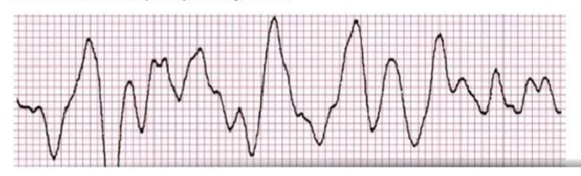
The nurse on the telemetry unit is watching the electrocardiogram (ECG) monitor at the nurses' station when the alarm sounds. The nurse observes the client's ECG in the image. The nurse checks on the client and assesses that the client's status matches the rhythm on the monitor. What is the priority nursing action?
Call the health care provider for a change in cardiac drugs.
Place the client in a sitting position and administer oxygen.
Call the Rapid response team to come and assess the client.
Call a Code and initiate cardiopulmonary resuscitation
The Correct Answer is D
A. Call the health care provider for a change in cardiac drugs: Notifying the provider is important for ongoing management, but the rhythm shown in the image is ventricular fibrillation (VF), which is immediately life-threatening. Delaying action to call the provider risks the client’s survival.
B. Place the client in a sitting position and administer oxygen: Positioning and oxygen may support a stable client with mild symptoms, but VF causes ineffective cardiac output, so interventions that only support oxygenation are insufficient. Immediate resuscitative measures are required.
C. Call the rapid response team to come and assess the client: While the rapid response team can assist, VF requires immediate intervention—delaying defibrillation and CPR while waiting for others significantly reduces survival chances.
D. Call a code and initiate cardiopulmonary resuscitation: Ventricular fibrillation is a pulseless, life-threatening arrhythmia that requires immediate activation of a code and initiation of CPR, followed by defibrillation. Early chest compressions and defibrillation are critical to restoring cardiac output and preventing sudden cardiac death.
Nursing Test Bank
Naxlex Comprehensive Predictor Exams
Related Questions
Correct Answer is B
Explanation
A. Obtain a STAT electrocardiogram (EKG).: An EKG evaluates cardiac rhythm and ongoing ischemic changes but does not assess neurological status. New disorientation during alteplase infusion raises concern for intracranial hemorrhage. Cardiac monitoring is important, but it does not address the immediate neurologic emergency suggested by acute mental status changes.
B. Call the primary health care provider immediately.: Alteplase is a fibrinolytic that increases the risk of bleeding, including intracranial hemorrhage. Sudden confusion and disorientation are early neurologic signs that may indicate cerebral bleeding. Immediate provider notification is critical so the infusion can be stopped and urgent neuroimaging, such as a CT scan, can be initiated to evaluate for hemorrhage.
C. Prepare the client for percutaneous cardiac intervention (PCI).: PCI is considered if thrombolytic therapy fails or if there is persistent ischemia. Disorientation is not an indication of failed reperfusion but rather a potential bleeding complication. Preparing for PCI would delay evaluation of a potentially life-threatening neurologic event.
D. Obtain STAT cardiac enzymes.: Cardiac enzymes help evaluate myocardial injury but are not useful in assessing acute neurologic deterioration. Elevated enzymes confirm myocardial infarction but do not explain sudden changes in mental status. The priority is evaluating for a hemorrhagic complication related to thrombolytic therapy.
Correct Answer is A
Explanation
A. Client took metformin 500 mg by mouth this morning: Metformin must be withheld before and for 48 hours after procedures involving iodinated contrast dye, such as a coronary arteriogram. Contrast can impair renal function, increasing the risk of lactic acidosis in clients taking metformin. The provider must be notified immediately.
B. Sinus bradycardia with a rate of 56 on the monitor: A heart rate of 56 bpm may be normal for some clients, especially those on beta-blockers. While it should be documented and monitored, it is not the priority concern prior to the procedure.
C. Client reports chest pain that occurred yesterday: Chest pain history is relevant but expected in clients undergoing coronary arteriography. Pain that occurred yesterday and is not current is less urgent than the metformin issue.
D. Blood glucose level 144 mg/dL: A glucose level of 144 mg/dL is mildly elevated but not critical in the context of this procedure. It does not pose the same immediate risk as contrast administration with recent metformin use.
Whether you are a student looking to ace your exams or a practicing nurse seeking to enhance your expertise , our nursing education contents will empower you with the confidence and competence to make a difference in the lives of patients and become a respected leader in the healthcare field.
Visit Naxlex, invest in your future and unlock endless possibilities with our unparalleled nursing education contents today