
The thirst mechanism is located in the:
Adrenal gland
Cerebral cortex
Pituitary gland
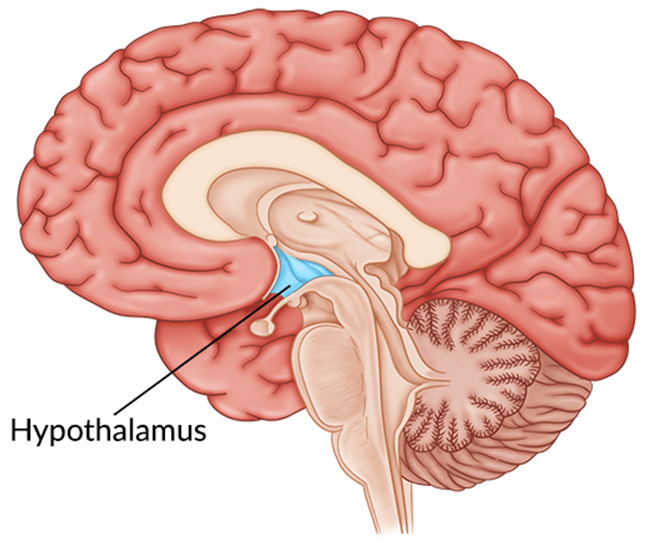
Hypothalamus
The Correct Answer is D
Choice A reason: This is incorrect because the adrenal gland is not involved in the thirst mechanism. The adrenal gland is responsible for producing hormones such as cortisol, aldosterone, and adrenaline, which regulate stress response, blood pressure, and metabolism.
Choice B reason: This is incorrect because the cerebral cortex is not involved in the thirst mechanism. The cerebral cortex is the outer layer of the brain that is responsible for higher cognitive functions such as memory, language, and reasoning.
Choice C reason: This is incorrect because the pituitary gland is not directly involved in the thirst mechanism. The pituitary gland is a small gland at the base of the brain that produces hormones that control growth, reproduction, and metabolism. However, the pituitary gland does secrete antidiuretic hormone (ADH), which is regulated by the hypothalamus and affects water balance in the body.
Choice D reason: This is correct because the hypothalamus is the location of the thirst mechanism. The hypothalamus is a part of the brain that regulates many bodily functions such as temperature, appetite, sleep, and emotions. The hypothalamus also monitors the blood osmolarity and triggers the sensation of thirst when the blood is too concentrated.
Nursing Test Bank
Naxlex Comprehensive Predictor Exams
Related Questions
Correct Answer is A
Explanation
Choice A reason: This is correct because prolonged bed rest can cause hypocalcemia, or low serum calcium level. Calcium is stored in the bones and is released into the blood when the bones are stressed by weight-bearing activities. When a person is on bed rest, the bones are not stimulated and the calcium remains in the bones, leading to a decrease in serum calcium level.
Choice B reason: This is incorrect because too much butter consumption does not affect the serum calcium level directly. Butter is a source of fat and calories, which can affect the cholesterol and triglyceride levels, but not the calcium level. However, too much butter consumption can cause obesity, which can increase the risk of osteoporosis and fractures.
Choice C reason: This is incorrect because hyperparathyroidism can cause hypercalcemia, or high serum calcium level. Hyperparathyroidism is a condition where the parathyroid glands produce too much parathyroid hormone (PTH), which regulates the calcium and phosphorus balance in the body. PTH stimulates the release of calcium from the bones into the blood, leading to an increase in serum calcium level.
Choice D reason: This is incorrect because excessive ingestion of vitamin D can also cause hypercalcemia, or high serum calcium level. Vitamin D is a fat-soluble vitamin that helps the body absorb calcium from the food and supplements. When a person takes too much vitamin D, the calcium absorption is increased and the serum calcium level rises.
Correct Answer is D
Explanation
Choice A reason: This is incorrect because normal saline is not indicated for this client. Normal saline is a isotonic solution that does not alter the acid-base balance. The client has respiratory alkalosis, which is caused by hyperventilation and results in a high pH and a low PaCO2.
Choice B reason: This is incorrect because Allen's test is not relevant for this client. Allen's test is a test to assess the patency of the radial and ulnar arteries before performing an arterial blood gas (ABG) sampling or cannulation. The client already has ABG results, so there is no need to perform Allen's test.
Choice C reason: This is incorrect because increasing breathing would worsen the client's condition. Increasing breathing would cause the client to exhale more carbon dioxide, which would lower the PaCO2 and raise the pH even more. This would increase the severity of respiratory alkalosis.
Choice D reason: This is correct because slowing down breathing would help the client to correct the respiratory alkalosis. Slowing down breathing would allow the client to retain more carbon dioxide, which would increase the PaCO2 and lower the pH. This would bring the acid-base balance closer to normal.
Whether you are a student looking to ace your exams or a practicing nurse seeking to enhance your expertise , our nursing education contents will empower you with the confidence and competence to make a difference in the lives of patients and become a respected leader in the healthcare field.
Visit Naxlex, invest in your future and unlock endless possibilities with our unparalleled nursing education contents today