
What is the name of the highlighted body cavity?
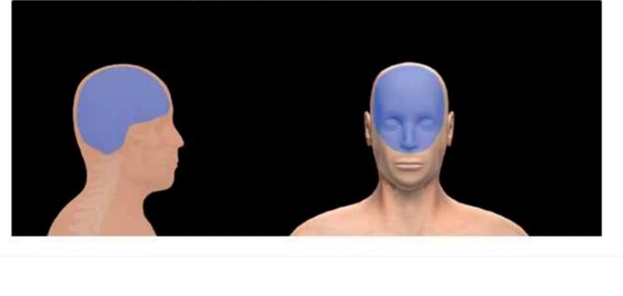
Cranial cavity
Thoracic cavity
Abdominal cavity
Pelvic cavity
The Correct Answer is A
The human body is organized into several major anatomical cavities that house and protect delicate internal organs. These cavities are lined by specific membranes and are categorized based on their location within the body's structural framework. The cranial cavity is a specialized dorsal space that acts as the protective bony container for the central nervous system, ensuring the brain remains shielded from external trauma.
A. The cranial cavity, also known as the endocranium, is the space enclosed by the bones of the skull. It directly houses the brain, the meninges, and the cerebrospinal fluid that cushions the brain. This cavity is continuous with the vertebral canal, forming the dorsal body cavity, which is the primary site of protection for the central nervous system.
B. The thoracic cavity is located in the upper trunk of the body, protected by the rib cage and the sternum. It houses vital organs such as the heart, lungs, esophagus, and trachea. It is separated from the abdominal cavity below by the diaphragm and is completely separate from the cranial cavity shown in the diagram.
C. The abdominal cavity occupies the upper portion of the abdominopelvic cavity. It contains the majority of the digestive organs, including the stomach, liver, intestines, and kidneys. Because it is located in the trunk and holds visceral organs associated with digestion and metabolism, it bears no anatomical relationship to the cranial cavity.
D. The pelvic cavity is the lowermost portion of the abdominopelvic cavity, located within the bony pelvis. It contains the urinary bladder, reproductive organs, and the terminal portions of the gastrointestinal tract. Like the abdominal cavity, it is positioned far from the head and is not involved in housing the brain.
Nursing Test Bank
Naxlex Comprehensive Predictor Exams
Related Questions
Correct Answer is C
Explanation
The marked structure is the cerebellum, a major part of the hindbrain located posterior to the brainstem and inferior to the occipital lobes of the cerebrum. It consists of two hemispheres connected by the vermis and has a highly folded surface (folia) that increases its cortical area. The cerebellum is primarily responsible for coordination of voluntary movements, maintenance of posture, balance, and fine motor control. It does not initiate movement but ensures that movements are smooth, precise, and well-timed.
A. Cerebrum: The cerebrum is the largest part of the brain and consists of the cerebral hemispheres, including the frontal, parietal, temporal, and occipital lobes. It is responsible for higher cognitive functions such as reasoning, memory, language, and voluntary motor activity. Unlike the cerebellum, it is located superiorly and anteriorly in the cranial cavity and is not involved in fine motor coordination and balance regulation.
B. Brainstem: The brainstem connects the cerebrum and cerebellum to the spinal cord and consists of the midbrain, pons, and medulla oblongata. It regulates vital autonomic functions such as respiration, heart rate, and blood pressure. While it lies close to the cerebellum, it is a vertical structure inferior to the cerebrum rather than a posterior, bilobed structure like the cerebellum.
C. Cerebellum: The cerebellum is located in the posterior cranial fossa, inferior to the occipital lobes and posterior to the brainstem. It is responsible for coordinating voluntary motor activity, maintaining balance, posture, and muscle tone. It receives input from the cerebral cortex and sensory systems to fine-tune motor output. Its highly folded folia and bilateral hemispheres are characteristic features.
D. Medulla oblongata: The medulla oblongata is the lowest part of the brainstem, continuous with the spinal cord. It controls essential autonomic functions such as breathing, heart rate, and blood pressure regulation. Unlike the cerebellum, it is a narrow, tubular structure and does not have a highly folded cortical surface or function in motor coordination and balance.
Correct Answer is C
Explanation
The scapula (shoulder blade) is a flat, triangular bone located on the posterior aspect of the thoracic cage. It plays a key role in upper limb movement by serving as an attachment point for muscles that stabilize and move the shoulder joint. Anatomically, it has specific borders, angles, and processes that help define its orientation and muscular attachments. Understanding these landmarks is essential for identifying scapular anatomy and its functional biomechanics in shoulder movement.
A. Acromion, coracoid, and glenoid borders: the acromion, coracoid process, and glenoid cavity are not borders of the scapula. Instead, they are specific anatomical processes and a socket. The acromion articulates with the clavicle, the coracoid serves as a muscle attachment point, and the glenoid cavity forms the shoulder joint with the humerus. These are structural features, not the three defined borders of the scapula.
B. Supraspinous, infraspinous, and subscapular borders: these terms refer to fossae (depressions) or surface regions, not borders. The supraspinous and infraspinous fossae are separated by the spine of the scapula and serve as attachment sites for rotator cuff muscles. The subscapular fossa is located on the anterior surface of the scapula. These are anatomical regions, not the structural margins of the bone.
C. Superior, medial, and lateral borders: the scapula has three distinct borders that define its triangular shape. The superior border is the shortest and contains the suprascapular notch. The medial (vertebral) border runs parallel to the spine and provides muscle attachment sites. The lateral (axillary) border is thicker and leads toward the glenoid cavity. These borders are key landmarks used in anatomical orientation and muscle attachment.
D. Inferior, anterior, and posterior borders: the scapula is not described using anterior or posterior borders. Anatomically, it is defined by superior, medial, and lateral borders instead. While the scapula does have surfaces (anterior and posterior), these are not classified as borders.
Whether you are a student looking to ace your exams or a practicing nurse seeking to enhance your expertise , our nursing education contents will empower you with the confidence and competence to make a difference in the lives of patients and become a respected leader in the healthcare field.
Visit Naxlex, invest in your future and unlock endless possibilities with our unparalleled nursing education contents today