
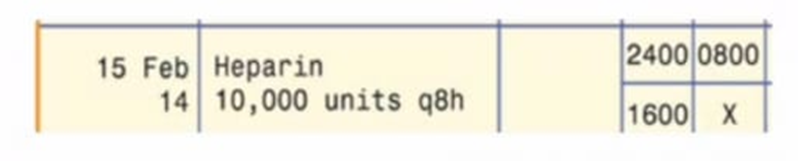
What is the route for this medication?
ivss
top
po
route not included
The Correct Answer is D
A. ivss: This is not a recognized or standard abbreviation for a route of administration. While "IV" means intravenous, the combination with "ss" (one-half) does not indicate a route. The medication order provided in the image does not contain such abbreviation.
B. top: The abbreviation "top" stands for the topical route of administration. The medication order for Heparin shown in the image does not contain this abbreviation or any other symbol that would indicate the route.
C. po: The abbreviation "po" stands for "per os," or by mouth. A medication order must include a route, but this specific order does not contain the "po" abbreviation. Additionally, Heparin is not administered orally because it is not absorbed in the gastrointestinal tract.
D. route not included: A complete and safe medication order must include a clear route of administration to prevent a medication error. The order for Heparin in the image lists the drug, dose, and frequency, but it is missing the route, which is an essential piece of information.
Nursing Test Bank
Naxlex Comprehensive Predictor Exams
Related Questions
Correct Answer is D
Explanation
A. Coumadin 10 mg scored tablets: A 10 mg tablet exceeds the ordered dose of 7.5 mg. Although it's scored, splitting it in a way that gives exactly 7.5 mg would be imprecise and not ideal for accurate dosing.
B. Coumadin 1 mg scored tablets: While these allow precise dosing, it would require administering multiple tablets (e.g., seven 1 mg tablets and one half), which increases pill burden and potential for error.
C. Coumadin injection 5 mg/vial: The prescribed route is oral (PO), not parenteral. Using an injection would not comply with the prescribed route of administration.
D. Coumadin 5 mg scored tablets: The 5 mg scored tablet can be used to administer one whole 5 mg tablet and one-half tablet (2.5 mg), totaling 7.5 mg. This provides an accurate and convenient way to deliver the dose.
Correct Answer is ["4"]
Explanation
Syringe 1: This U-100 insulin syringe with a 30-unit capacity is inappropriate for this task because the required dose of 65 units exceeds its maximum capacity. This syringe is calibrated for U-100 insulin, and using it for U-500 insulin would lead to a potentially fatal overdose.
Syringe 2: This is a U-100 insulin syringe with a 50-unit capacity. Its capacity is insufficient for the 65-unit dose. Critically, using a U-100 syringe for U-500 insulin would result in a significant medication error and a massive overdose.
Syringe 3: This is a U-100 insulin syringe with a 100-unit capacity. Although the 65-unit dose fits within its capacity, the unit markings are based on U-100 concentration, so drawing to the 65-unit line would actually administer 65 U-100 units, which is a severe overdose of U-500 insulin.
Syringe 4: This is a small-volume syringe calibrated in milliliters, not U-100 units. The proper dose of 65 units of U-500 insulin is calculated as 65 units / 500 units per mL = 0.13 mL. This syringe can accurately and safely measure this specific volume, making it the appropriate choice to prevent a dosing error.
Whether you are a student looking to ace your exams or a practicing nurse seeking to enhance your expertise , our nursing education contents will empower you with the confidence and competence to make a difference in the lives of patients and become a respected leader in the healthcare field.
Visit Naxlex, invest in your future and unlock endless possibilities with our unparalleled nursing education contents today