
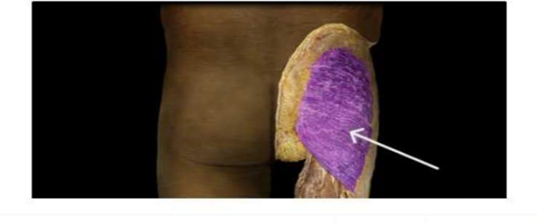
Which structure is highlighted and indicated by the arrow in the image below?
Gluteus medius
Gluteus minimus
Gluteus maximus
Piriformis
The Correct Answer is C
The highlighted structure is the gluteus maximus, the largest and most superficial muscle of the gluteal region. It forms the bulk of the buttock and originates from the posterior ilium, sacrum, coccyx, and sacrotuberous ligament, inserting into the iliotibial tract and femur. Its primary physiological role is powerful hip extension, especially during actions such as climbing stairs, rising from a seated position, and running. It also contributes to lateral rotation and stabilization of the pelvis and trunk during upright posture and locomotion.
A. Gluteus medius: The gluteus medius lies deep to the gluteus maximus and is located on the lateral aspect of the ilium. It functions primarily in hip abduction and pelvic stabilization during single-leg stance, preventing pelvic drop on the opposite side. Unlike the gluteus maximus, it is not the primary muscle forming the bulk of the buttock and is less superficial.
B. Gluteus minimus: The gluteus minimus is the smallest and deepest of the gluteal muscles, positioned beneath the gluteus medius. It assists in hip abduction and medial rotation of the thigh. It is not visible superficially and does not form the prominent contour of the buttock, making it distinct from the gluteus maximus.
C. Gluteus maximus: The gluteus maximus is a large, thick, quadrangular muscle forming the superficial mass of the buttock. It is the primary extensor of the hip joint and is heavily engaged in powerful movements such as standing from a seated position, running, and climbing. It also contributes to external rotation and supports the iliotibial tract for lateral stability of the knee. Its size, location, and function make it the correct identification.
D. Piriformis: The piriformis is a deep gluteal muscle originating from the anterior sacrum and inserting on the greater trochanter of the femur. It functions mainly in lateral rotation of the hip when the hip is extended and assists in abduction when the hip is flexed. It is located deep within the gluteal region and is not responsible for forming the surface contour of the buttock like the gluteus maximus.
Nursing Test Bank
Naxlex Comprehensive Predictor Exams
Related Questions
Correct Answer is D
Explanation
The skeletal system is composed of bones, cartilage, ligaments, and joints that provide structural support and enable movement. It plays several essential physiological roles including protection of vital organs, facilitation of movement through muscle attachment, storage of minerals such as calcium and phosphorus, and hematopoiesis (blood cell production) within the bone marrow. While it interacts with multiple body systems, its functions are primarily structural, metabolic, and hematologic rather than endocrine or digestive in nature.
A. It generates the movements of the limbs: bones act as levers that work with skeletal muscles to produce movement at joints. When muscles contract, they pull on bones via tendons, creating motion in the limbs. This biomechanical interaction allows activities such as walking, running, and grasping. Therefore, this is a valid function of the skeletal system.
B. It stores inorganic salts: Bones serve as a major reservoir for minerals, especially calcium and phosphorus, which are essential for muscle contraction, nerve conduction, and bone strength. These minerals can be released into the bloodstream when needed to maintain homeostasis. Thus, the skeletal system plays a key role in mineral storage and regulation.
C. It produces red blood cells: Red bone marrow within certain bones (such as the sternum, ribs, pelvis, and long bones in children) is responsible for hematopoiesis, the production of red blood cells, white blood cells, and platelets. This process is essential for oxygen transport, immune defense, and clotting. Blood cell production is an important skeletal function.
D. It secretes hormones for digestion: hormone secretion for digestion is not a function of the skeletal system. Digestive hormones such as gastrin, secretin, and cholecystokinin are produced by endocrine cells in the gastrointestinal tract. While bone does produce certain regulatory hormones like osteocalcin, it does not secrete hormones involved in digestion.
Correct Answer is D
Explanation
Bone is a dynamic tissue that undergoes continuous remodeling throughout life to maintain strength, repair damage, and regulate calcium homeostasis. This remodeling process involves the coordinated activity of specialized bone cells, including osteoblasts, osteocytes, and osteoclasts. Osteoclasts are responsible for bone resorption, a process that removes old or damaged bone tissue. Their activity is essential for skeletal growth, fracture repair, and maintaining normal mineral balance within the body.
A. Bone-forming cells that secrete new bone matrix: This option describes osteoblasts, not osteoclasts. Osteoblasts are responsible for synthesizing and secreting osteoid, the organic component of bone matrix composed primarily of type I collagen. They promote bone formation and mineralization during growth and repair.
B. Mature bone cells that maintain the matrix: This option refers to osteocytes, which are mature bone cells derived from osteoblasts that become trapped within the mineralized matrix. Osteocytes maintain bone tissue, monitor mechanical stress, and help regulate remodeling by communicating with osteoblasts and osteoclasts. Their primary role is maintenance rather than bone resorption.
C. Cartilage cells found in the epiphyseal plate: This option describes chondrocytes, the cells responsible for producing and maintaining cartilage. Chondrocytes are found within structures such as articular cartilage and the epiphyseal growth plate, where they contribute to longitudinal bone growth. They are not involved in bone resorption and are not classified as bone cells.
D. Bone cells that break down bone matrix: osteoclasts are large, multinucleated cells specialized for bone resorption. They attach to the bone surface and release hydrogen ions and lysosomal enzymes that dissolve the mineralized matrix and degrade collagen fibers. This process releases calcium and phosphate into the bloodstream and allows old or damaged bone to be replaced with new bone tissue. Osteoclast activity is essential for normal bone remodeling, skeletal growth, and mineral homeostasis.
Whether you are a student looking to ace your exams or a practicing nurse seeking to enhance your expertise , our nursing education contents will empower you with the confidence and competence to make a difference in the lives of patients and become a respected leader in the healthcare field.
Visit Naxlex, invest in your future and unlock endless possibilities with our unparalleled nursing education contents today