
Classification of Fractures
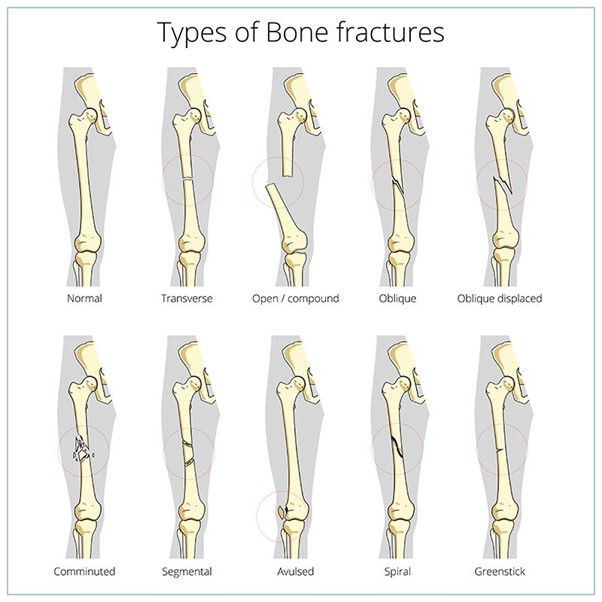
Fractures can be classified based on various criteria, including the mechanism of injury, location, pattern of the break, and whether the bone is displaced or not. Common types of fractures include:
- Closed (Simple) Fracture: The bone breaks but does not penetrate the skin.
- Open (Compound) Fracture: The broken bone penetrates through the skin, increasing the risk of infection.
- Greenstick Fracture: Common in children, the bone bends and partially breaks, similar to a green twig.
- Comminuted Fracture: The bone shatters into multiple fragments.
- Transverse Fracture: The break occurs in a straight line across the bone.
- Oblique Fracture: The break is at an angle to the bone's long axis.
- Spiral Fracture: The fracture spirals around the bone due to torsional forces.
- Impacted Fracture: The bone fragments are driven into each other.
- Pathological Fracture: Occurs in weakened bones due to underlying conditions like osteoporosis or cancer.
Nursing Test Bank
Test Bank #1: RN Pharmacology Exams
Test Bank #2: RN Medical-Surgical Exams
Test Bank #3: RN Fundamentals Exams
Test Bank #4: RN Maternal-Newborn Exams
Test Bank #5: RN Anatomy and Physiology Exams
Test Bank #6: RN Obstetrics and Pediatrics Exams
Test Bank #7: RN Fluid and Electrolytes Exams
Test Bank #9: RN Adult Health
Test Bank #10: RN Dosage Calculation
Test Bank #11: RN Community Health Exams
Test Bank #12: RN Psychology Exams
Test Bank #13: RN Nursing Care Of Children
Test Bank #14: RN Foundations of Nursing Exams
Naxlex Comprehensive Predictor Exams
Exam #1: RN Comprehensive predictor 2023 proctored exam
Exam #2: Ati rn vati comprehensive predictor proctored exam
Exam #3: Ati Rn Comprehensive Predictor Proctored Exam 2023
Exam #4: Rn Comprehensive Predictor 2023 Proctored Exam - St. Joseph
Exam #5: RN Comprehensive Predictor Proctored Exam (National U CA San Diego)
Exam #6: Ati rn comprehensive predictor 2023 retake proctored exam
Exam #7: RN Hesi Exit Proctored Exam
Exam #8: Hesi RN Exit proctored exam
Exam #9: Hesi rn exit proctored exam
Exam #10: Hesi Rn compass exit B proctored exam
Questions on Classification of Fractures
Correct Answer is C
Explanation
<p>Inability to bear weight on the affected limb: Inability to bear weight may be present in some fractures, but it is not a specific characteristic of stress fractures.</p>
Correct Answer is D
Explanation
<p>Closed reduction is a non-surgical procedure used to manually realign the fractured bone to its normal position without making an incision. It is often followed by cast immobilization or other forms of stabilization.<br />
</p>
Correct Answer is C
Explanation
<p>Impacted fracture: An impacted fracture occurs when the bone fragments are driven into each other, often seen in a fall or compression injury, not involving ligament or tendon tears.</p>
Correct Answer is C
Explanation
<p>Administering analgesics for pain relief is important, but it does not directly relate to assessing for neurovascular compromise before moving the limb.</p>
Correct Answer is B
Explanation
<p>Osteomyelitis: Osteomyelitis is a bone infection that can occur as a complication of fractures and is not specifically related to increased pressure within a closed space.</p>
Correct Answer is C
Explanation
<p>Comminuted fracture: In a comminuted fracture, the bone breaks into multiple pieces, which is not associated with twisting forces.</p>
Correct Answer is D
Explanation
<p>Patients with external fixation require close monitoring of the pin sites for signs of infection, as they are at risk of developing pin site infections.<br />
</p>
Correct Answer is A
Explanation
<p>Osteomyelitis: Osteomyelitis is a bone infection that can develop as a complication of fractures, but it may or may not cause persistent pain and limited function, depending on its severity and treatment response.</p>
Correct Answer is A
Explanation
<p>Greenstick fracture: A greenstick fracture is an incomplete fracture seen in children, where the bone bends and partially breaks on one side but remains intact on the other side. It is not specifically at an angle to the long axis of the bone.</p>
Correct Answer is A
Explanation
<p>Ultrasound: Ultrasound is primarily used for imaging soft tissues and may not provide sufficient detail for evaluating fractures. X-rays are more appropriate for initial assessment.</p>
Correct Answer is C
Explanation
<p>Assessing the quality of pain experienced by the patient is important for pain management but is not the priority over assessing for signs of infection in an open fracture.</p>
Correct Answer is D
Explanation
<p>: Educating the patient about signs of neurovascular compromise, such as changes in sensation, color, or temperature of the limb, is essential to ensure early detection of potential complications and timely intervention.<br />
</p>
Correct Answer is C
Explanation
<p>Ultrasound: Ultrasound is useful for certain soft tissue evaluations but is not commonly used for diagnosing fractures.</p>
Correct Answer is C
Explanation
<p>Asthma: Asthma is a respiratory condition that affects the airways and lungs and is not linked to an increased risk of fractures.</p>
Correct Answer is A
Explanation
<p>Osteomyelitis: Osteomyelitis is a bone infection that can develop as a complication of fractures, but it does not typically present with warmth and redness at the site.</p>
Correct Answer is A
Explanation
No explanation
Correct Answer is D
Explanation
<p>A closed fracture is a fracture where the skin remains intact over the fractured bone, and there is no open wound at the site of the fracture.<br />
</p>
Correct Answer is C
Explanation
<p>Spiral fracture: A spiral fracture is characterized by a twisting or spiraling break along the bone, but it does not result in multiple pieces.</p>
Correct Answer is C
Explanation
<p>Stress fracture: A stress fracture is a small crack or incomplete break in the bone, often caused by repetitive stress and overuse.</p>
Correct Answer is B
Explanation
<p>Oblique fracture: An oblique fracture is a type of fracture where the fracture line is diagonal to the long axis of the bone and can occur in both children and adults.</p>
Correct Answer is D
Explanation
<p>Severe pain, pallor (pale skin color), and loss of pulses distal to the fracture are concerning signs of compartment syndrome, a serious complication that requires immediate medical intervention.<br />
</p>
Correct Answer is D
Explanation
<p>Osteoporosis is a condition characterized by weakened and porous bones, leading to an increased risk of fractures, especially in the hip, spine, and wrist.<br />
</p>
Correct Answer is D
Explanation
<p>Colles' fracture is a type of distal radius fracture that results in angulation and swelling of the distal forearm near the wrist joint.<br />
</p>
Correct Answer is B
Explanation
<p>Stress fracture: A stress fracture is a tiny crack in the bone caused by repetitive stress and overuse. It does not involve bone crushing or fragmentation.</p>
Correct Answer is C
Explanation
<p>Stiffness and limited range of motion in nearby joints: Stiffness and limited range of motion may occur after a fracture but are not as urgent as neurovascular compromise.</p>
Correct Answer is D
Explanation
<p>A closed fracture is a fracture where the skin remains intact over the fractured bone, and there is no open wound at the site of the fracture.<br />
</p>
Correct Answer is C
Explanation
<p>Decreased bone density: Decreased bone density, often seen in osteoporosis, contributes to fractures in older adults.</p>
Correct Answer is D
Explanation
<p>Hypertrophic nonunion occurs when there is excessive callus formation at the fracture site, but the bone ends fail to unite. This can lead to persistent pain and limited function.<br />
</p>
Correct Answer is D
Explanation
<p>Before applying a cast, the nurse should obtain a baseline neurovascular assessment of the extremity to establish normal function. This assessment will serve as a reference for comparison throughout the cast's application and during the healing process.<br />
</p>