
Clinical Manifestations
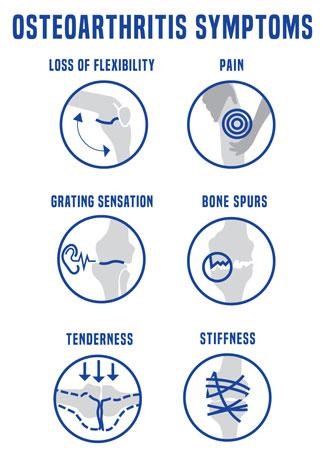
The clinical presentation of OA varies depending on the affected joints, but common signs and symptoms include:
- Joint Pain: Pain is the hallmark symptom of OA and is typically worse with movement or weight-bearing activities.
- Joint Stiffness: Stiffness and limited range of motion in the affected joint, particularly after periods of inactivity or rest.
- Joint Swelling: Inflammation may cause mild to moderate joint swelling.
- Crepitus: A crunching or cracking sensation during joint movement due to roughened joint surfaces rubbing against each other.
- Joint Instability: The affected joint may feel less stable and may give way or feel weak during movement.
- Functional Impairment: OA can limit daily activities, such as walking, climbing stairs, and grasping objects.
Nursing Test Bank
Test Bank #1: RN Pharmacology Exams
Test Bank #2: RN Medical-Surgical Exams
Test Bank #3: RN Fundamentals Exams
Test Bank #4: RN Maternal-Newborn Exams
Test Bank #5: RN Anatomy and Physiology Exams
Test Bank #6: RN Obstetrics and Pediatrics Exams
Test Bank #7: RN Fluid and Electrolytes Exams
Test Bank #9: RN Adult Health
Test Bank #10: RN Dosage Calculation
Test Bank #11: RN Community Health Exams
Test Bank #12: RN Psychology Exams
Test Bank #13: RN Nursing Care Of Children
Test Bank #14: RN Foundations of Nursing Exams
Naxlex Comprehensive Predictor Exams
Exam #1: RN Comprehensive predictor 2023 proctored exam
Exam #2: Ati rn vati comprehensive predictor proctored exam
Exam #3: Ati Rn Comprehensive Predictor Proctored Exam 2023
Exam #4: Rn Comprehensive Predictor 2023 Proctored Exam - St. Joseph
Exam #5: RN Comprehensive Predictor Proctored Exam (National U CA San Diego)
Exam #6: Ati rn comprehensive predictor 2023 retake proctored exam
Exam #7: RN Hesi Exit Proctored Exam
Exam #8: Hesi RN Exit proctored exam
Exam #9: Hesi rn exit proctored exam
Exam #10: Hesi Rn compass exit B proctored exam
Questions on Clinical Manifestations
Correct Answer is C
Explanation
<p>Osteoarthritis is not caused by the deposition of urate crystals. Urate crystal deposition is associated with gout, a different form of arthritis.</p>
Correct Answer is C
Explanation
<p>Joint injury is a risk factor associated with joint trauma or repetitive use injuries. The scenario does not provide information about any joint injury in this client.</p>
Correct Answer is C
Explanation
<p>A positive Babinski reflex is a neurological finding and is not related to the diagnosis of osteoarthritis.</p>
Correct Answer is C
Explanation
<p>Ultrasound is not commonly used for diagnosing osteoarthritis; it is more useful for soft tissue assessment.</p>
Correct Answer is B
Explanation
<p>Massaging the affected joint with essential oils. While massaging the affected joint may offer some relief, using a TENS unit is a more effective non-pharmacological intervention for pain management in osteoarthritis.</p>
Correct Answer is A
Explanation
<p>"Apply a heating pad for at least 1 hour to alleviate joint pain." Applying a heating pad for an extended period can cause burns and skin irritation. Using a heating pad for short intervals is appropriate for pain relief.</p>
Correct Answer is B
Explanation
<p>Infliximab is a biologic medication used in the management of inflammatory arthritis conditions, such as rheumatoid arthritis, and is not typically prescribed for osteoarthritis.</p>
Correct Answer is D
Explanation
<p>X-ray is the most commonly used diagnostic test to confirm the diagnosis of osteoarthritis. It can show joint space narrowing, osteophyte formation (bony overgrowths), and other changes characteristic of osteoarthritis. Rheumatoid factor (RF) and antinuclear antibody (ANA) blood tests are used to diagnose autoimmune conditions like rheumatoid arthritis, not osteoarthritis. Magnetic resonance imaging (MRI) can provide more detailed images of joint structures, but X-ray is typically the initial diagnostic test for osteoarthritis.<br />
</p>
Correct Answer is C
Explanation
<p>While osteoarthritis primarily involves synovial joints, it is not limited to these joints.</p>
Correct Answer is D
Explanation
<p>Obesity is a modifiable risk factor for osteoarthritis. Excess body weight puts increased stress on weight-bearing joints, such as the knees and hips, leading to accelerated wear and tear of the joint cartilage.<br />
</p>
Correct Answer is B
Explanation
<p>"I will use a wheelchair for all my daily activities." Using a wheelchair for all daily activities may not be necessary for a client with osteoarthritis, as it may lead to decreased mobility and muscle weakness.</p>
Correct Answer is C
Explanation
<p>Osteoarthritis is not caused by the deposition of urate crystals. Urate crystal deposition is associated with gout, a different form of arthritis.</p>
Correct Answer is C
Explanation
<p>Warm and erythematous joints are signs of inflammation and are more commonly seen in inflammatory arthritis conditions, not osteoarthritis.</p>
Correct Answer is D
Explanation
<p>Crepitus, a crackling or grating sensation during joint movement, is a common clinical manifestation of osteoarthritis. It occurs due to the irregular surfaces of the joint caused by cartilage degeneration.<br />
</p>
Correct Answer is C
Explanation
<p>Participating in high-impact sports and activities can exacerbate the symptoms of osteoarthritis and cause further joint damage. Low-impact exercises are a safer option for individuals with this condition.</p>